Skip to content
Discimus
  • Grades
  • Subjects
  • Occasions
  • Standards
  • Membership
Sign inJoin
  1. Home
  2. Grades
  3. Grade 6
  4. English Language Arts

Common Core State Standards for English Language Arts

Grade 6 English Language Arts

Phonics, reading, grammar, vocabulary and writing.

TopicsFigurative Language 2Grammar 6Punctuation 1Reading Comprehension 18Spelling 1Vocabulary 8Writing 25
StandardsL.6.1.AL.6.1.BL.6.1.CL.6.1.DL.6.1.EL.6.2.AL.6.2.BL.6.3.AL.6.3.BL.6.4.AL.6.4.BL.6.4.CL.6.4.DL.6.5.AL.6.5.BL.6.5.CL.6.6RI.6.1RI.6.2RI.6.3RI.6.4RI.6.5RI.6.6RI.6.7RI.6.8RI.6.9RI.6.10RL.6.1RL.6.2RL.6.3RL.6.4RL.6.5RL.6.6RL.6.7RL.6.9RL.6.10W.6.1.AW.6.1.BW.6.1.CW.6.1.DW.6.1.EW.6.2.AW.6.2.BW.6.2.CW.6.2.DW.6.2.EW.6.2.FW.6.3.AW.6.3.BW.6.3.CW.6.3.DW.6.3.EW.6.4W.6.5W.6.6W.6.7W.6.8W.6.9.AW.6.9.BW.6.10
  • ELAGrade 6

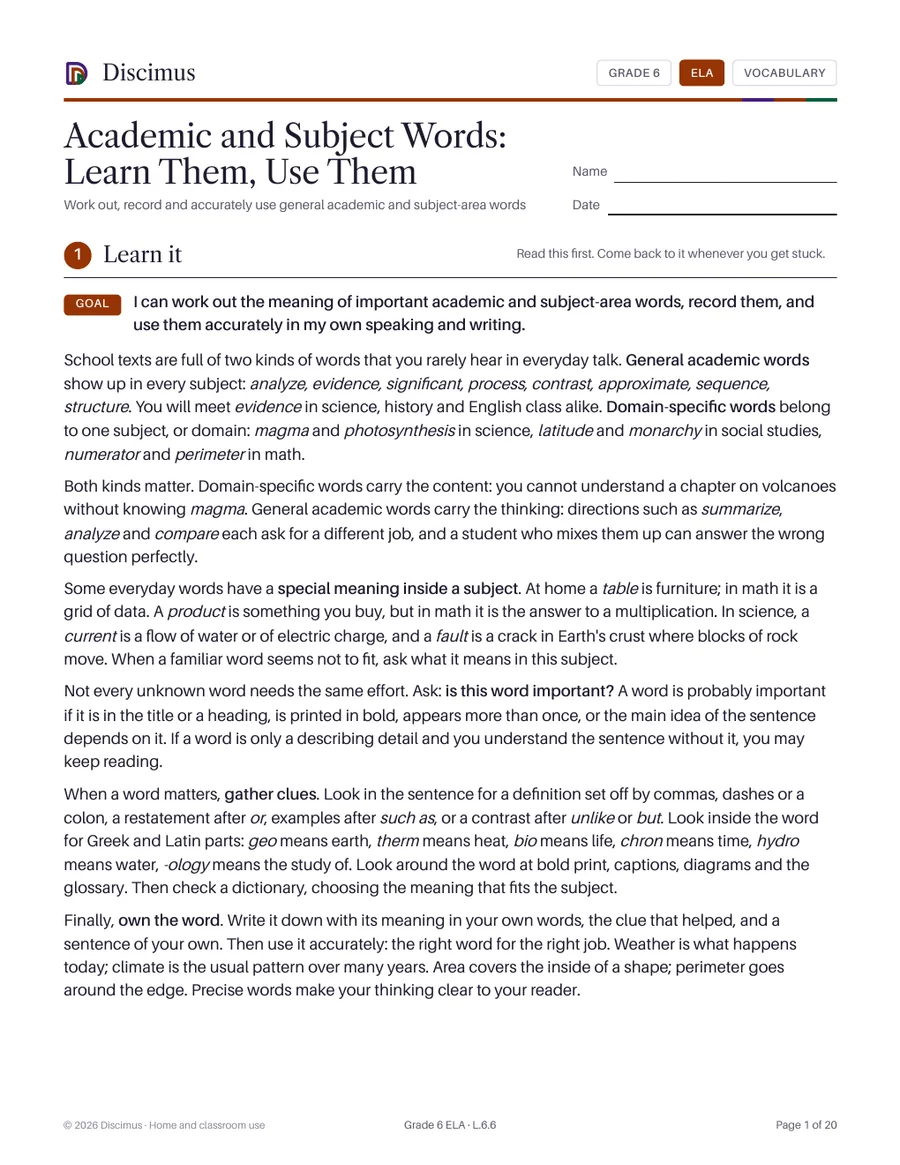
    Academic and Subject Words: Learn Them, Use Them

    Work out, record and accurately use general academic and subject-area words
  • ELAGrade 6

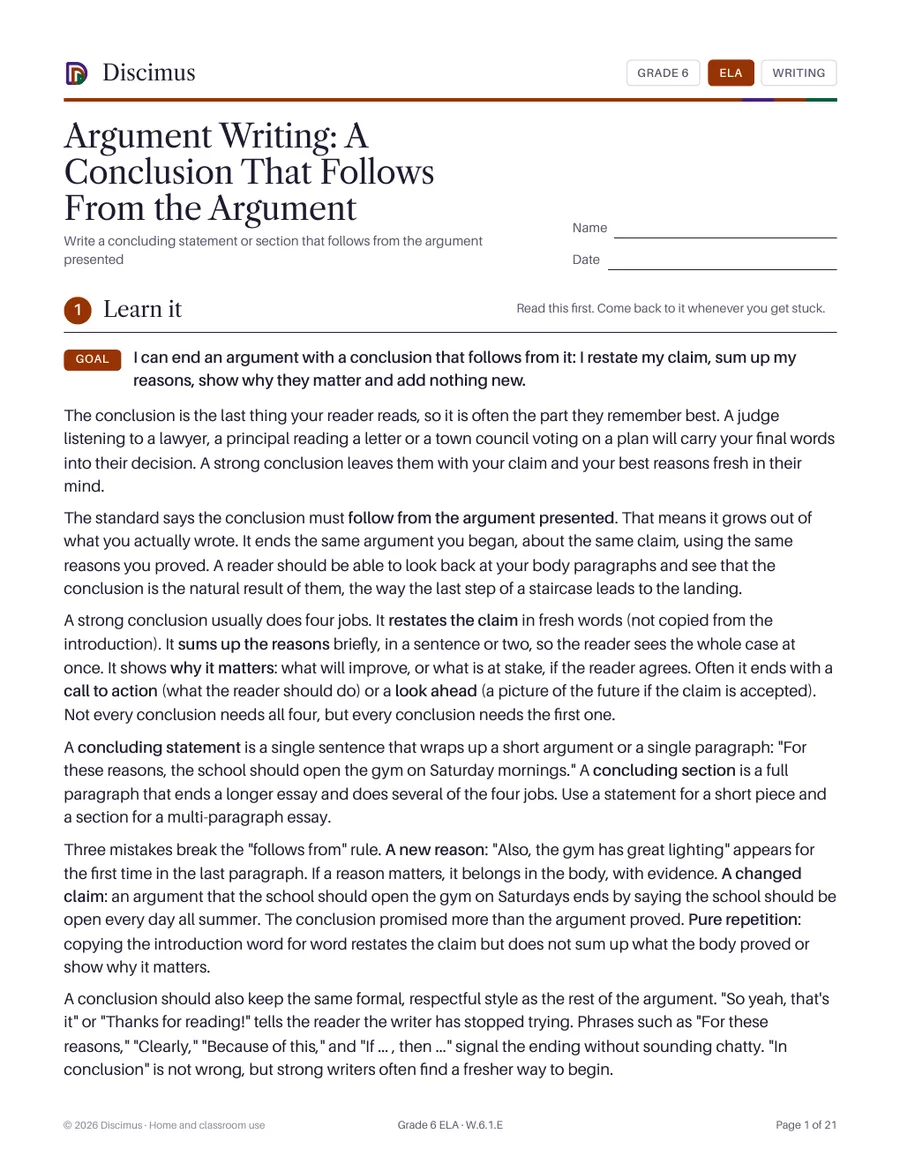
    Argument Writing: A Conclusion That Follows From the Argument

    Write a concluding statement or section that follows from the argument presented
  • ELAGrade 6

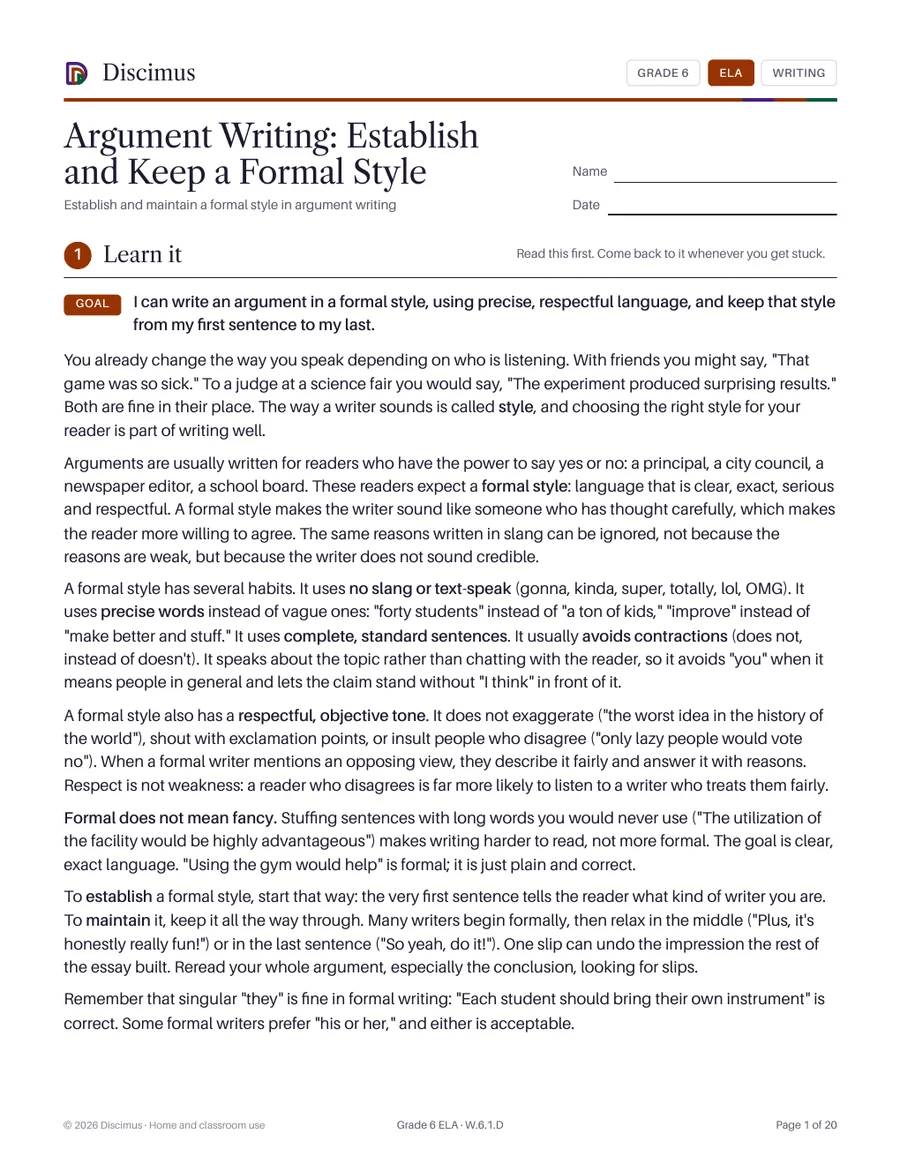
    Argument Writing: Establish and Keep a Formal Style

    Establish and maintain a formal style in argument writing
  • ELAGrade 6

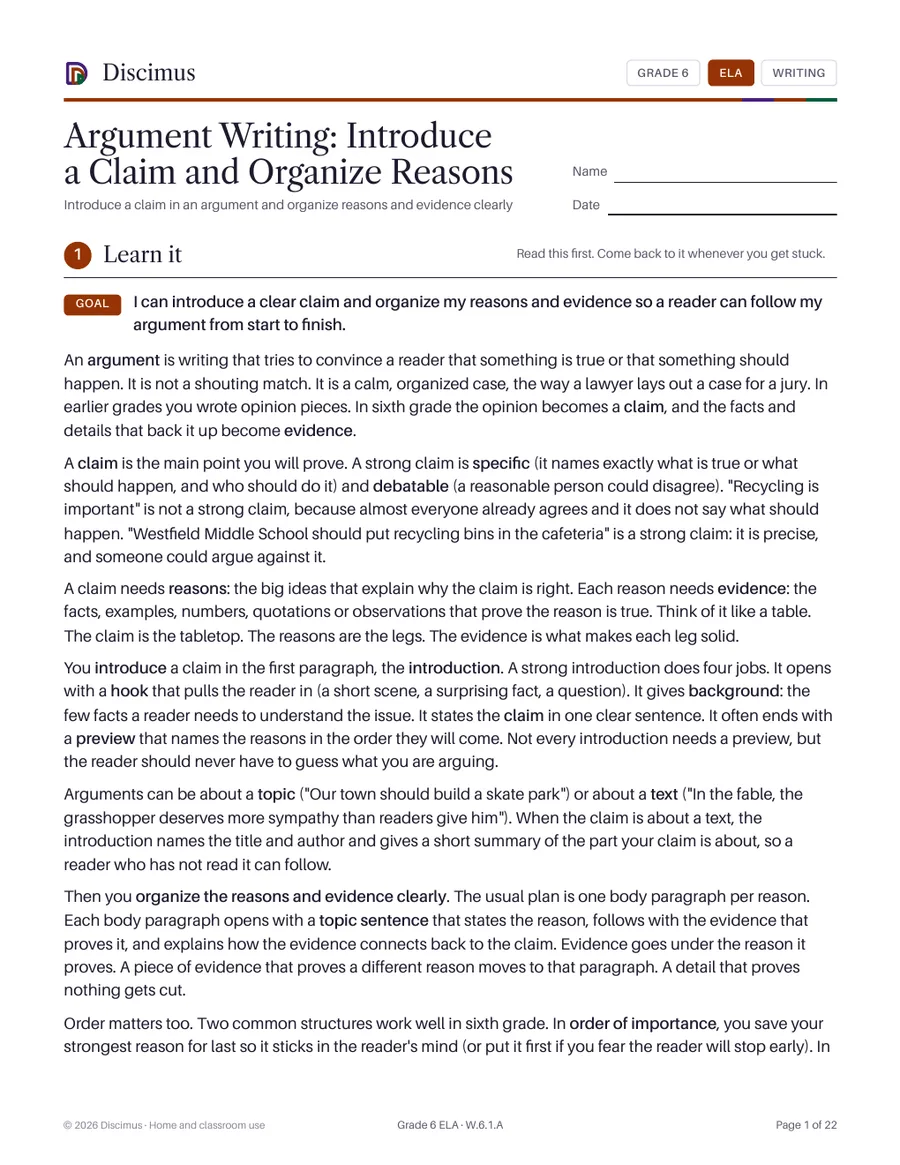
    Argument Writing: Introduce a Claim and Organize Reasons

    Introduce a claim in an argument and organize reasons and evidence clearly
  • ELAGrade 6

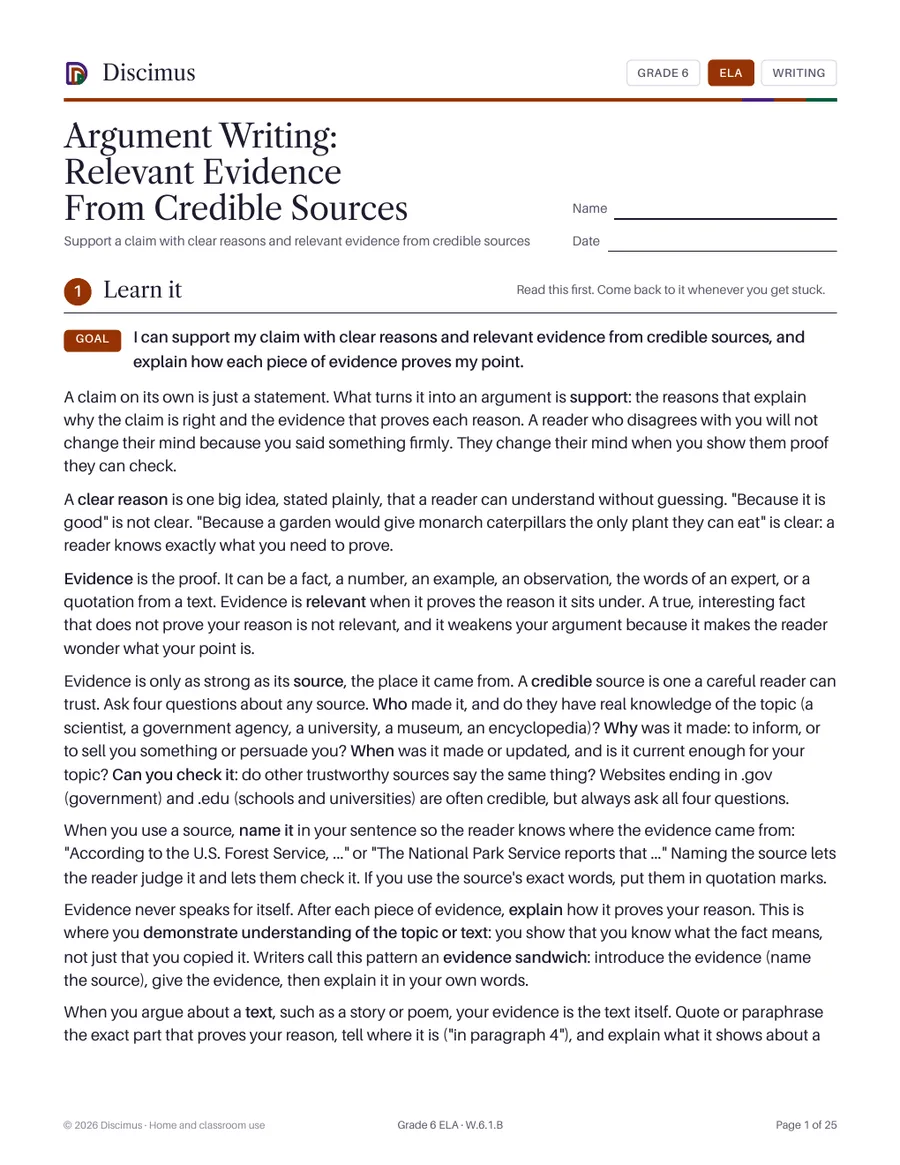
    Argument Writing: Relevant Evidence From Credible Sources

    Support a claim with clear reasons and relevant evidence from credible sources
  • ELAGrade 6

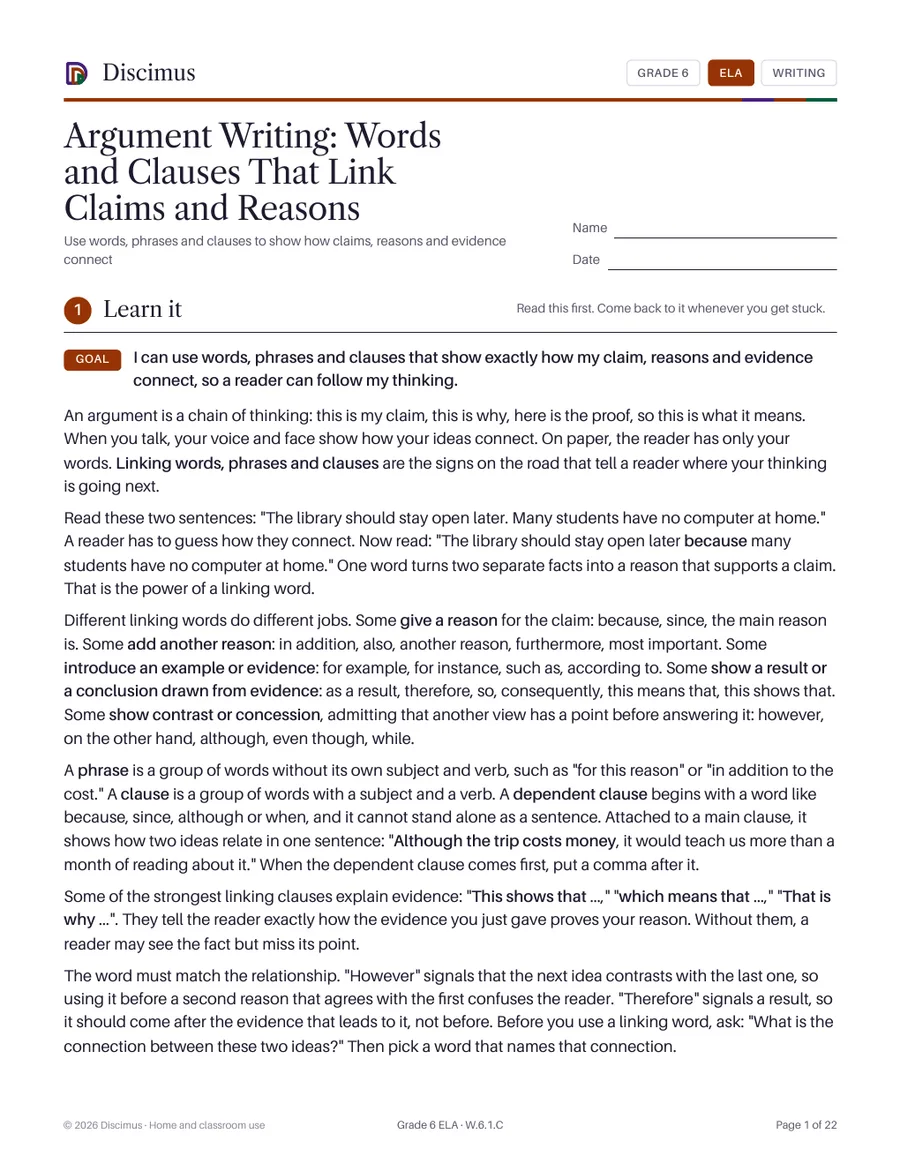
    Argument Writing: Words and Clauses That Link Claims and Reasons

    Use words, phrases and clauses to show how claims, reasons and evidence connect
  • ELAGrade 6

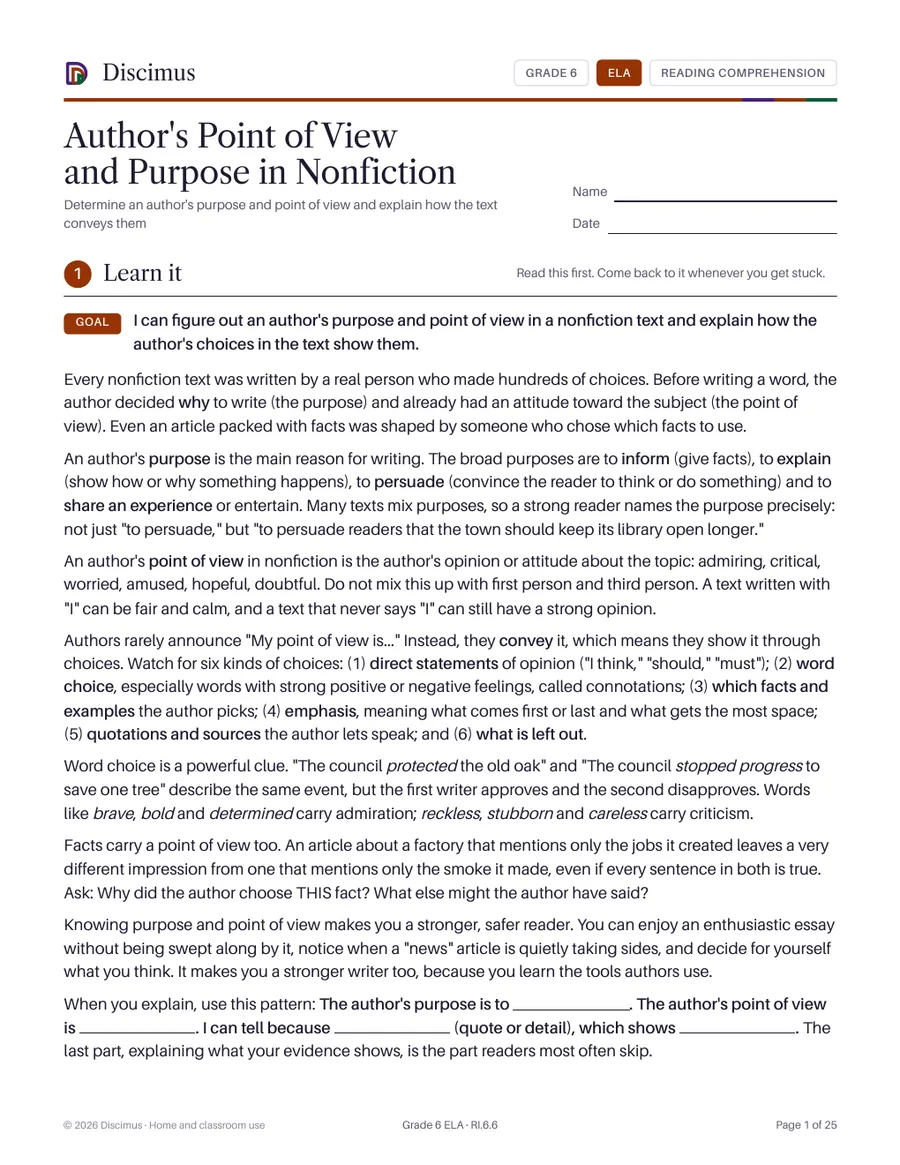
    Author's Point of View and Purpose in Nonfiction

    Determine an author's purpose and point of view and explain how the text conveys them
  • ELAGrade 6

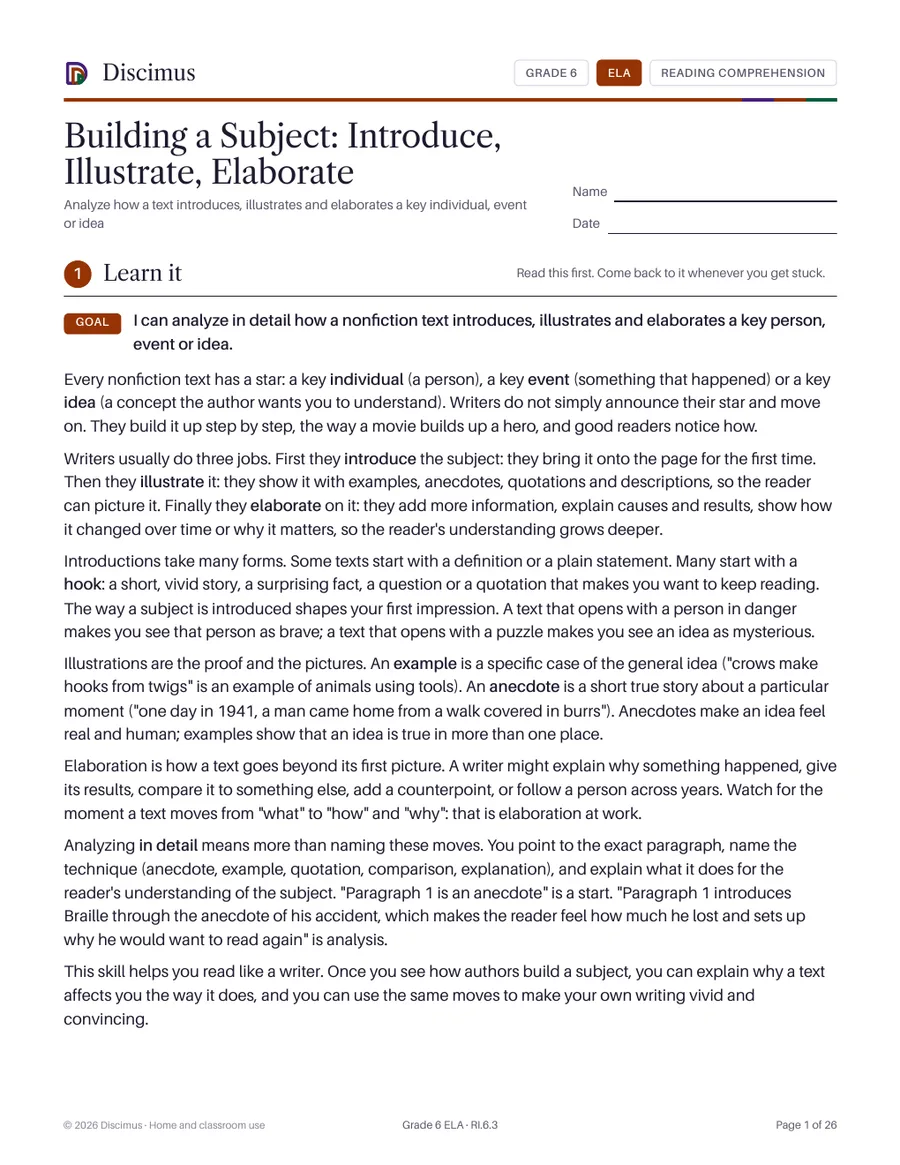
    Building a Subject: Introduce, Illustrate, Elaborate

    Analyze how a text introduces, illustrates and elaborates a key individual, event or idea
  • ELAGrade 6

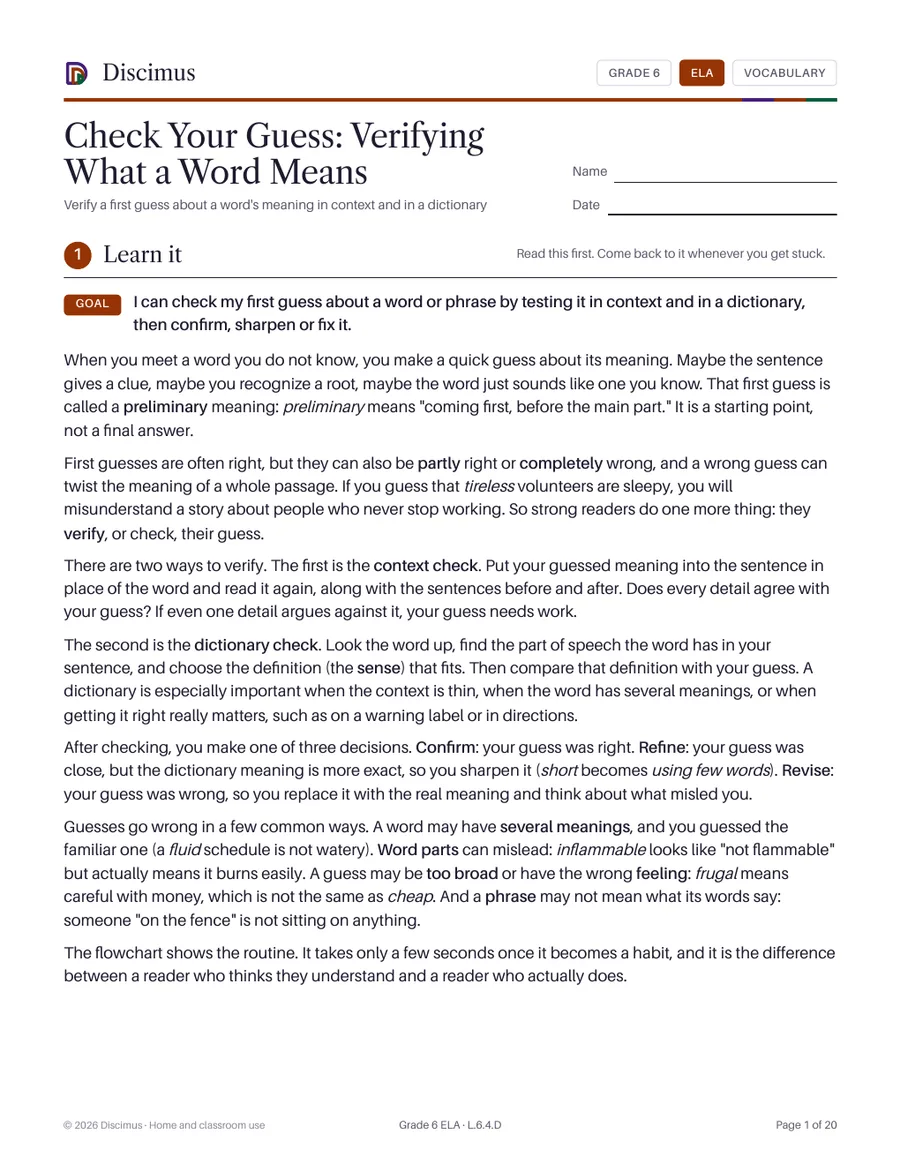
    Check Your Guess: Verifying What a Word Means

    Verify a first guess about a word's meaning in context and in a dictionary
  • ELAGrade 6

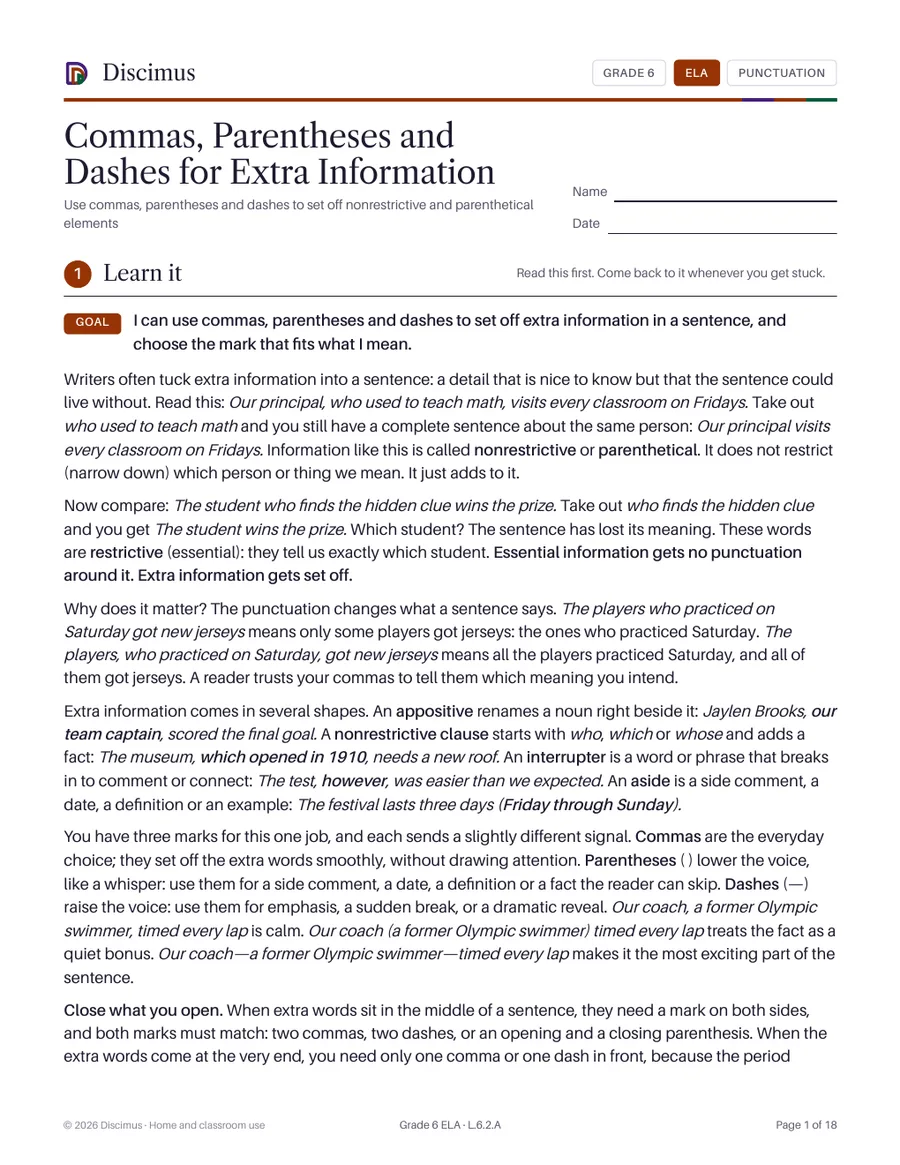
    Commas, Parentheses and Dashes for Extra Information

    Use commas, parentheses and dashes to set off nonrestrictive and parenthetical elements
  • ELAGrade 6

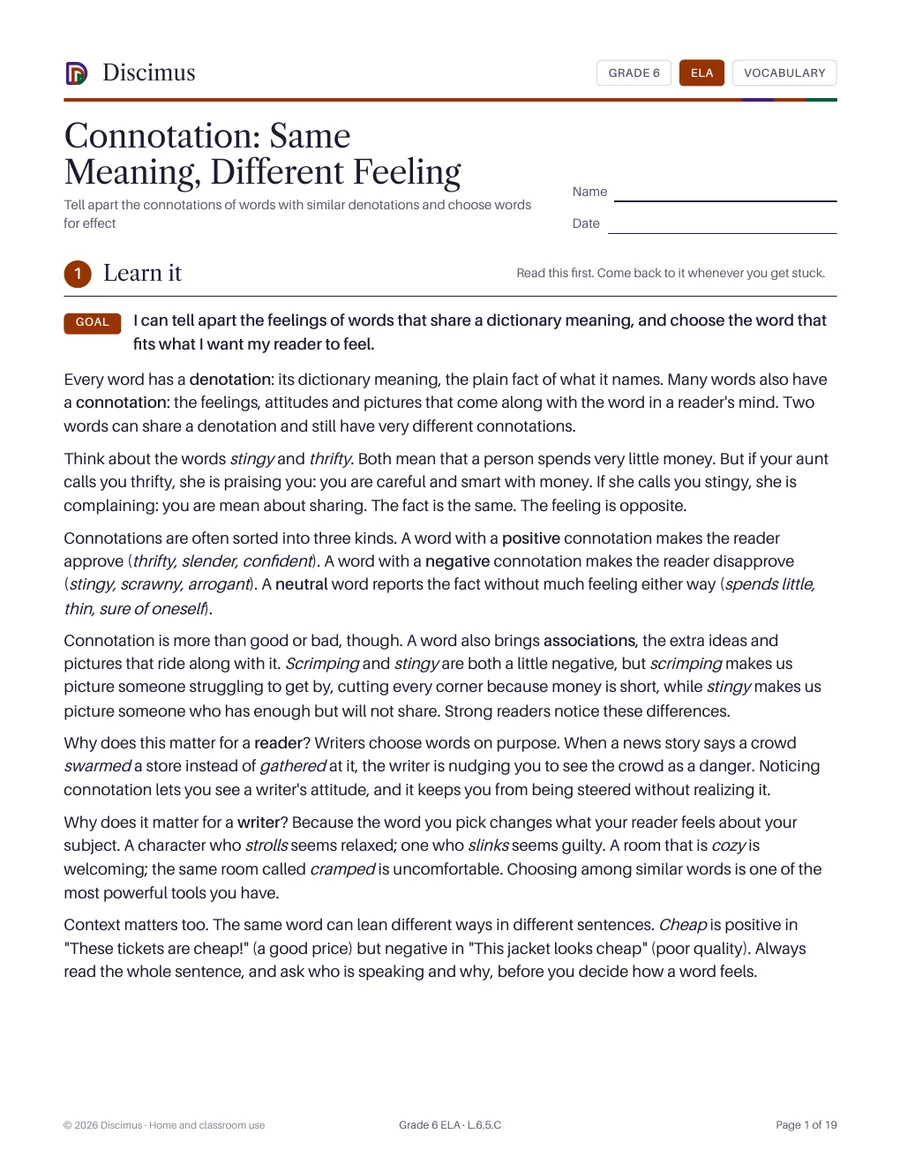
    Connotation: Same Meaning, Different Feeling

    Tell apart the connotations of words with similar denotations and choose words for effect
  • ELAGrade 6

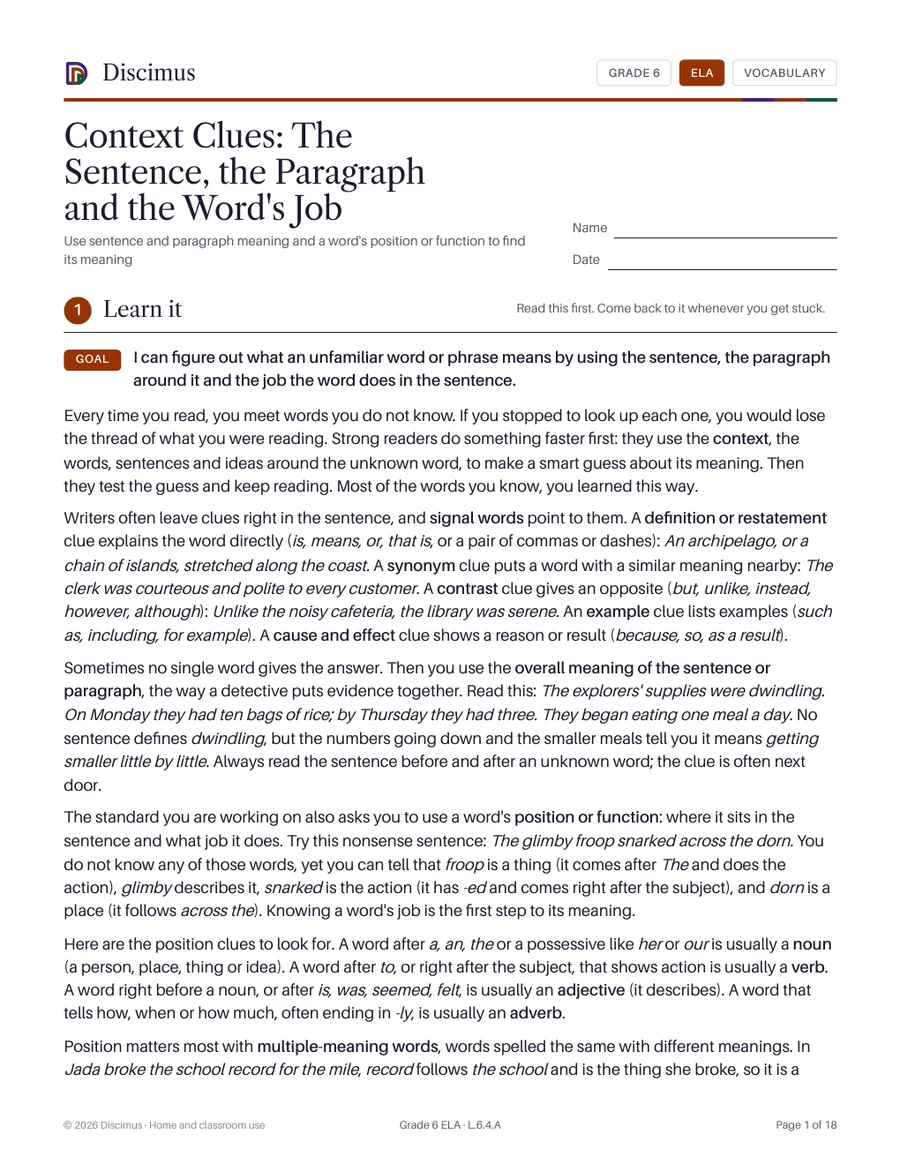
    Context Clues: The Sentence, the Paragraph and the Word's Job

    Use sentence and paragraph meaning and a word's position or function to find its meaning
  • ELAGrade 6

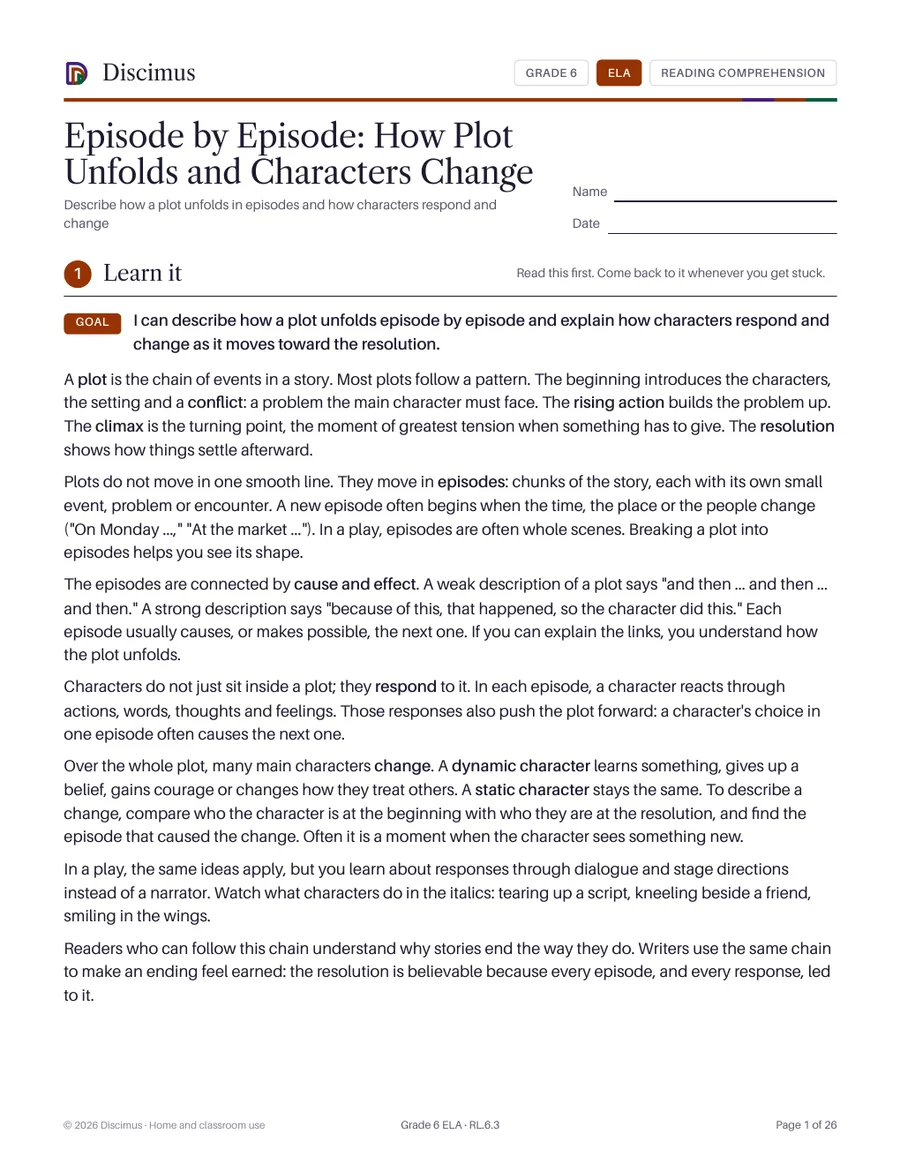
    Episode by Episode: How Plot Unfolds and Characters Change

    Describe how a plot unfolds in episodes and how characters respond and change
  • ELAGrade 6

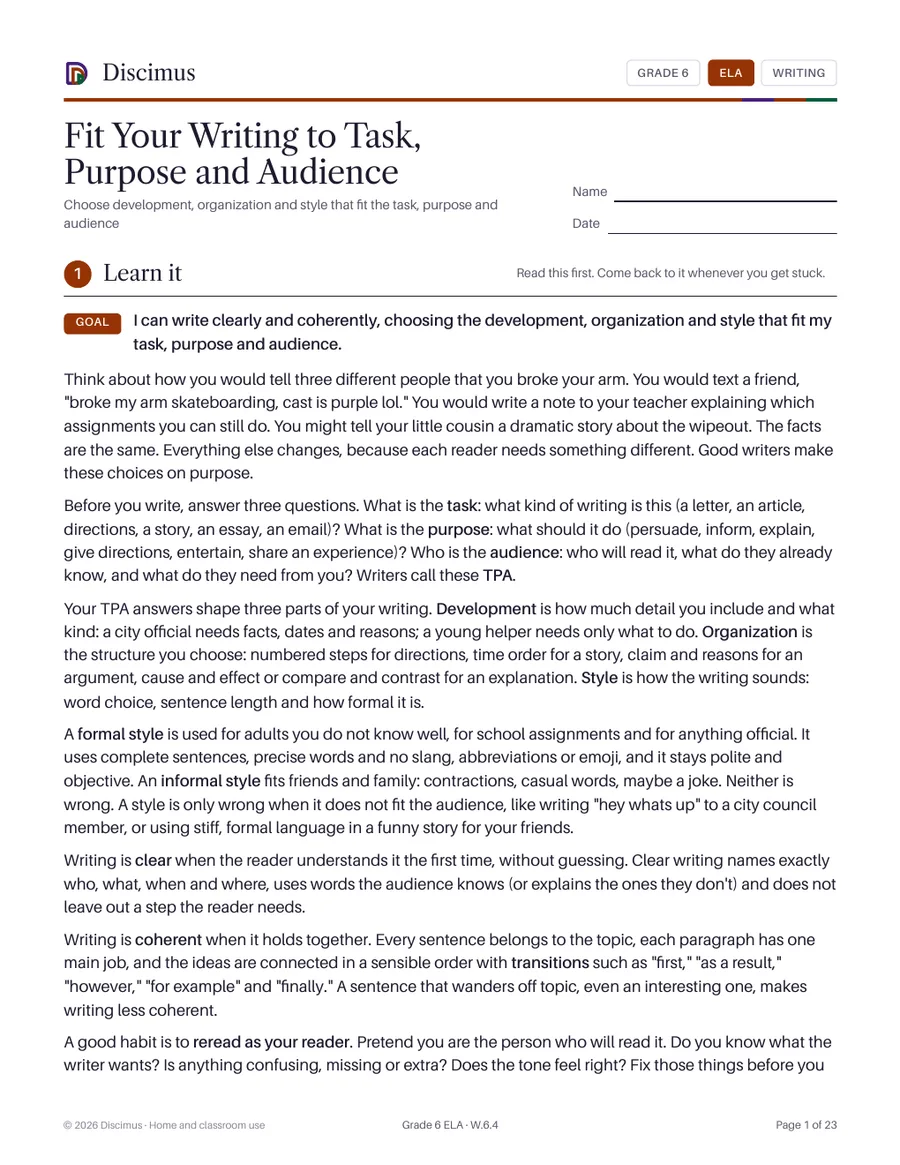
    Fit Your Writing to Task, Purpose and Audience

    Choose development, organization and style that fit the task, purpose and audience
  • ELAGrade 6

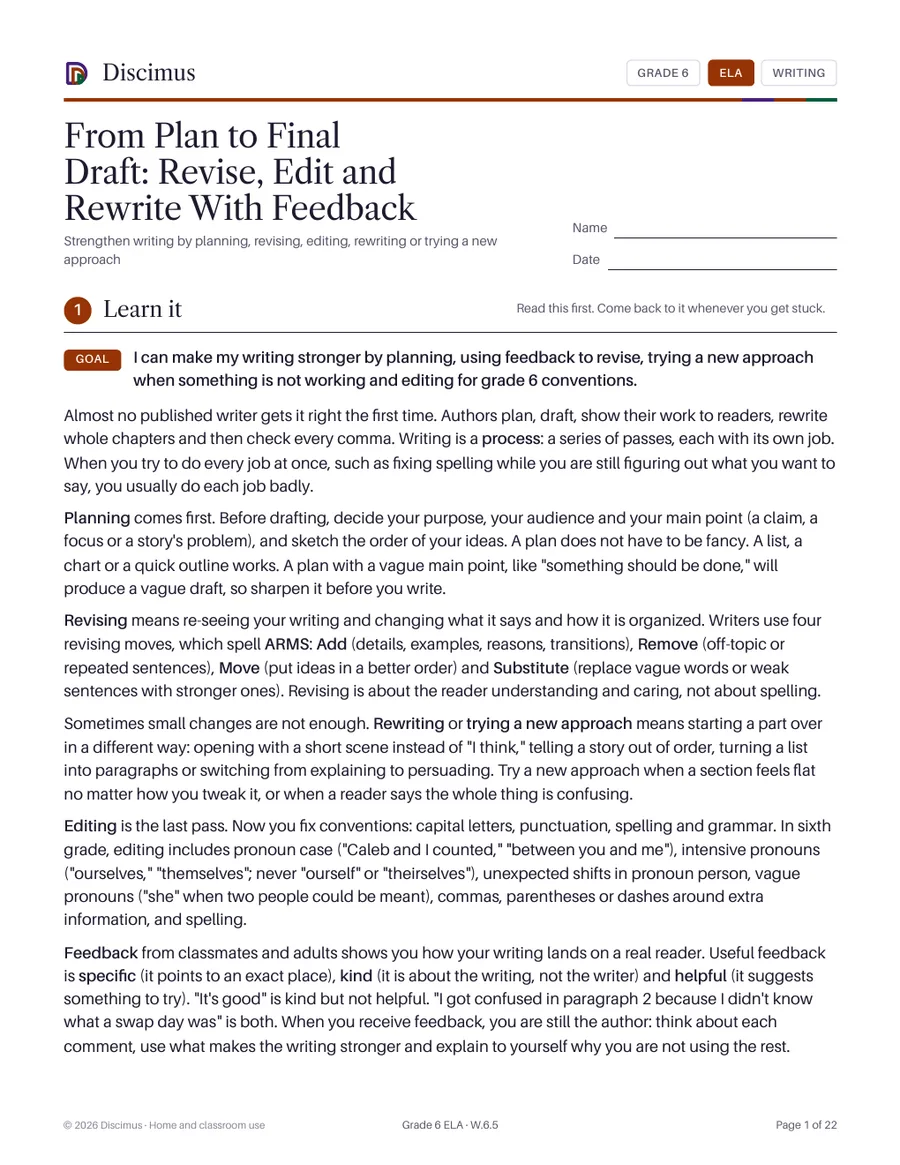
    From Plan to Final Draft: Revise, Edit and Rewrite With Feedback

    Strengthen writing by planning, revising, editing, rewriting or trying a new approach
  • ELAGrade 6

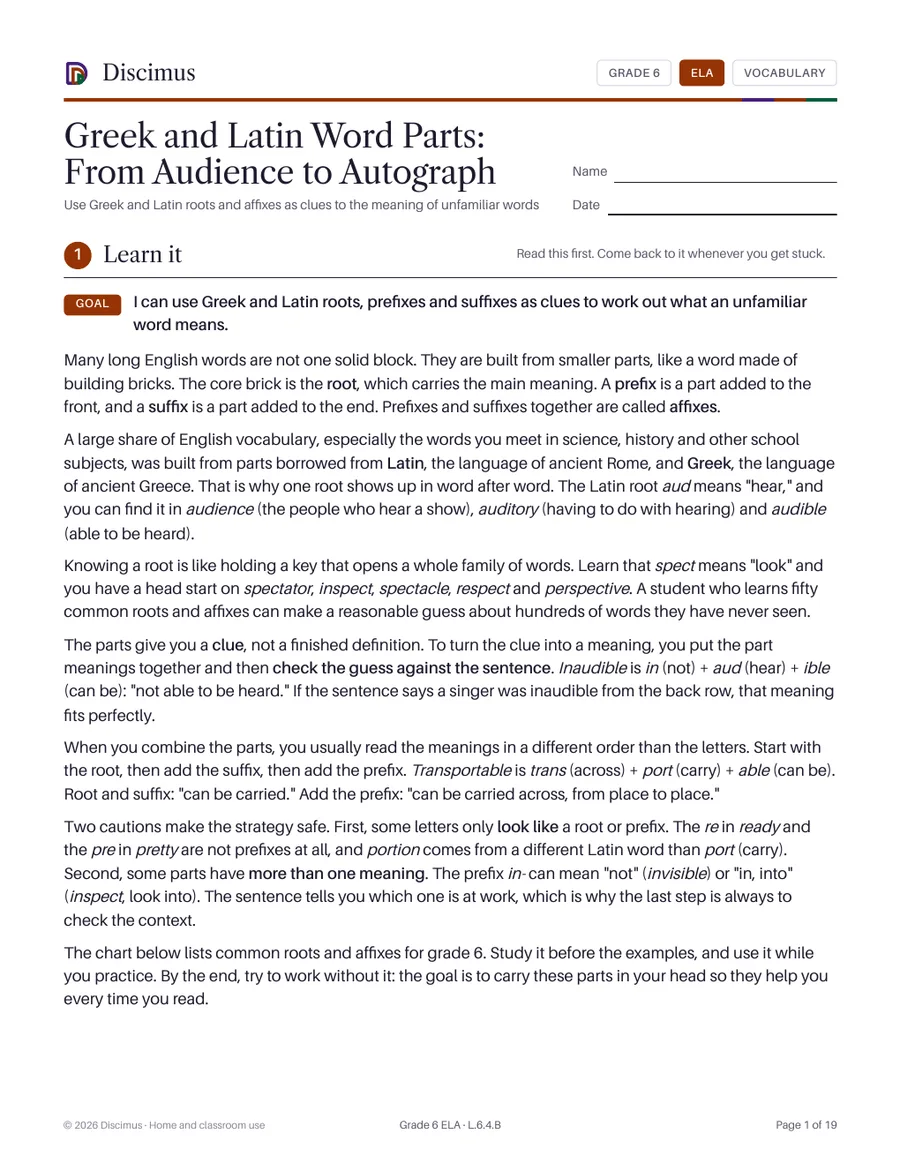
    Greek and Latin Word Parts: From Audience to Autograph

    Use Greek and Latin roots and affixes as clues to the meaning of unfamiliar words
  • ELAGrade 6

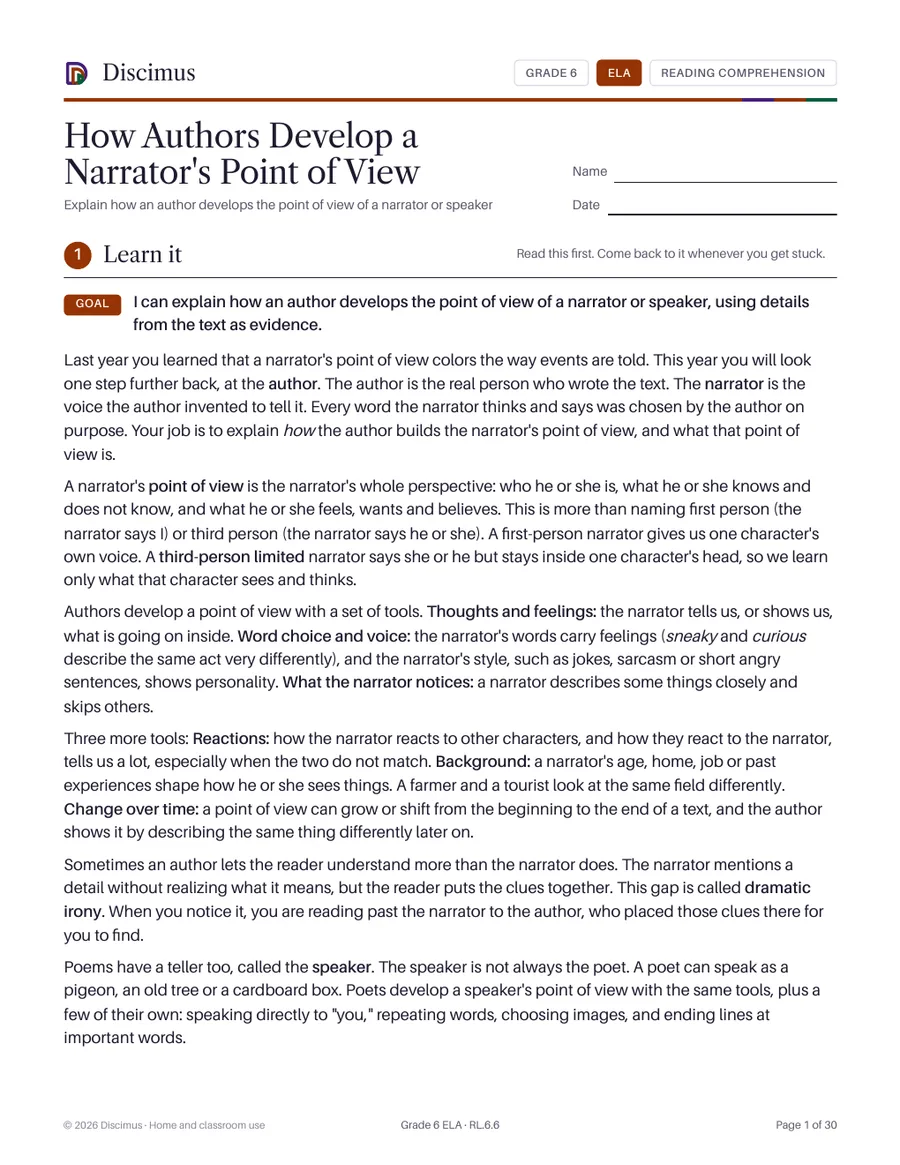
    How Authors Develop a Narrator's Point of View

    Explain how an author develops the point of view of a narrator or speaker
  • ELAGrade 6

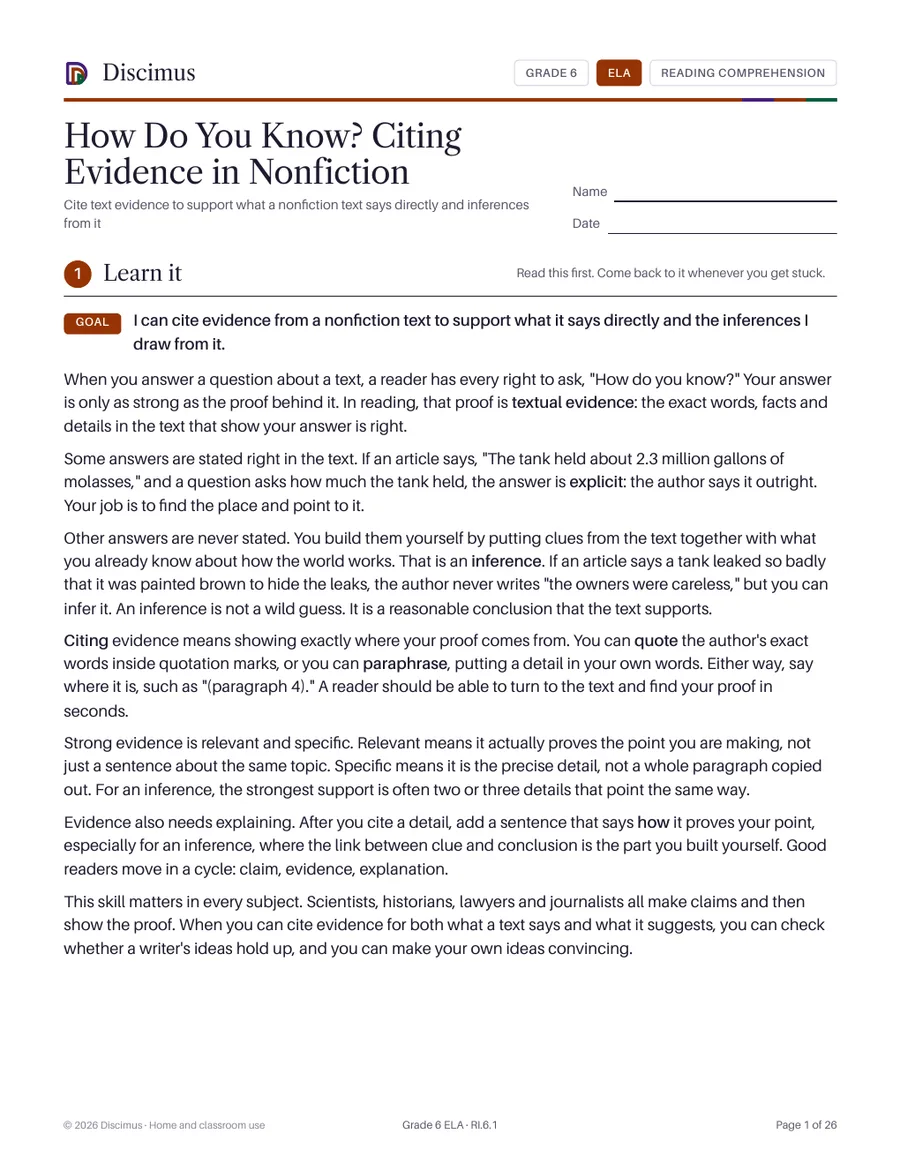
    How Do You Know? Citing Evidence in Nonfiction

    Cite text evidence to support what a nonfiction text says directly and inferences from it
  • ELAGrade 6

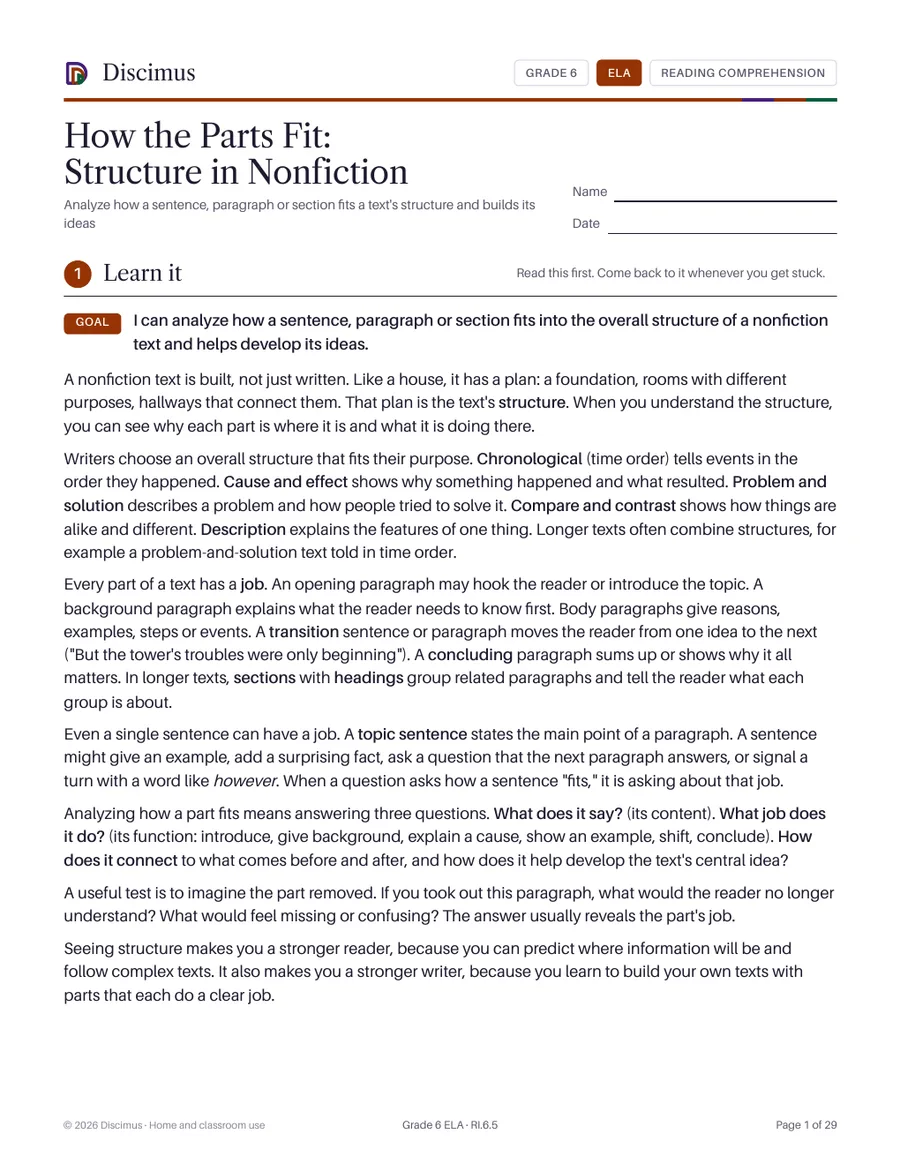
    How the Parts Fit: Structure in Nonfiction

    Analyze how a sentence, paragraph or section fits a text's structure and builds its ideas
  • ELAGrade 6

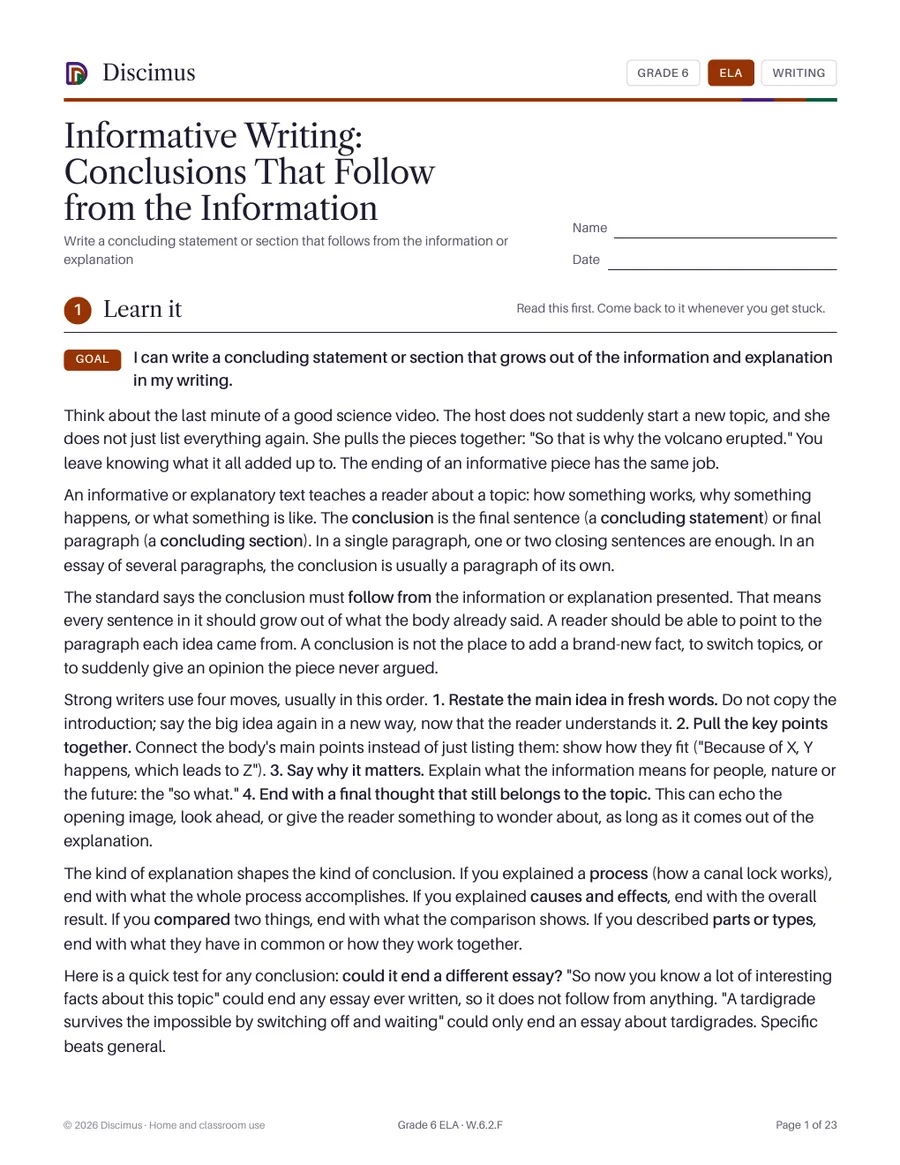
    Informative Writing: Conclusions That Follow from the Information

    Write a concluding statement or section that follows from the information or explanation
  • ELAGrade 6

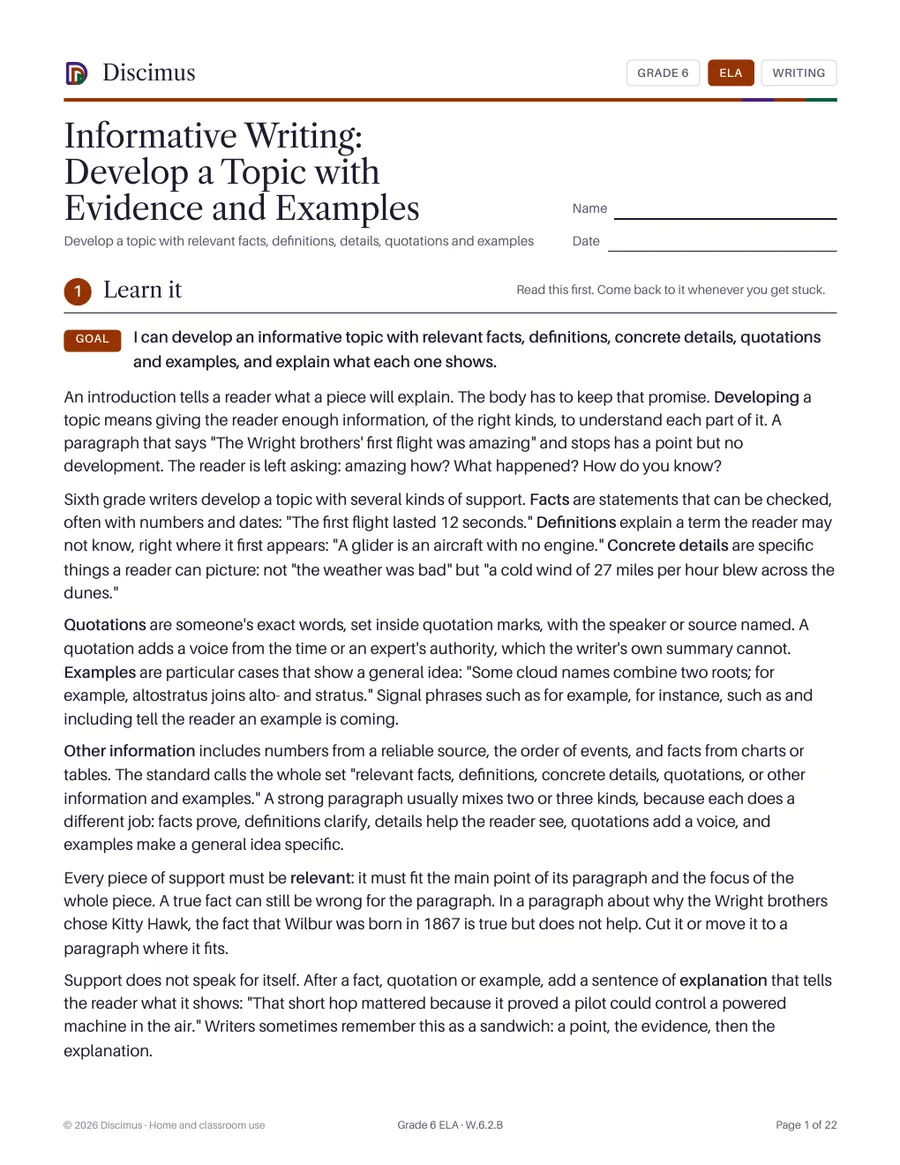
    Informative Writing: Develop a Topic with Evidence and Examples

    Develop a topic with relevant facts, definitions, details, quotations and examples
  • ELAGrade 6

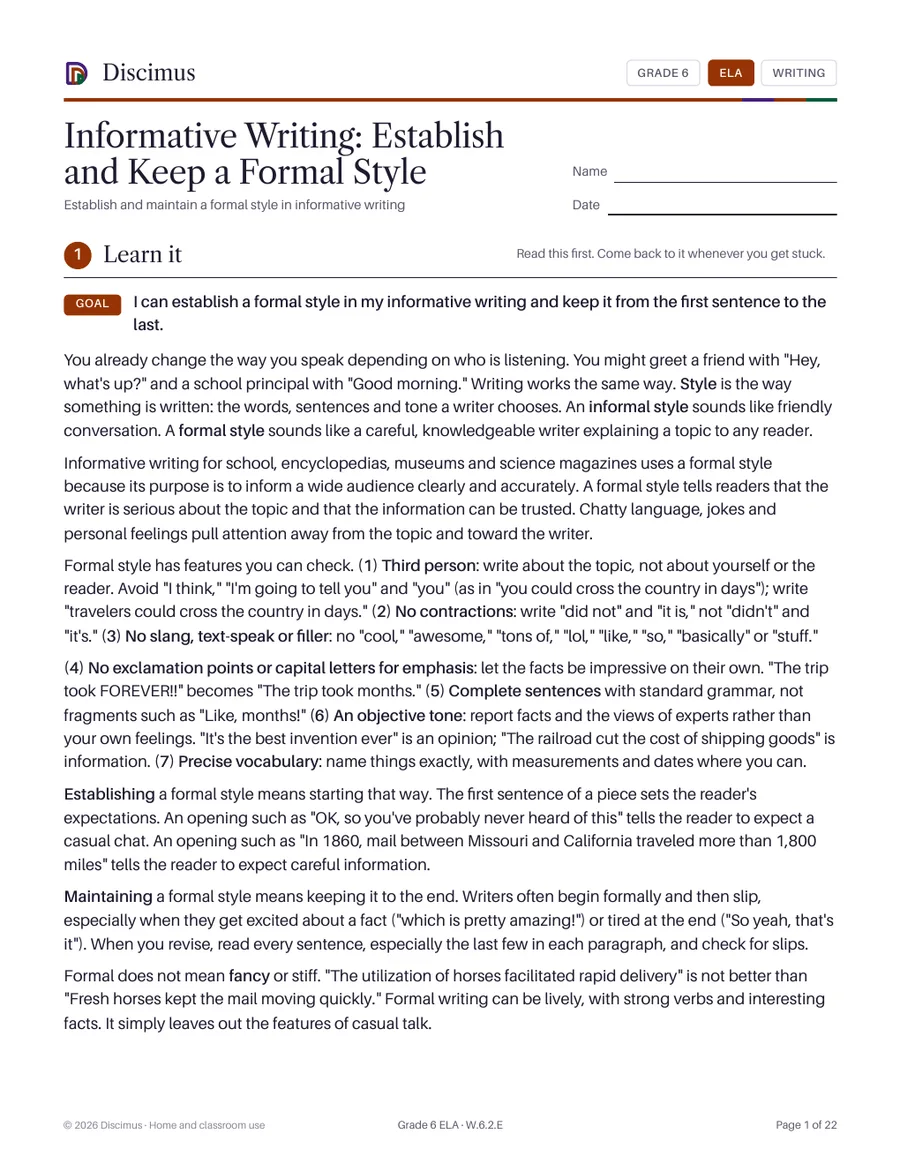
    Informative Writing: Establish and Keep a Formal Style

    Establish and maintain a formal style in informative writing
  • ELAGrade 6

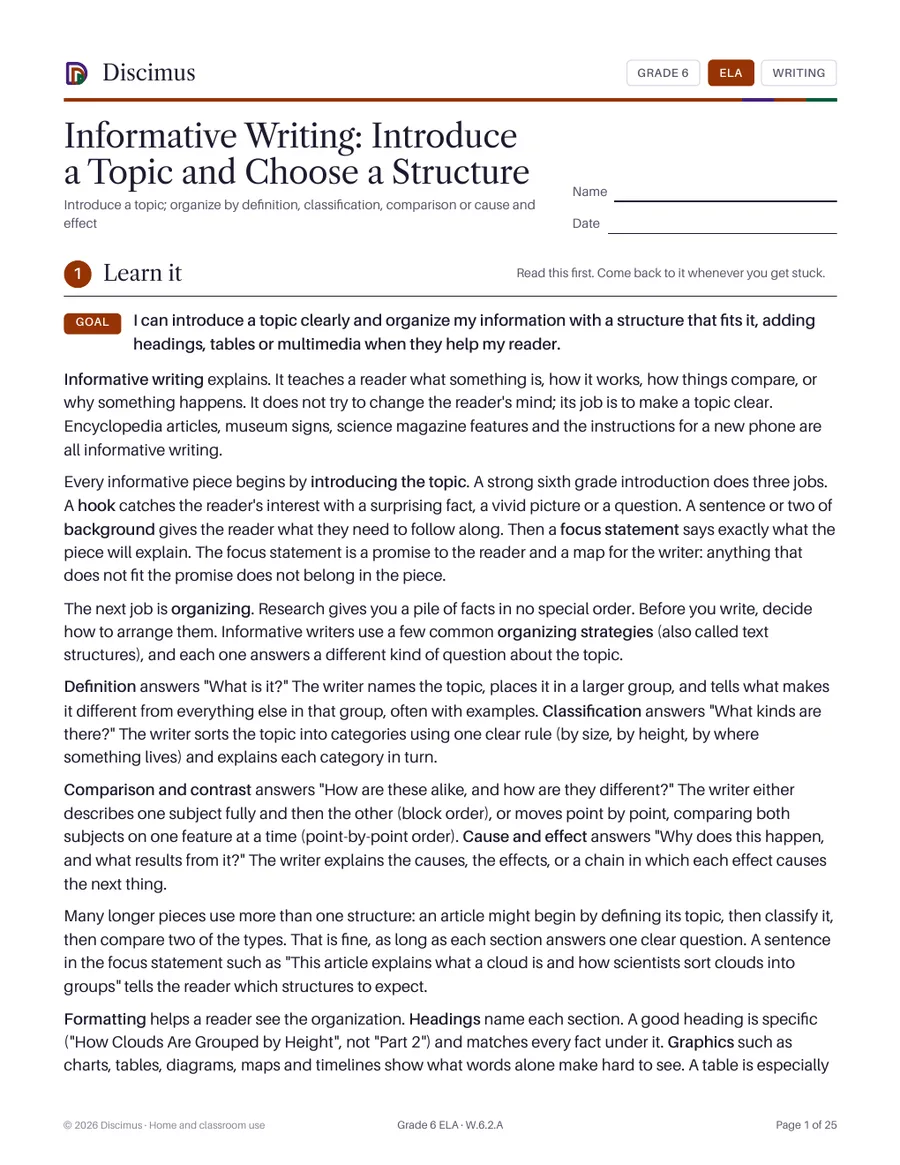
    Informative Writing: Introduce a Topic and Choose a Structure

    Introduce a topic; organize by definition, classification, comparison or cause and effect
  • ELAGrade 6

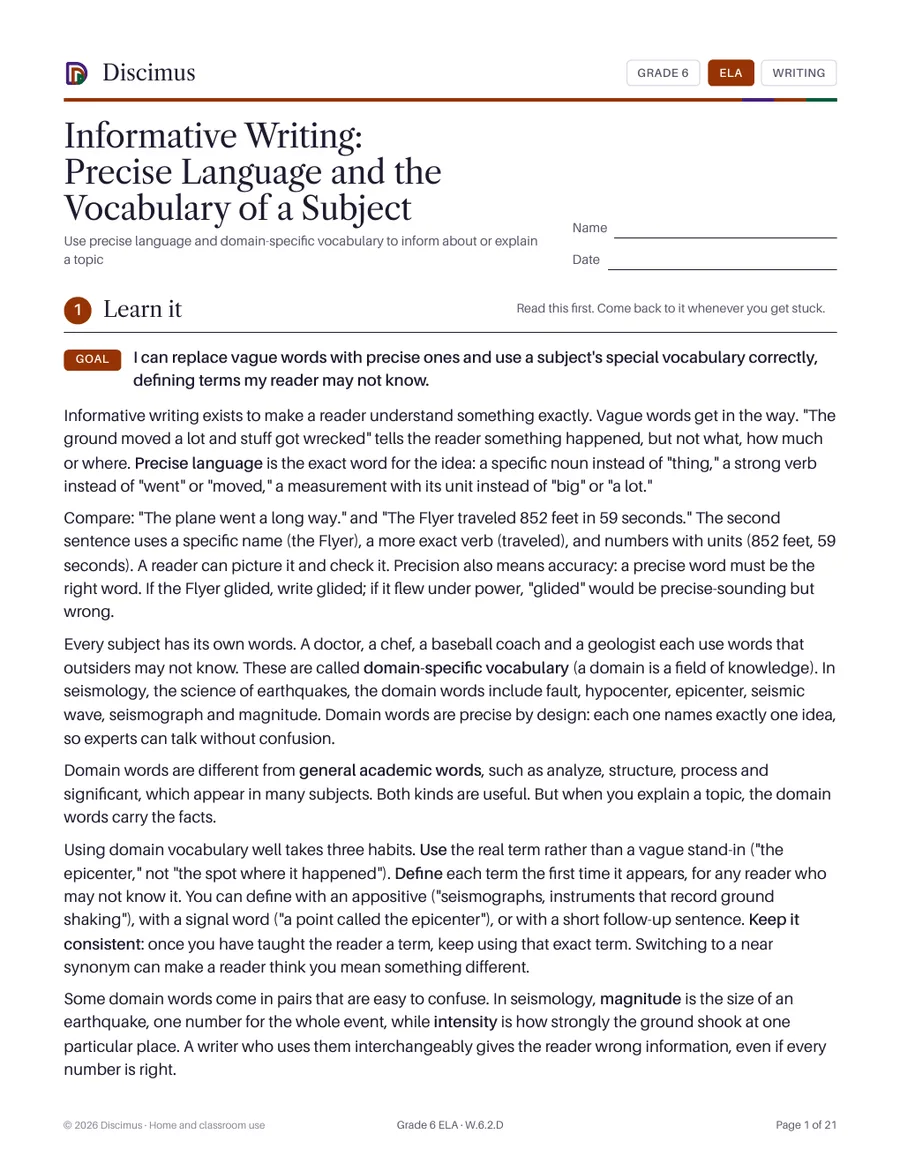
    Informative Writing: Precise Language and the Vocabulary of a Subject

    Use precise language and domain-specific vocabulary to inform about or explain a topic
  • ELAGrade 6

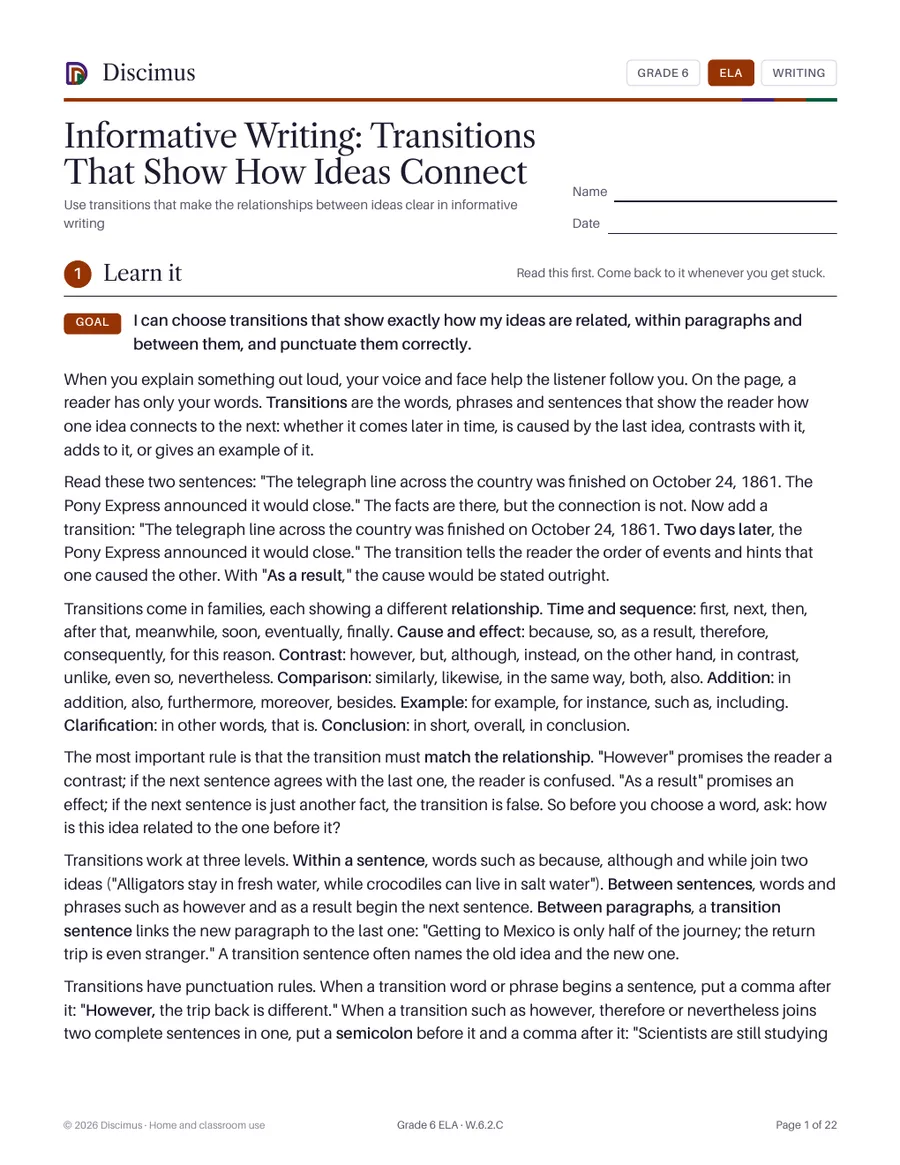
    Informative Writing: Transitions That Show How Ideas Connect

    Use transitions that make the relationships between ideas clear in informative writing
  • ELAGrade 6

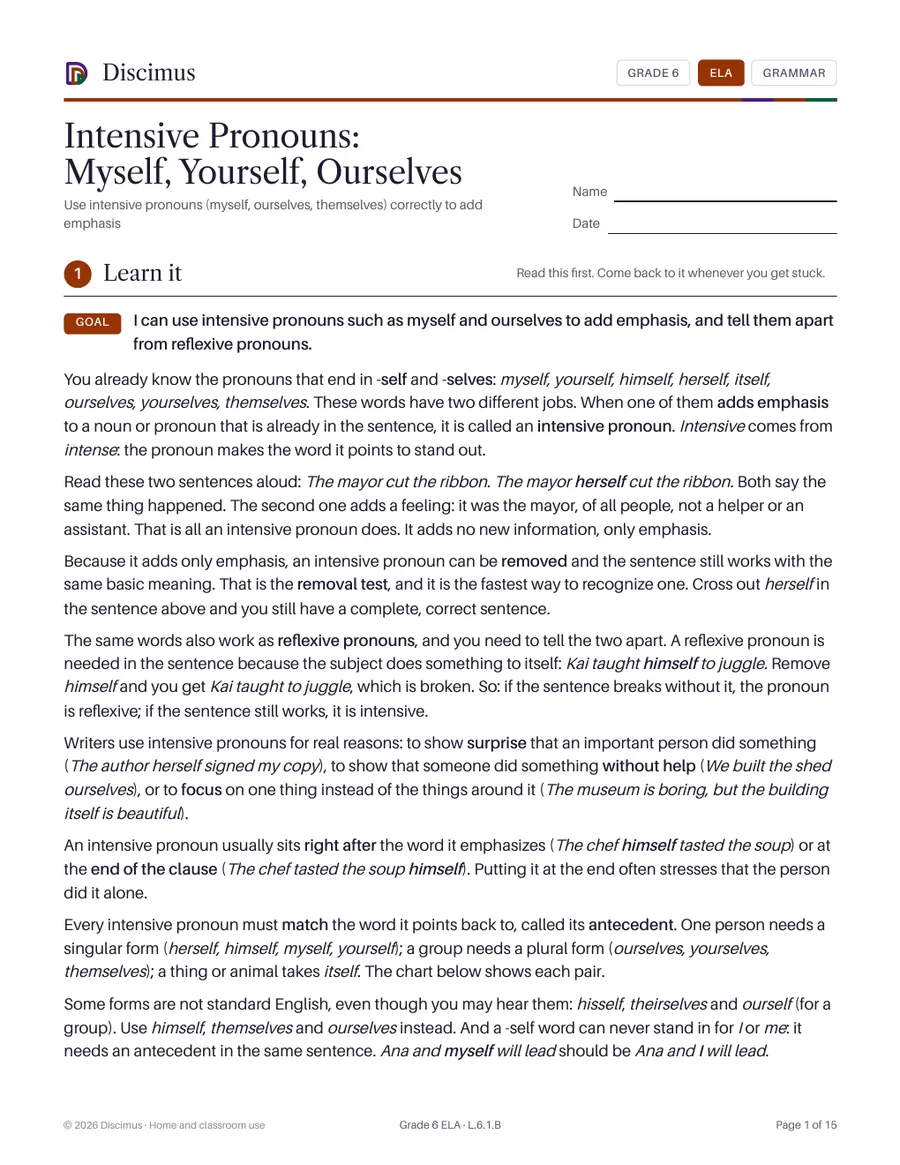
    Intensive Pronouns: Myself, Yourself, Ourselves

    Use intensive pronouns (myself, ourselves, themselves) correctly to add emphasis
  • ELAGrade 6

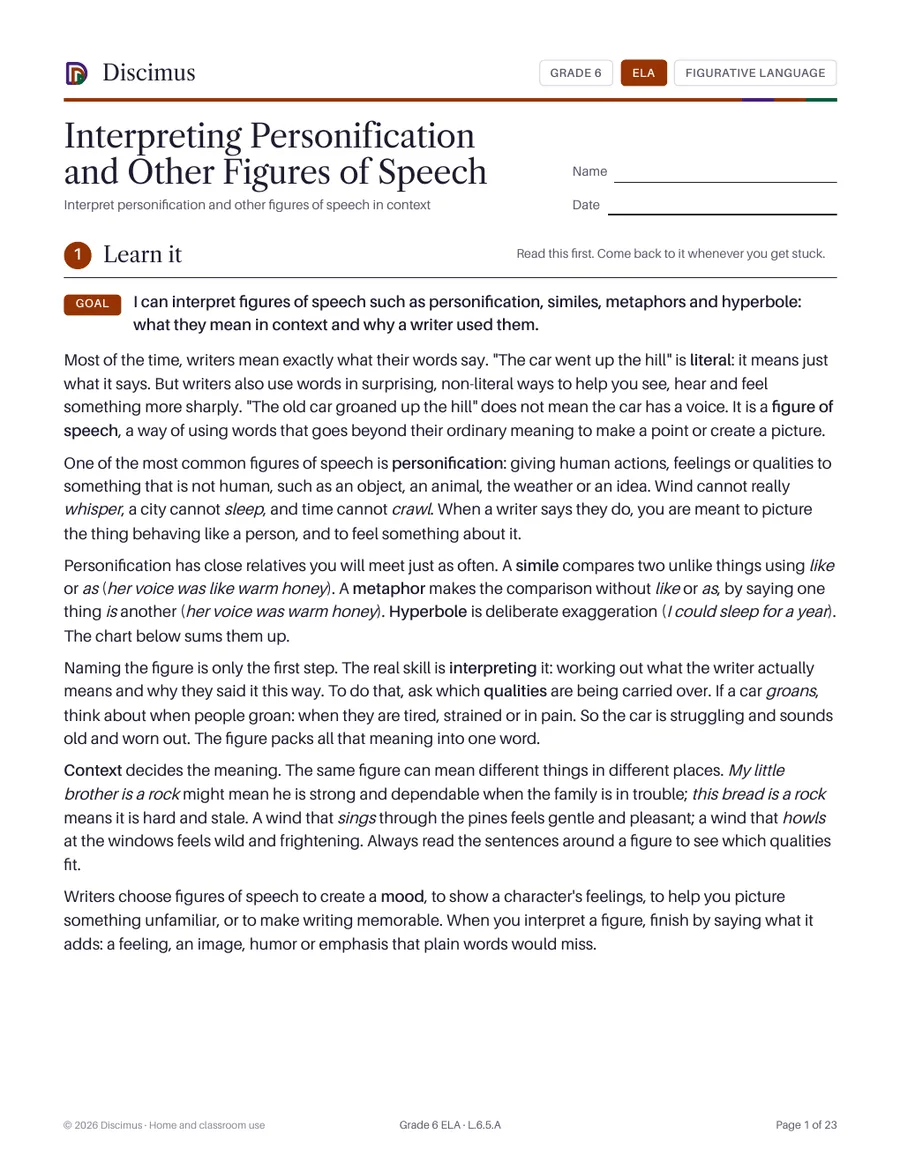
    Interpreting Personification and Other Figures of Speech

    Interpret personification and other figures of speech in context
  • ELAGrade 6

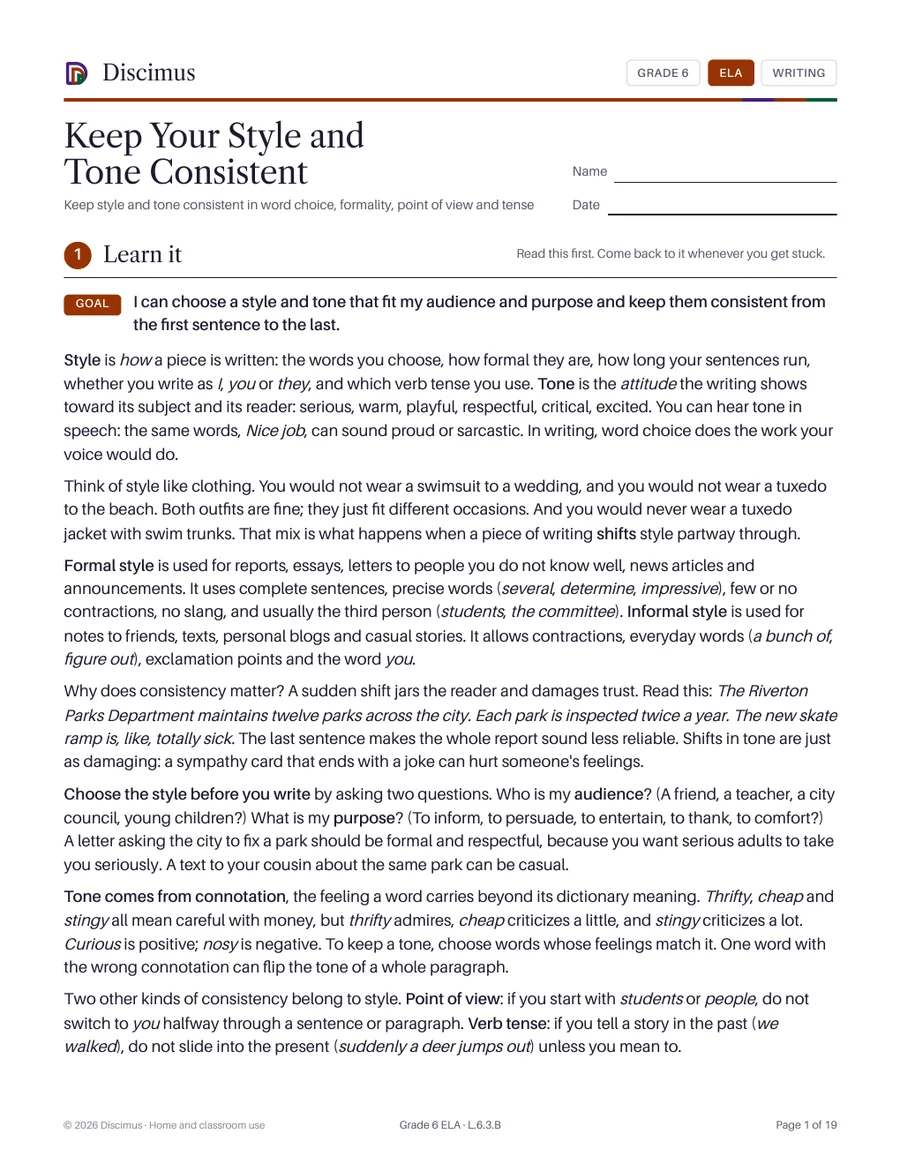
    Keep Your Style and Tone Consistent

    Keep style and tone consistent in word choice, formality, point of view and tense
  • ELAGrade 6

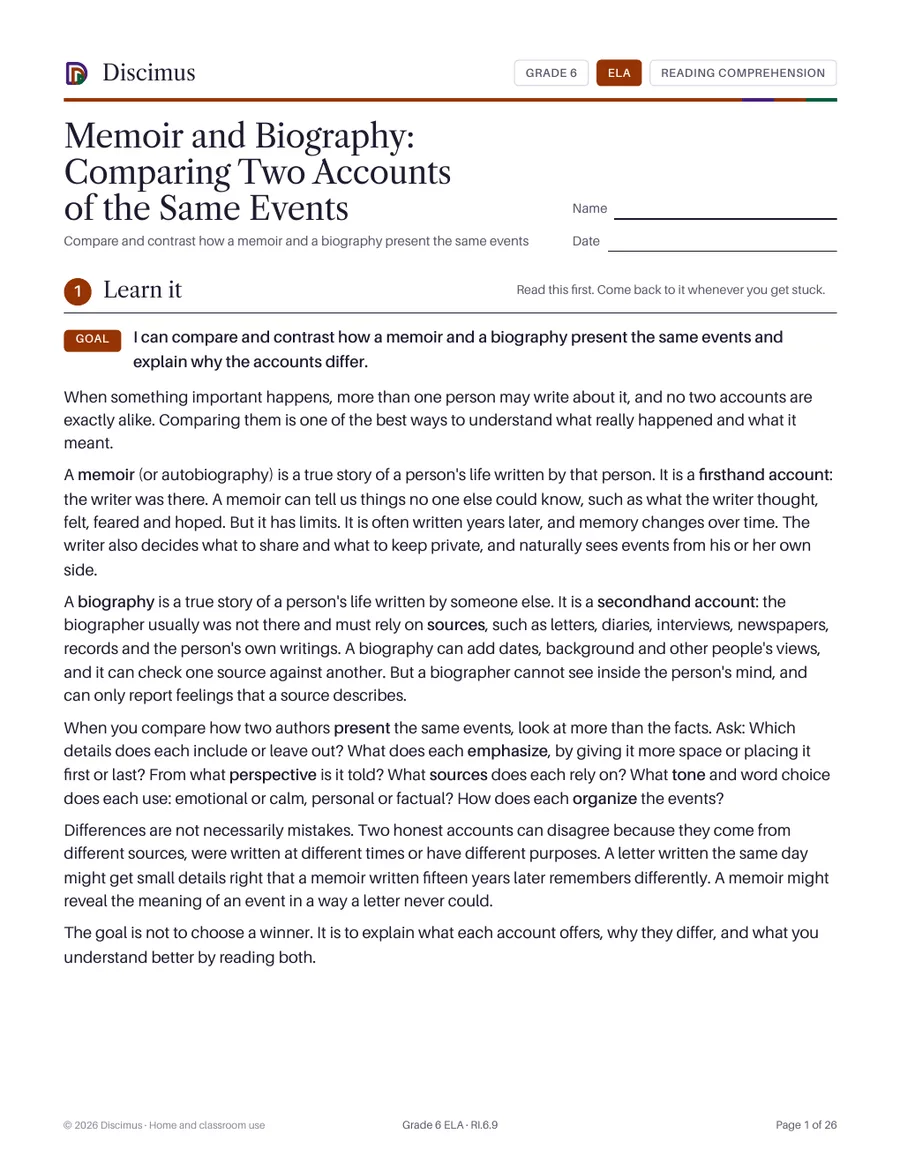
    Memoir and Biography: Comparing Two Accounts of the Same Events

    Compare and contrast how a memoir and a biography present the same events
  • ELAGrade 6

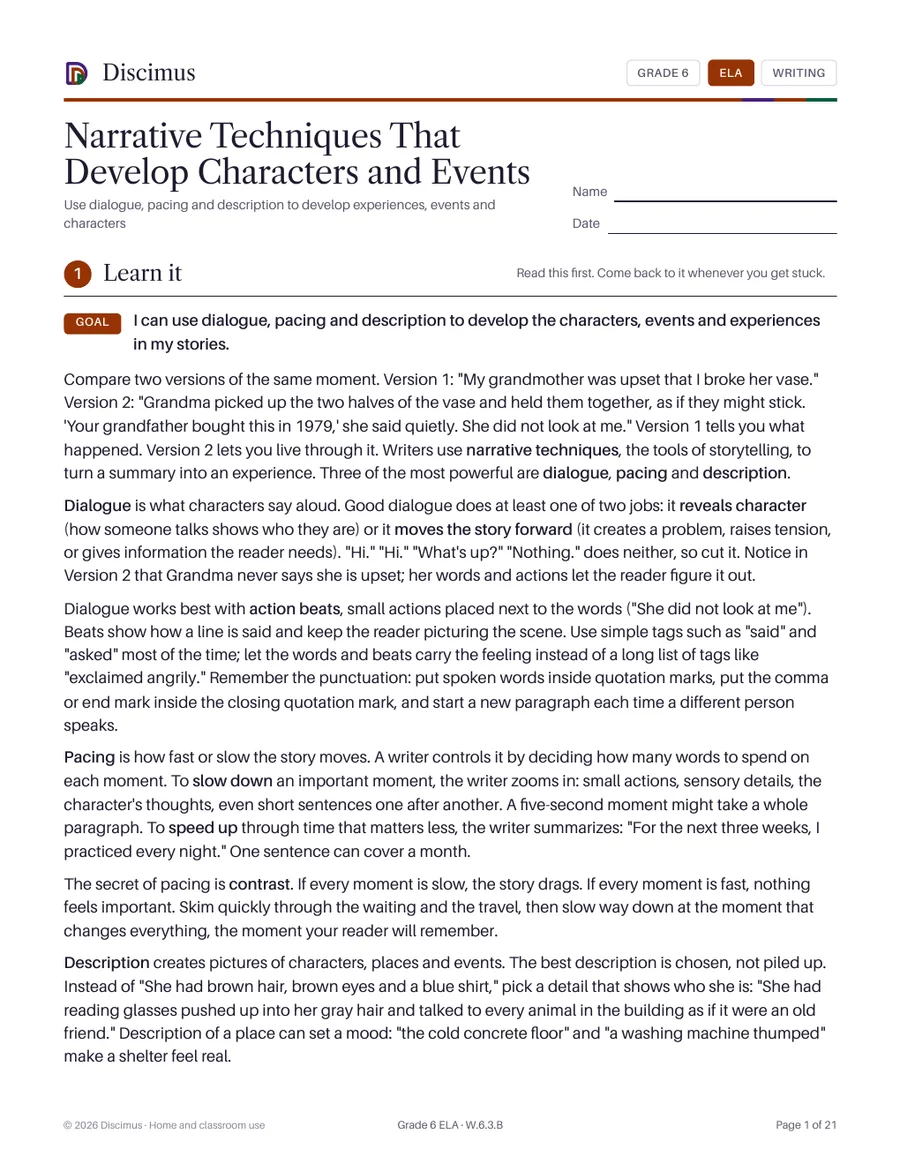
    Narrative Techniques That Develop Characters and Events

    Use dialogue, pacing and description to develop experiences, events and characters
  • ELAGrade 6

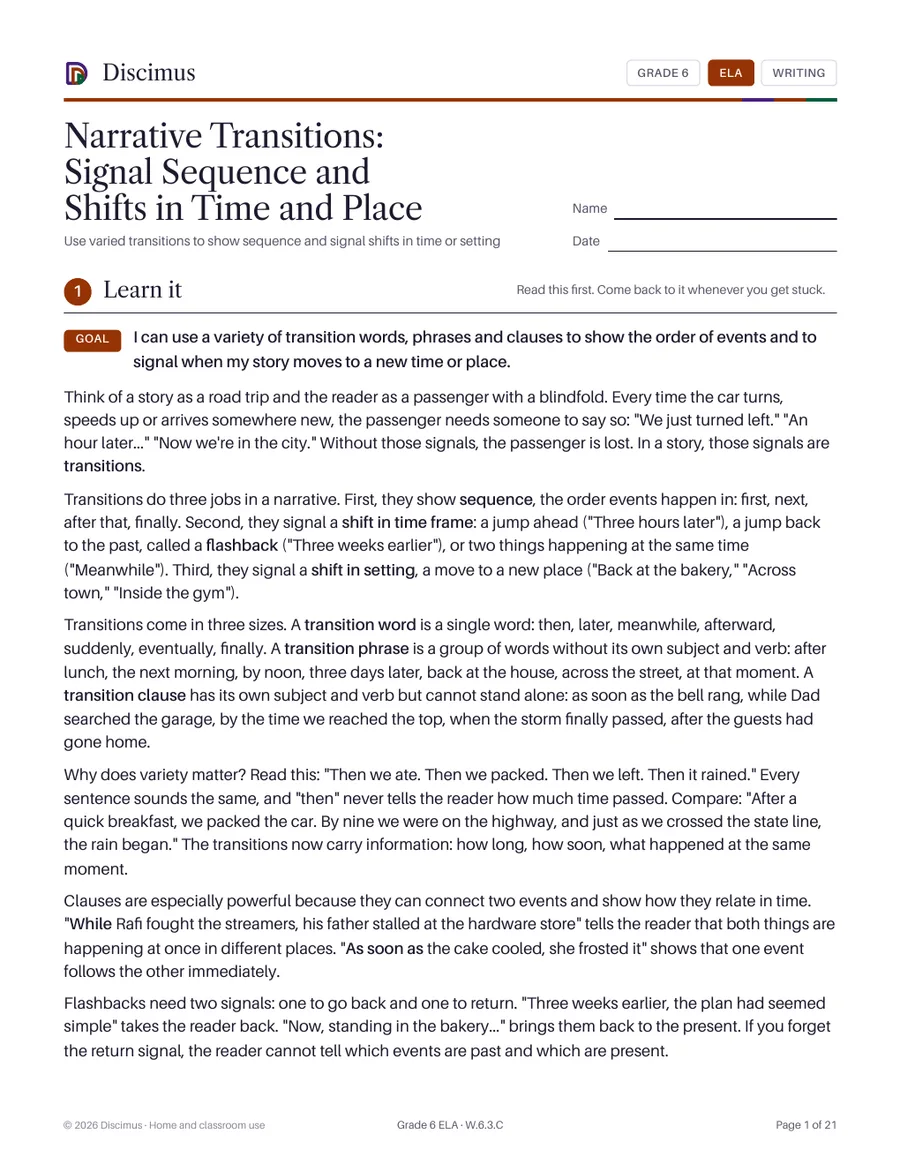
    Narrative Transitions: Signal Sequence and Shifts in Time and Place

    Use varied transitions to show sequence and signal shifts in time or setting
  • ELAGrade 6

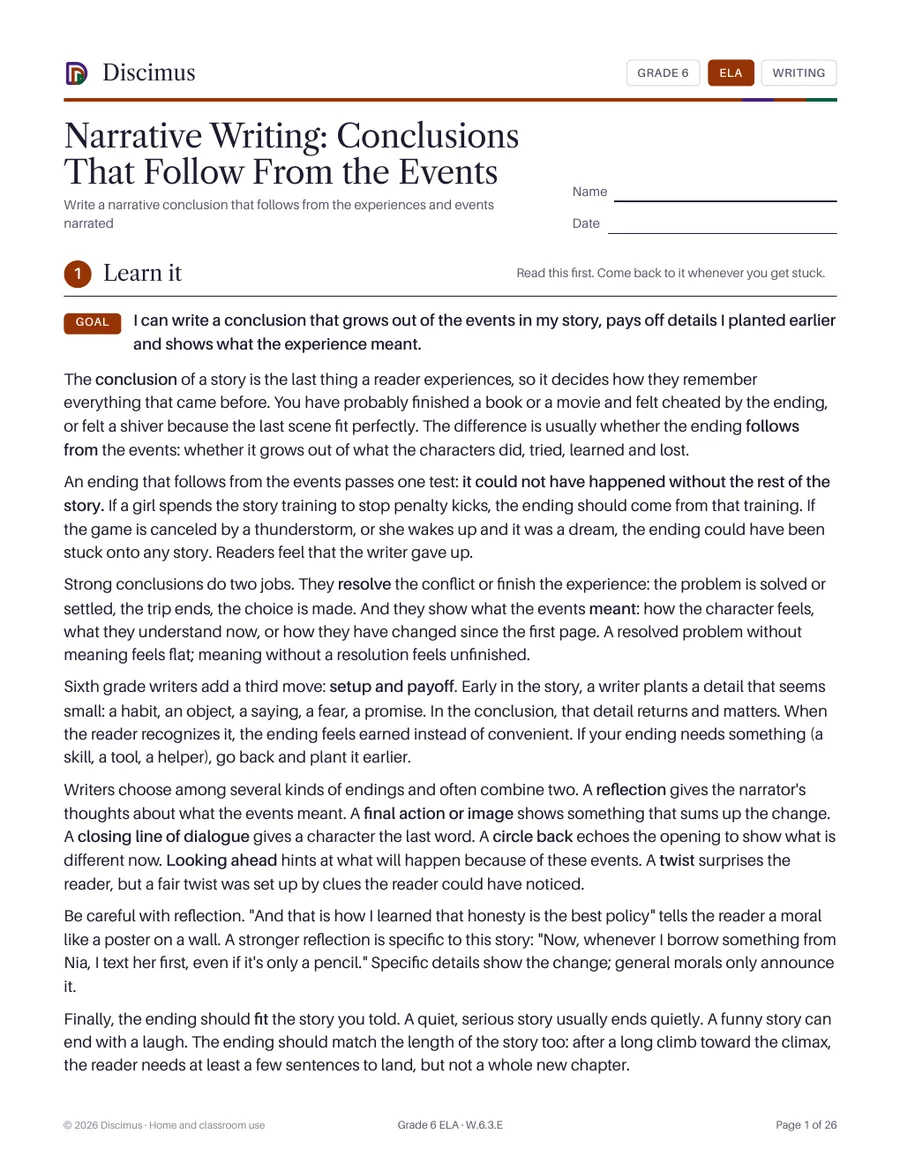
    Narrative Writing: Conclusions That Follow From the Events

    Write a narrative conclusion that follows from the experiences and events narrated
  • ELAGrade 6

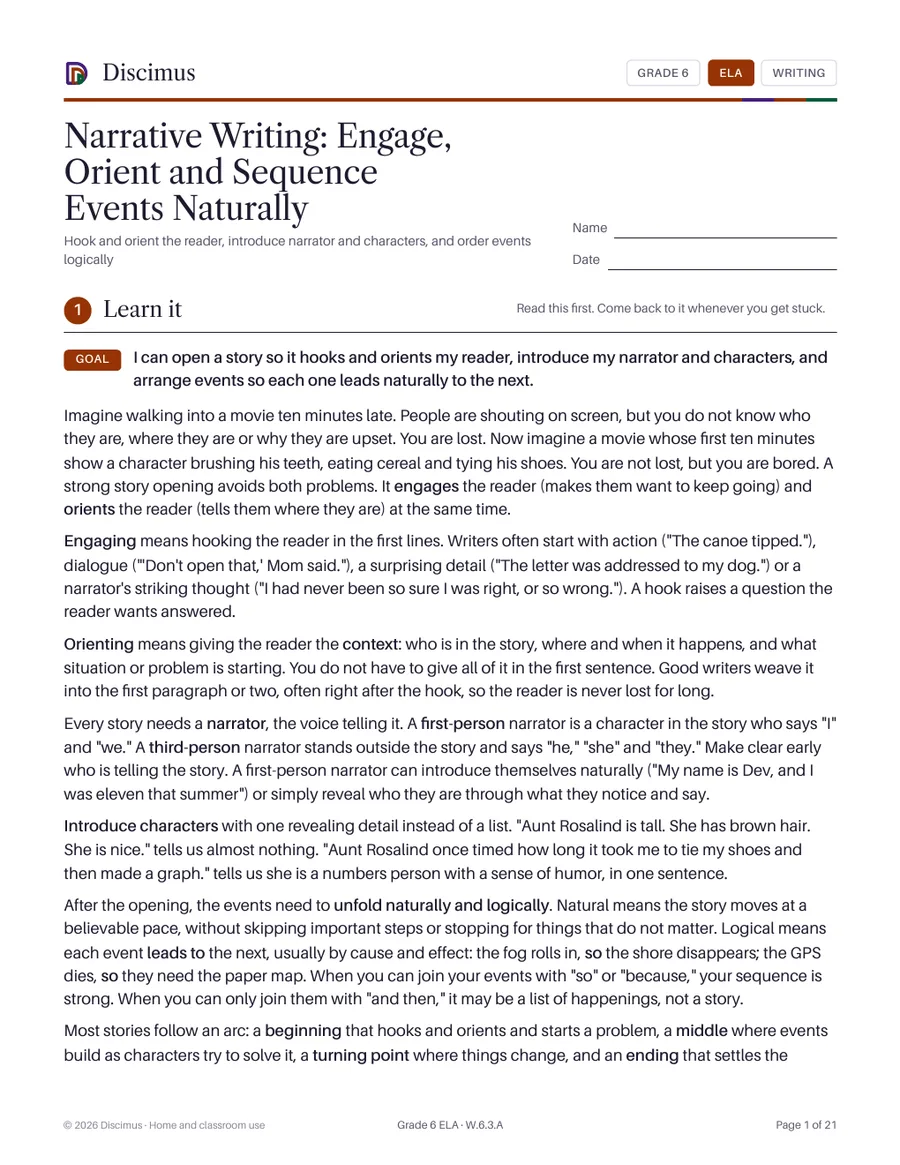
    Narrative Writing: Engage, Orient and Sequence Events Naturally

    Hook and orient the reader, introduce narrator and characters, and order events logically
  • ELAGrade 6

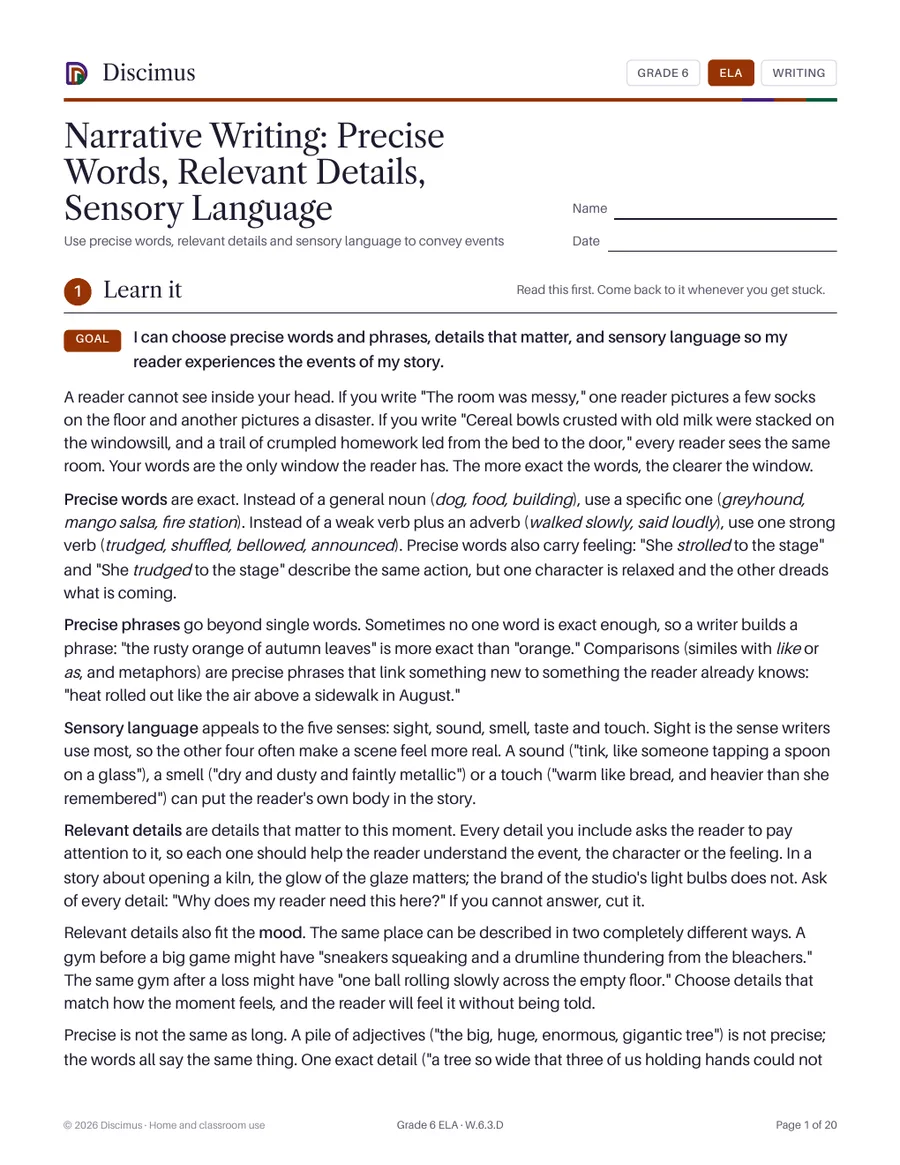
    Narrative Writing: Precise Words, Relevant Details, Sensory Language

    Use precise words, relevant details and sensory language to convey events
  • ELAGrade 6

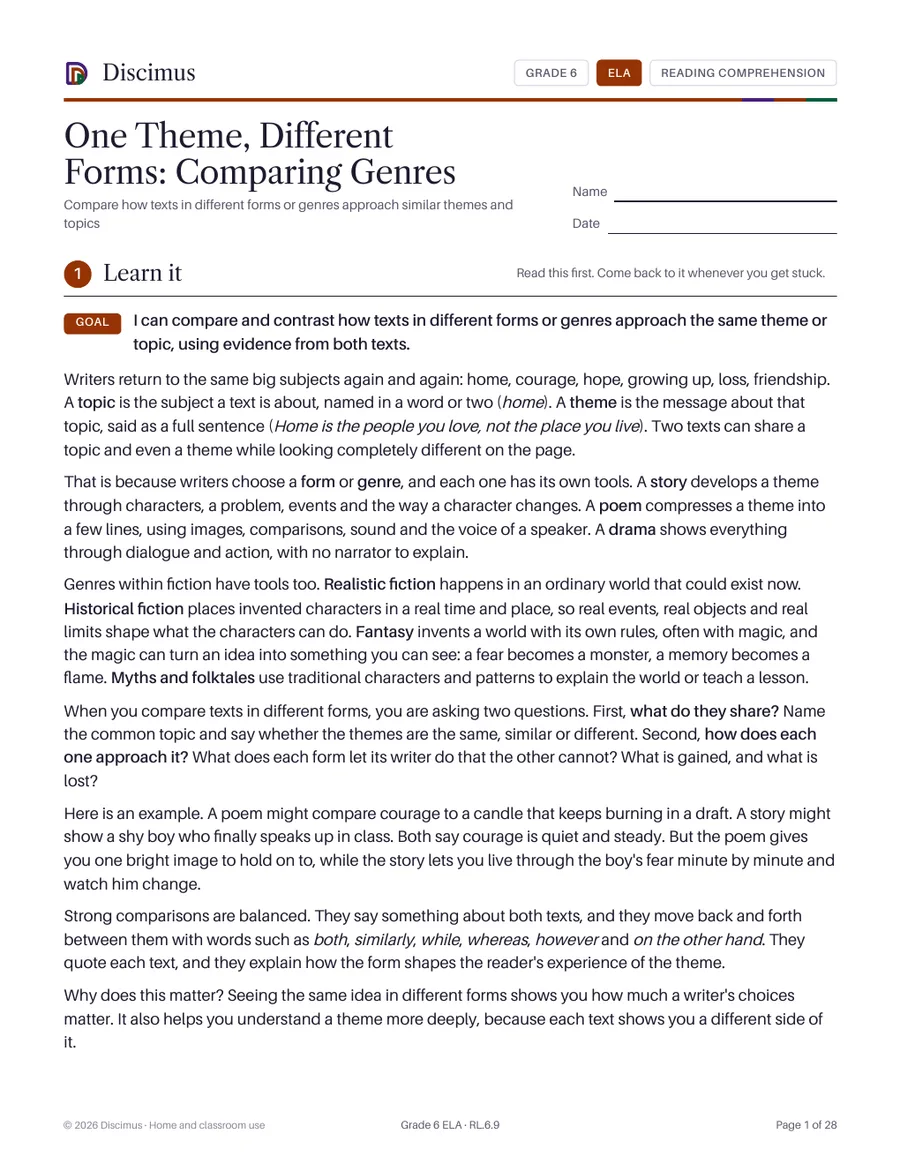
    One Theme, Different Forms: Comparing Genres

    Compare how texts in different forms or genres approach similar themes and topics
  • ELAGrade 6

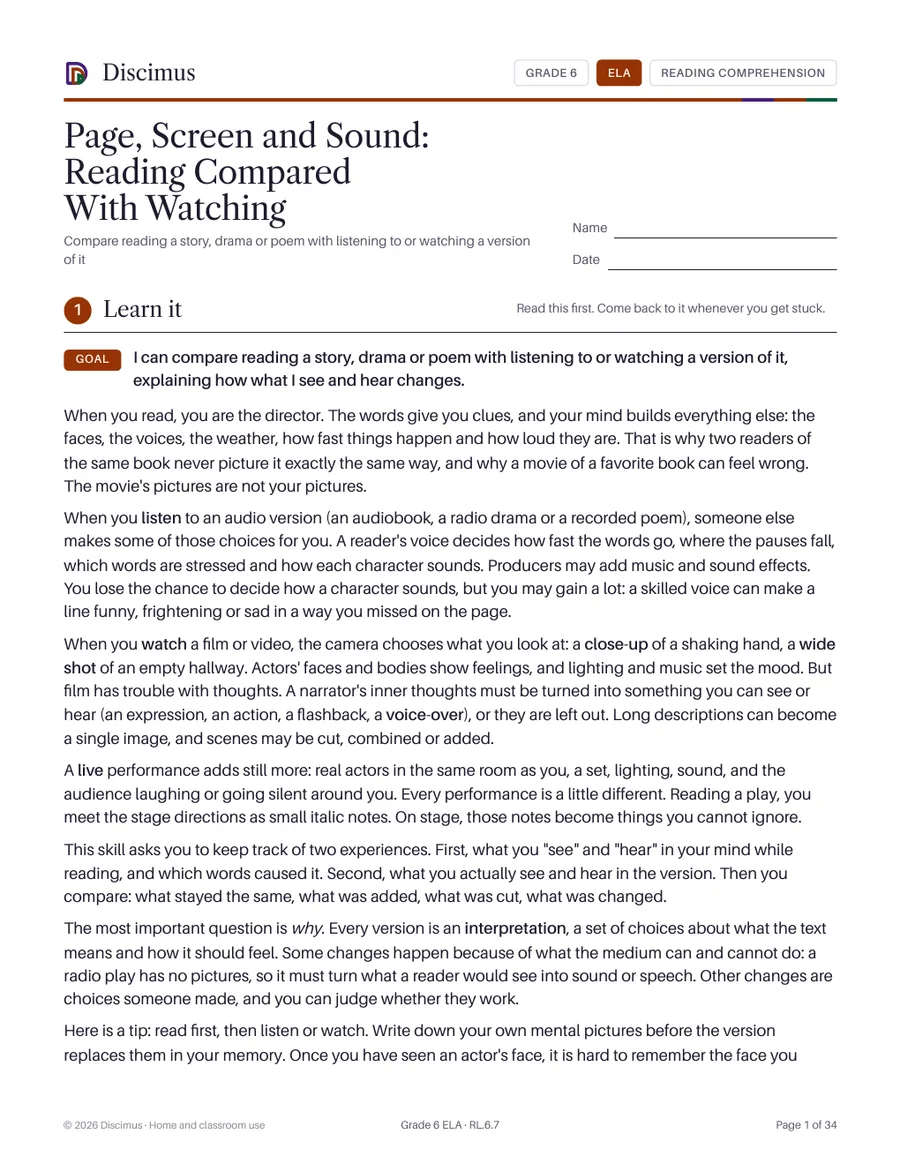
    Page, Screen and Sound: Reading Compared With Watching

    Compare reading a story, drama or poem with listening to or watching a version of it
  • ELAGrade 6

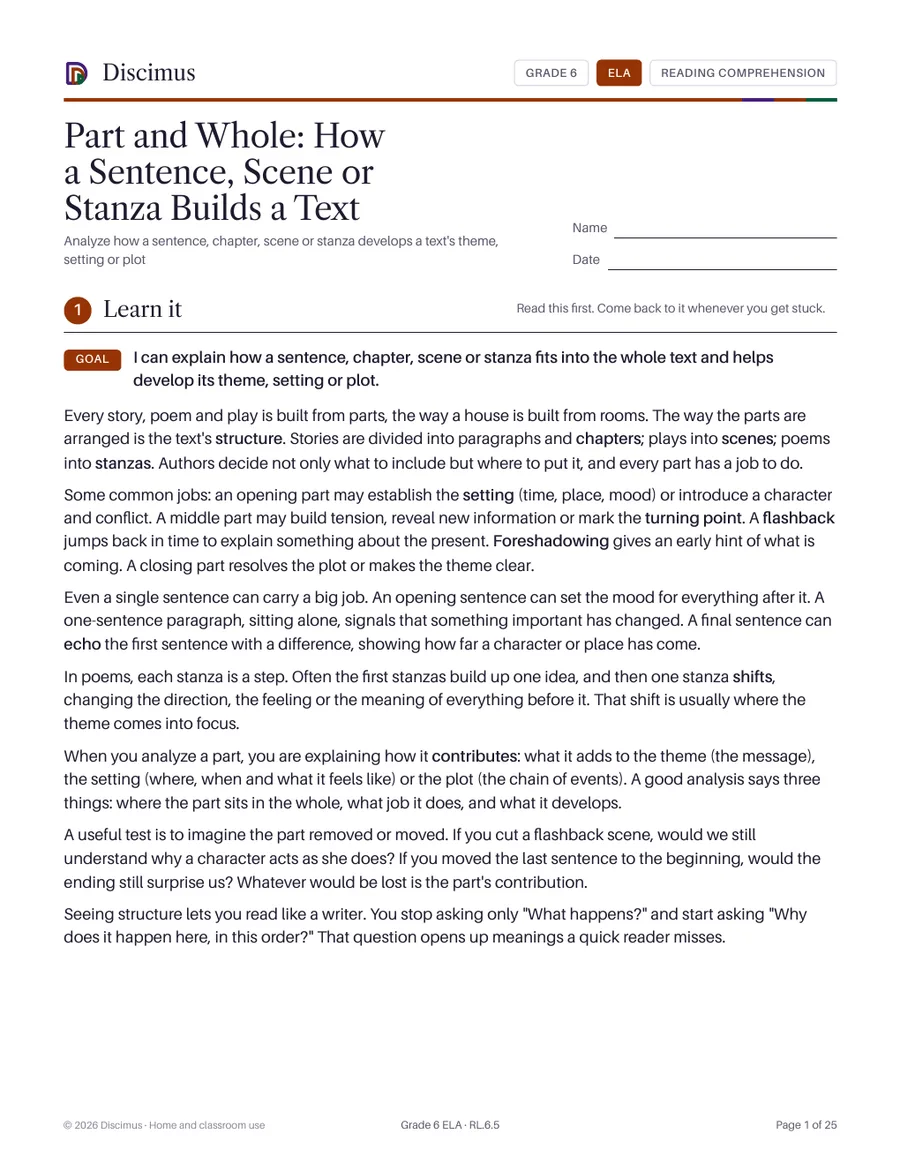
    Part and Whole: How a Sentence, Scene or Stanza Builds a Text

    Analyze how a sentence, chapter, scene or stanza develops a text's theme, setting or plot
  • ELAGrade 6

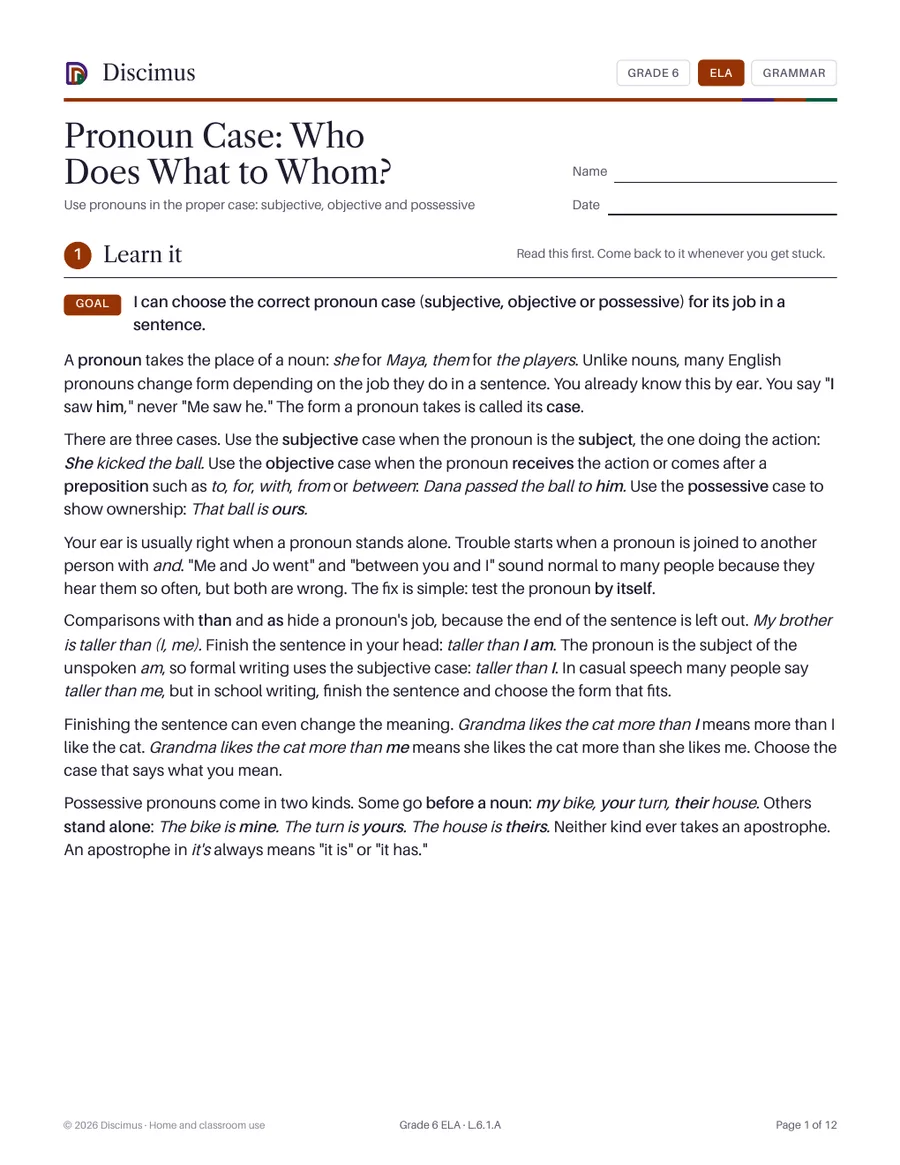
    Pronoun Case: Who Does What to Whom?

    Use pronouns in the proper case: subjective, objective and possessive
  • ELAGrade 6

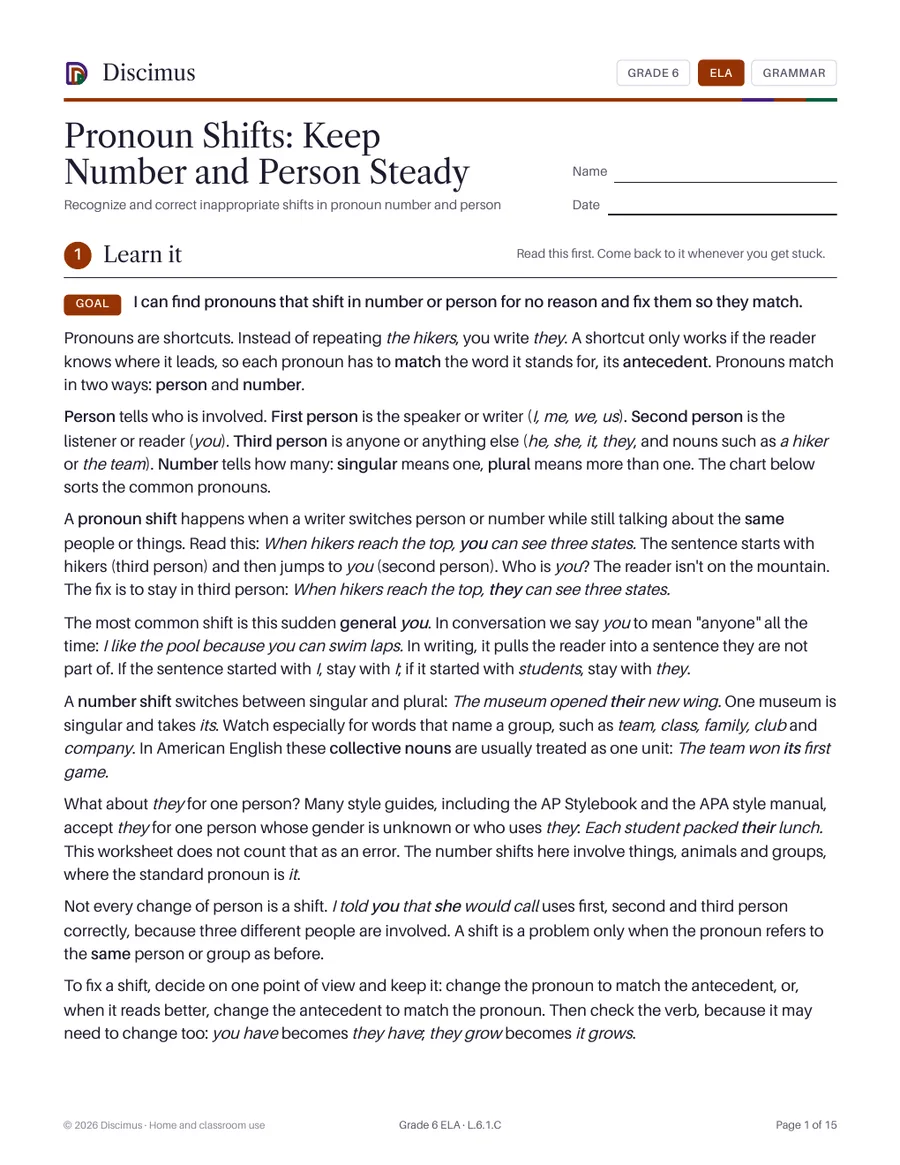
    Pronoun Shifts: Keep Number and Person Steady

    Recognize and correct inappropriate shifts in pronoun number and person
  • ELAGrade 6

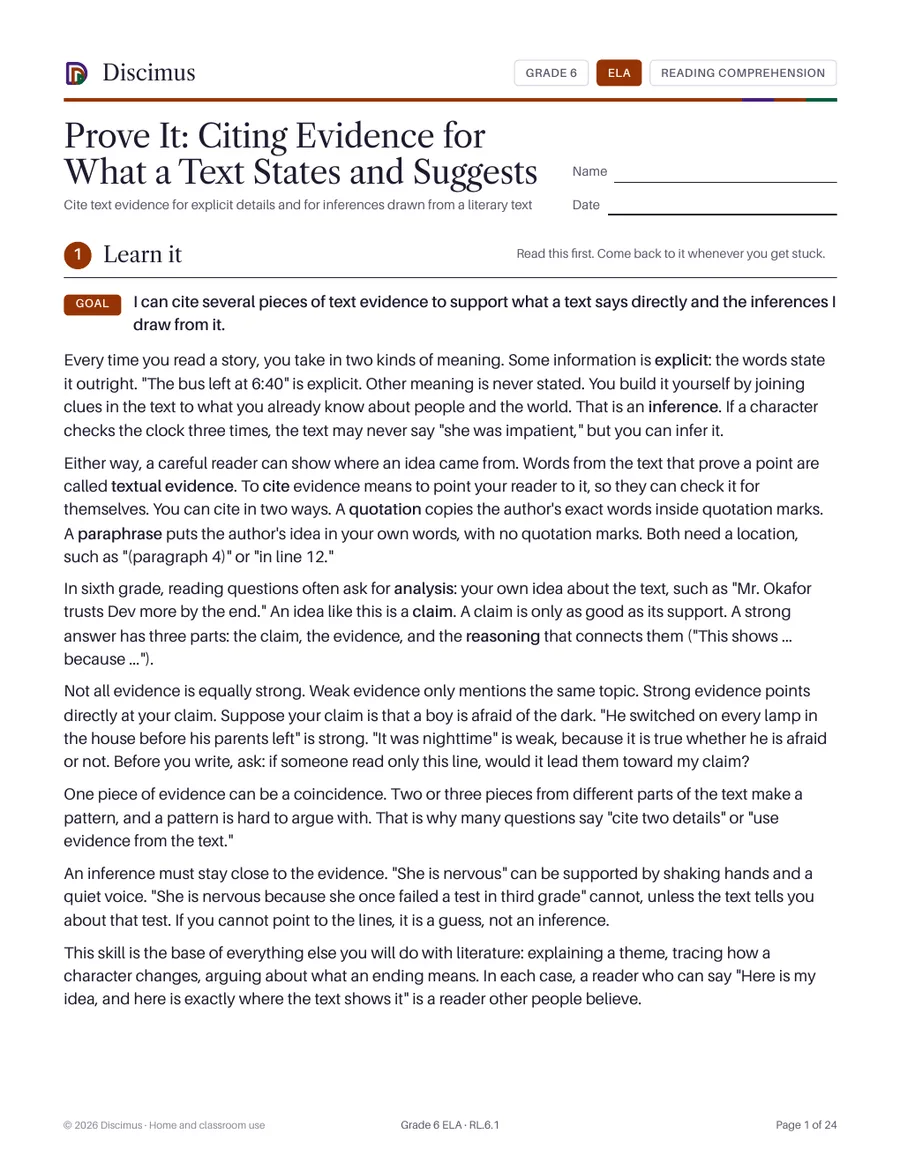
    Prove It: Citing Evidence for What a Text States and Suggests

    Cite text evidence for explicit details and for inferences drawn from a literary text
  • ELAGrade 6

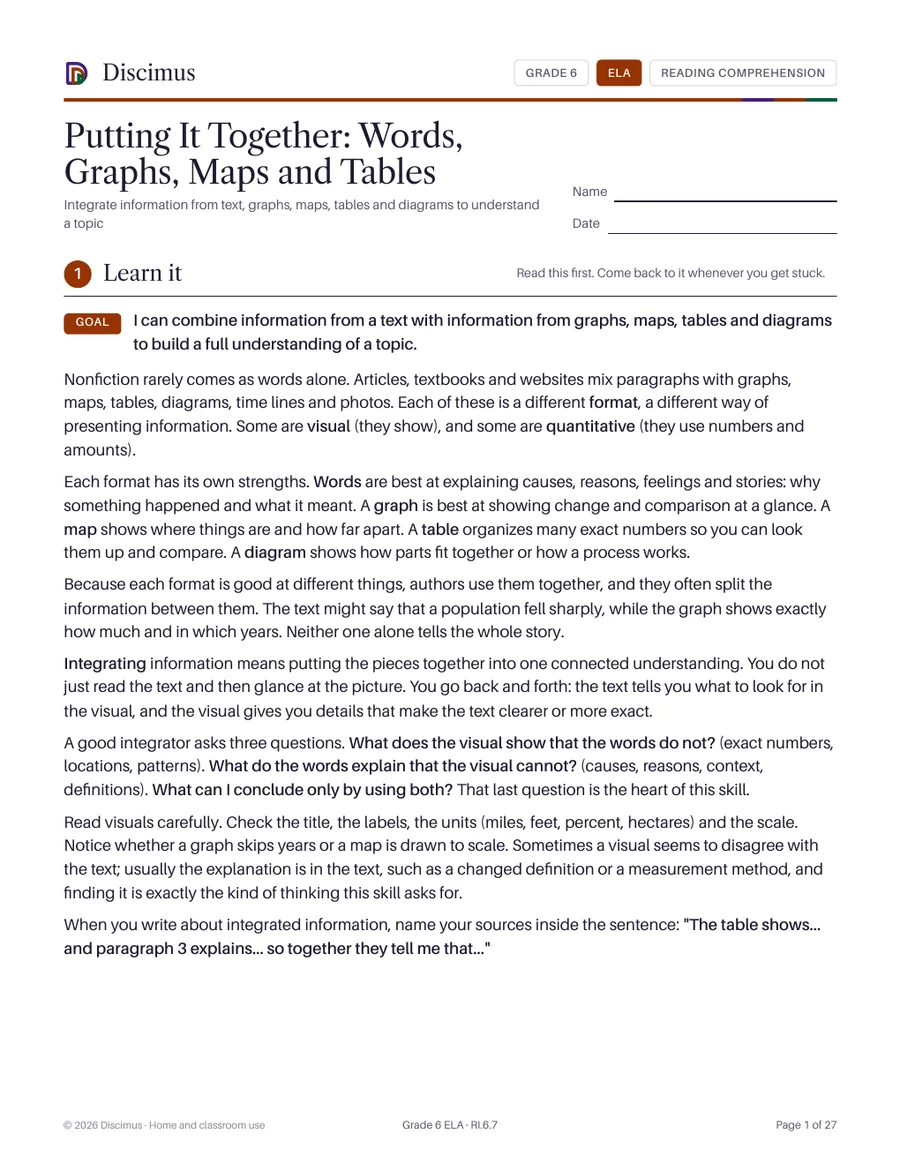
    Putting It Together: Words, Graphs, Maps and Tables

    Integrate information from text, graphs, maps, tables and diagrams to understand a topic
  • ELAGrade 6

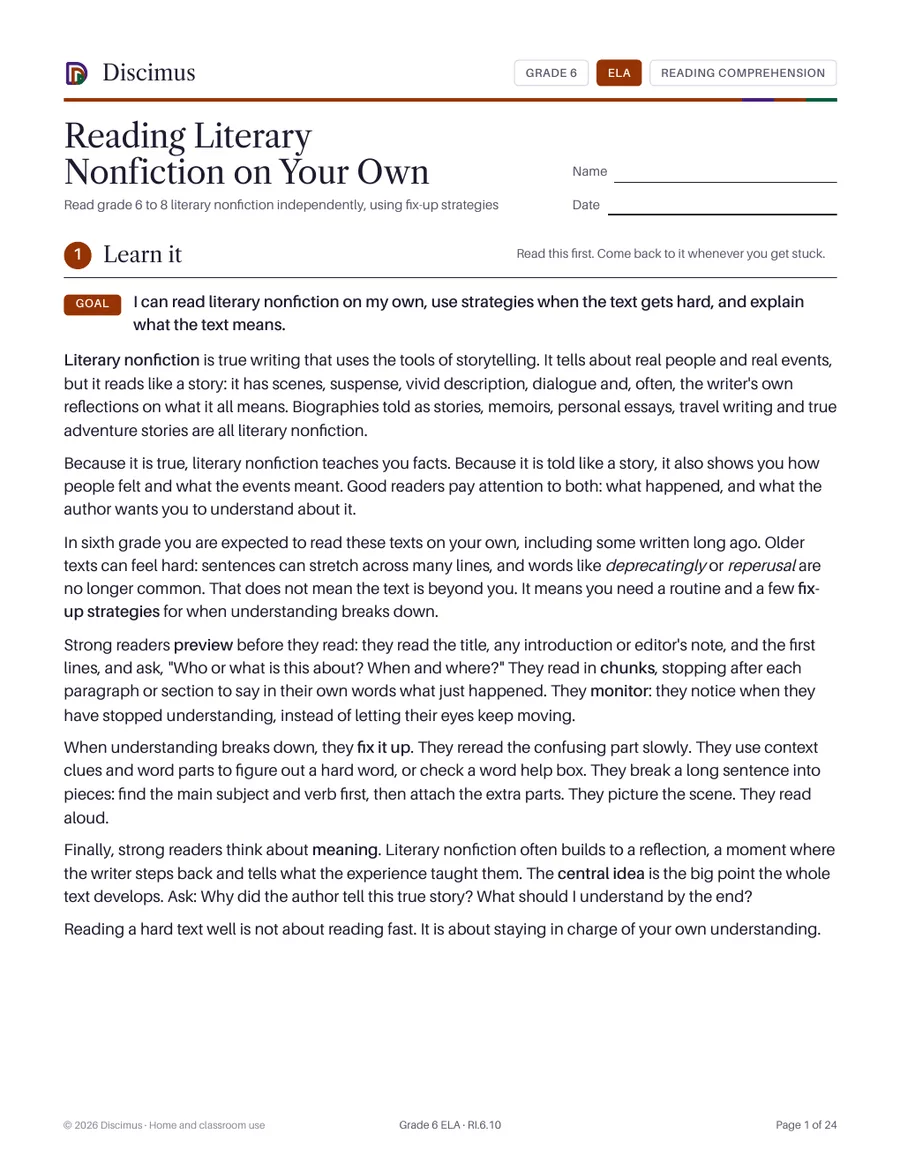
    Reading Literary Nonfiction on Your Own

    Read grade 6 to 8 literary nonfiction independently, using fix-up strategies
  • ELAGrade 6

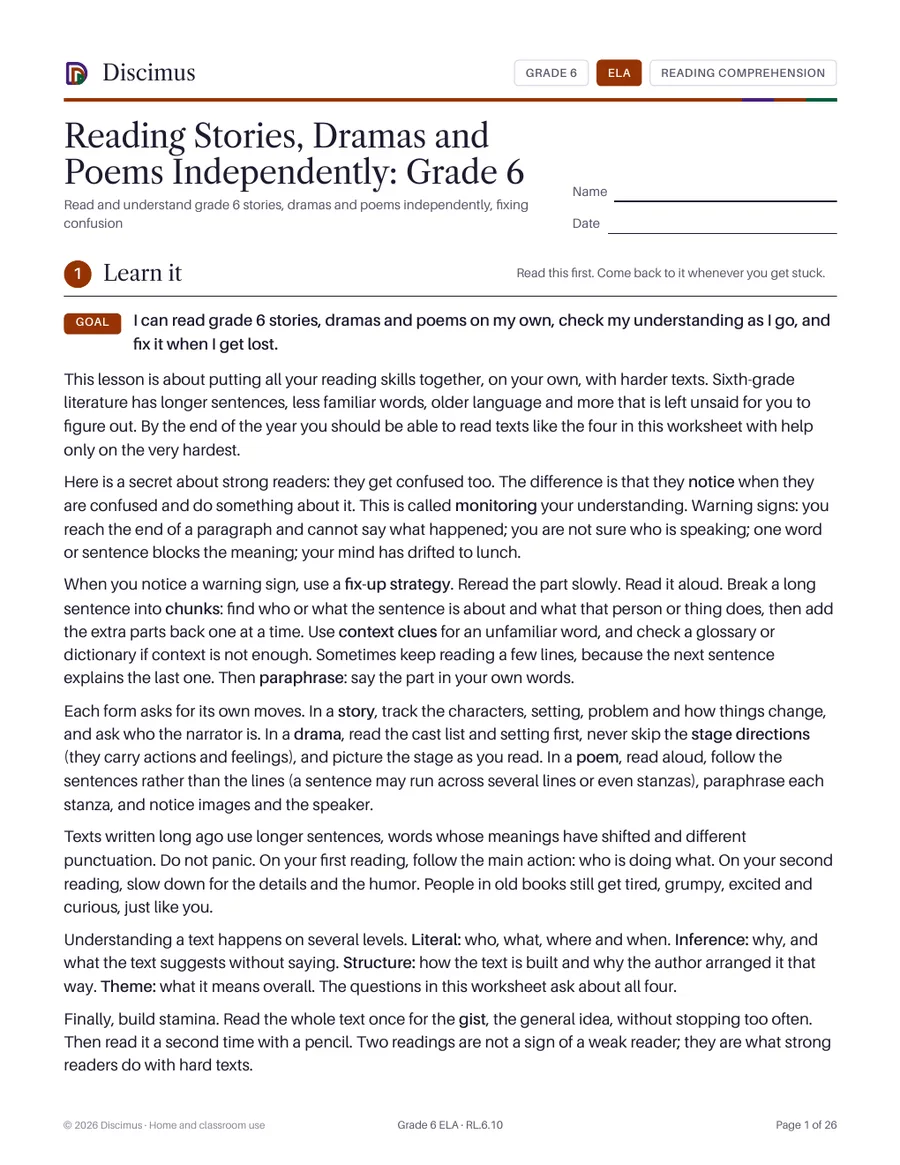
    Reading Stories, Dramas and Poems Independently: Grade 6

    Read and understand grade 6 stories, dramas and poems independently, fixing confusion
  • ELAGrade 6

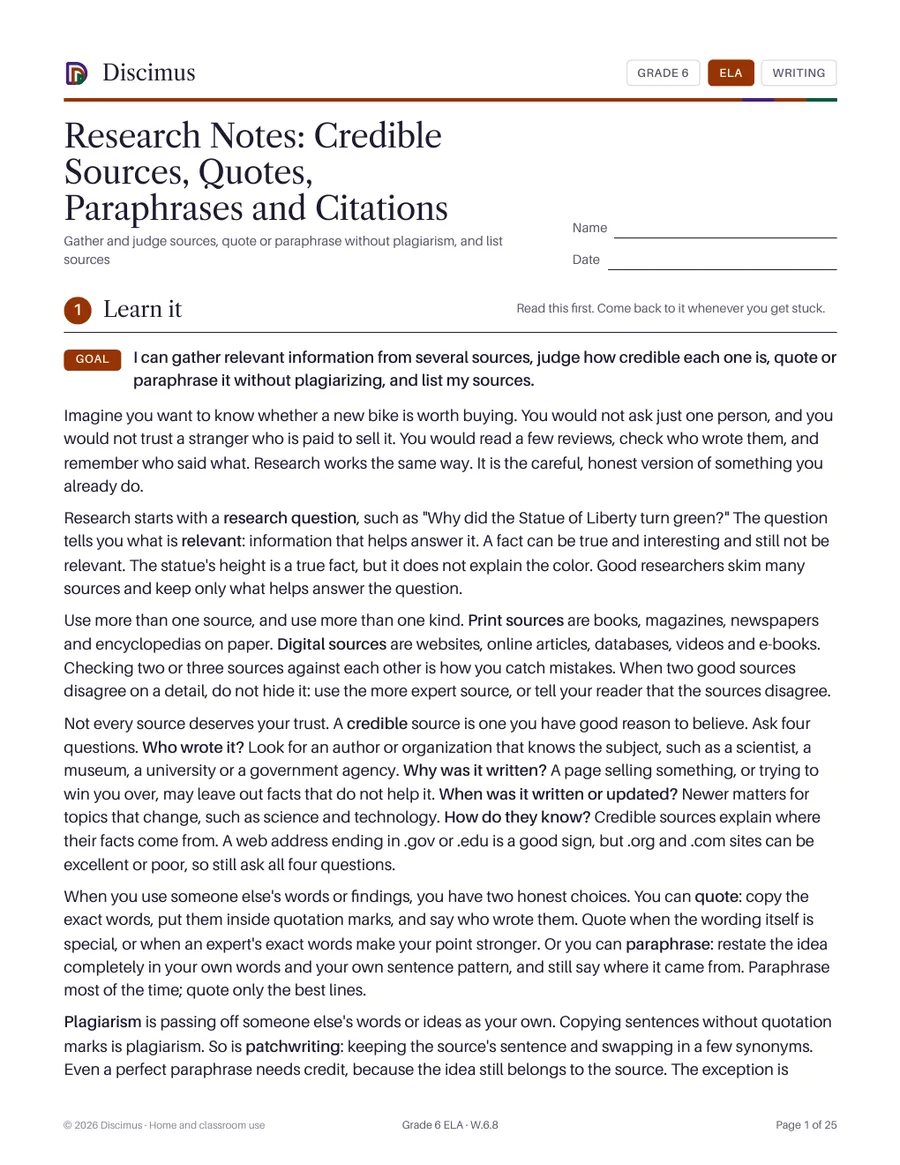
    Research Notes: Credible Sources, Quotes, Paraphrases and Citations

    Gather and judge sources, quote or paraphrase without plagiarism, and list sources
  • ELAGrade 6

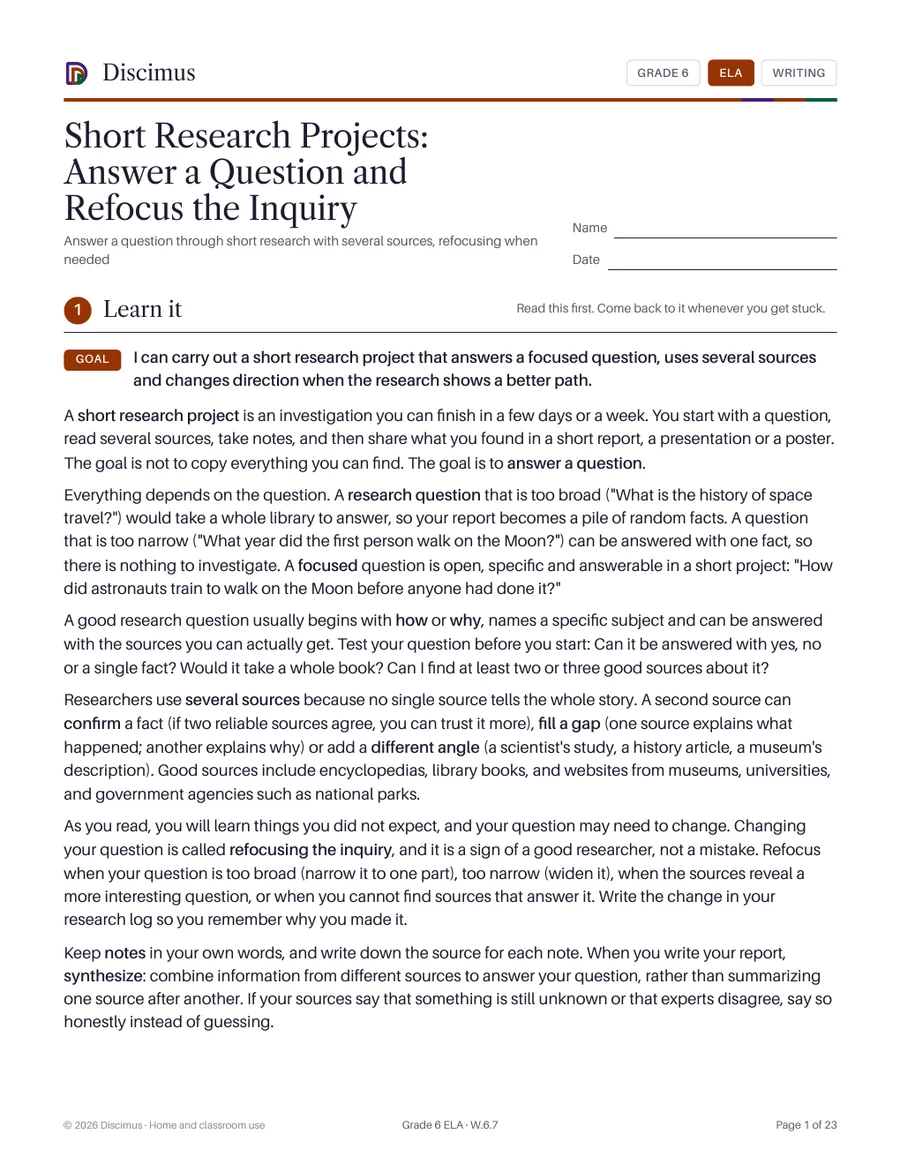
    Short Research Projects: Answer a Question and Refocus the Inquiry

    Answer a question through short research with several sources, refocusing when needed
  • ELAGrade 6

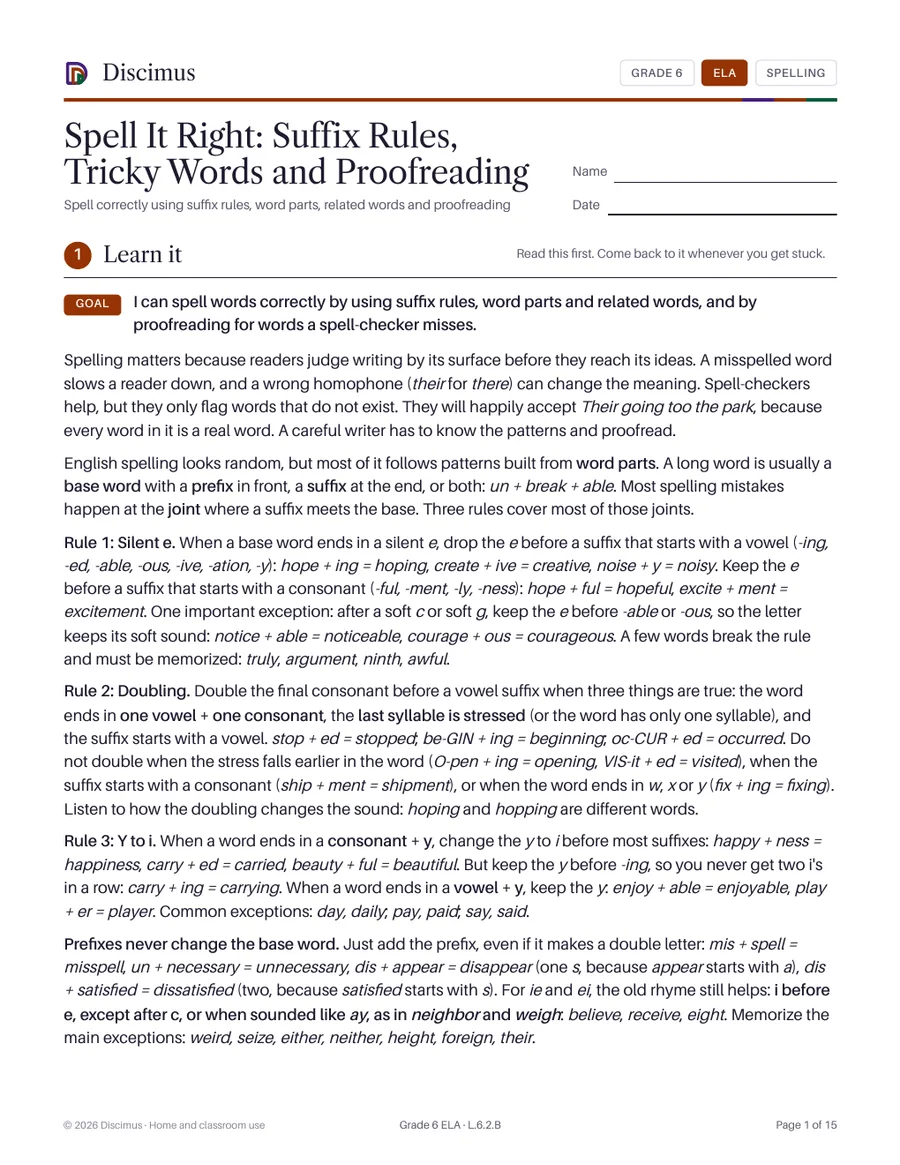
    Spell It Right: Suffix Rules, Tricky Words and Proofreading

    Spell correctly using suffix rules, word parts, related words and proofreading
  • ELAGrade 6

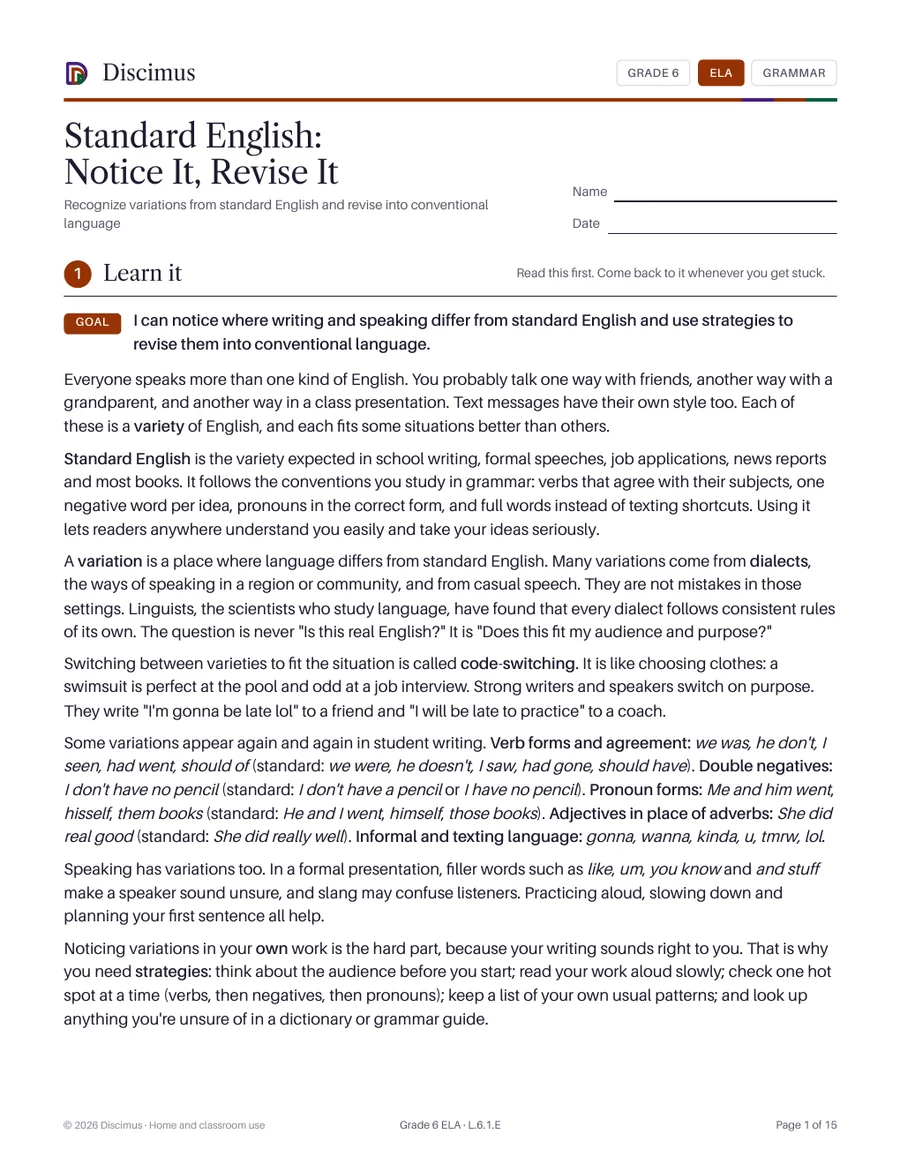
    Standard English: Notice It, Revise It

    Recognize variations from standard English and revise into conventional language
  • ELAGrade 6

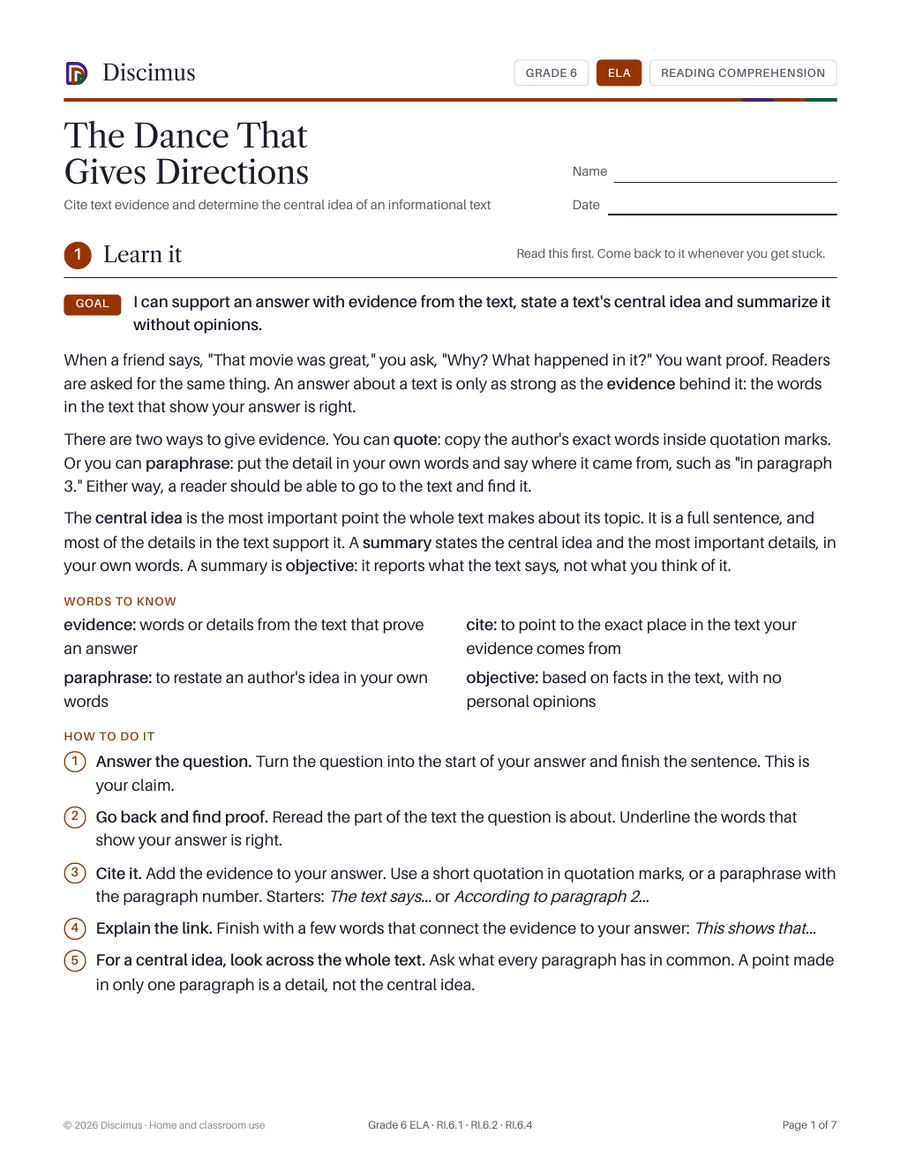
    The Dance That Gives Directions

    Cite text evidence and determine the central idea of an informational text
  • ELAGrade 6

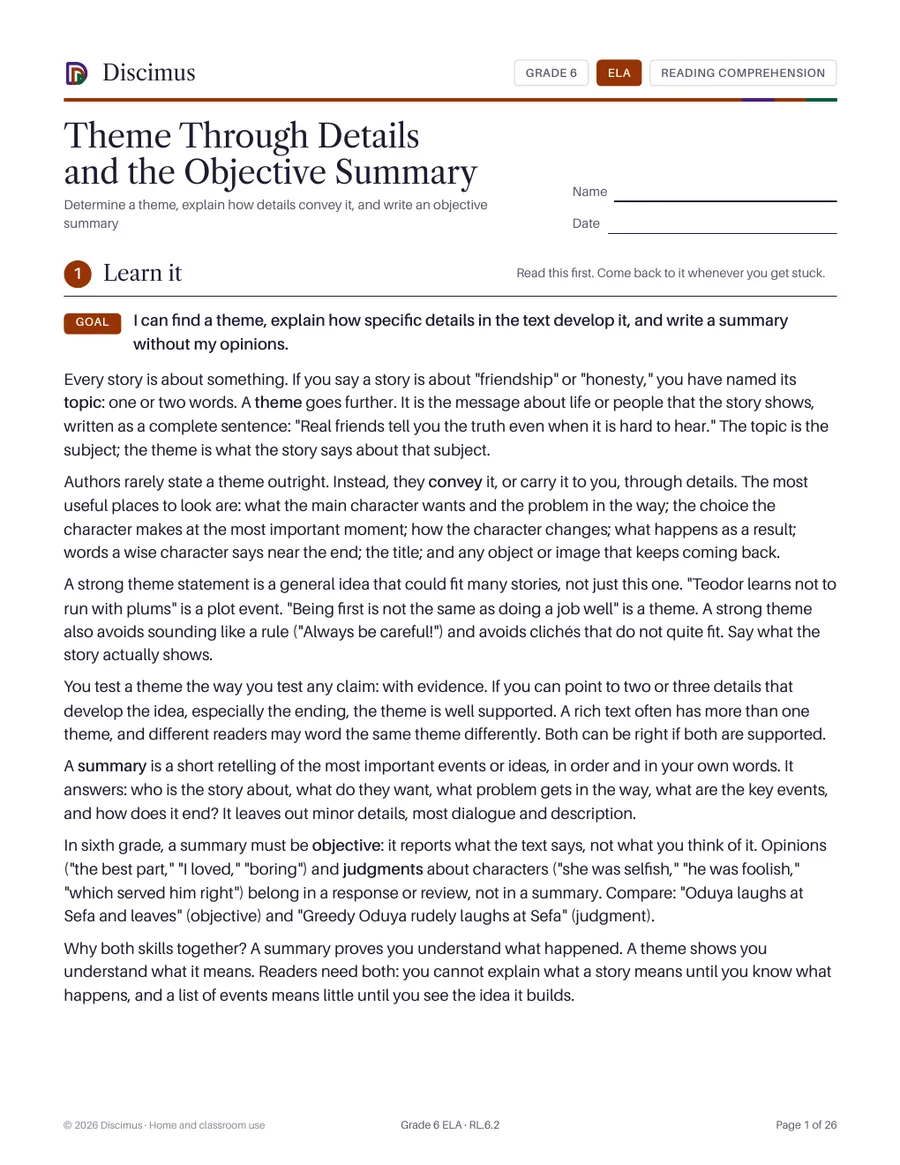
    Theme Through Details and the Objective Summary

    Determine a theme, explain how details convey it, and write an objective summary
  • ELAGrade 6

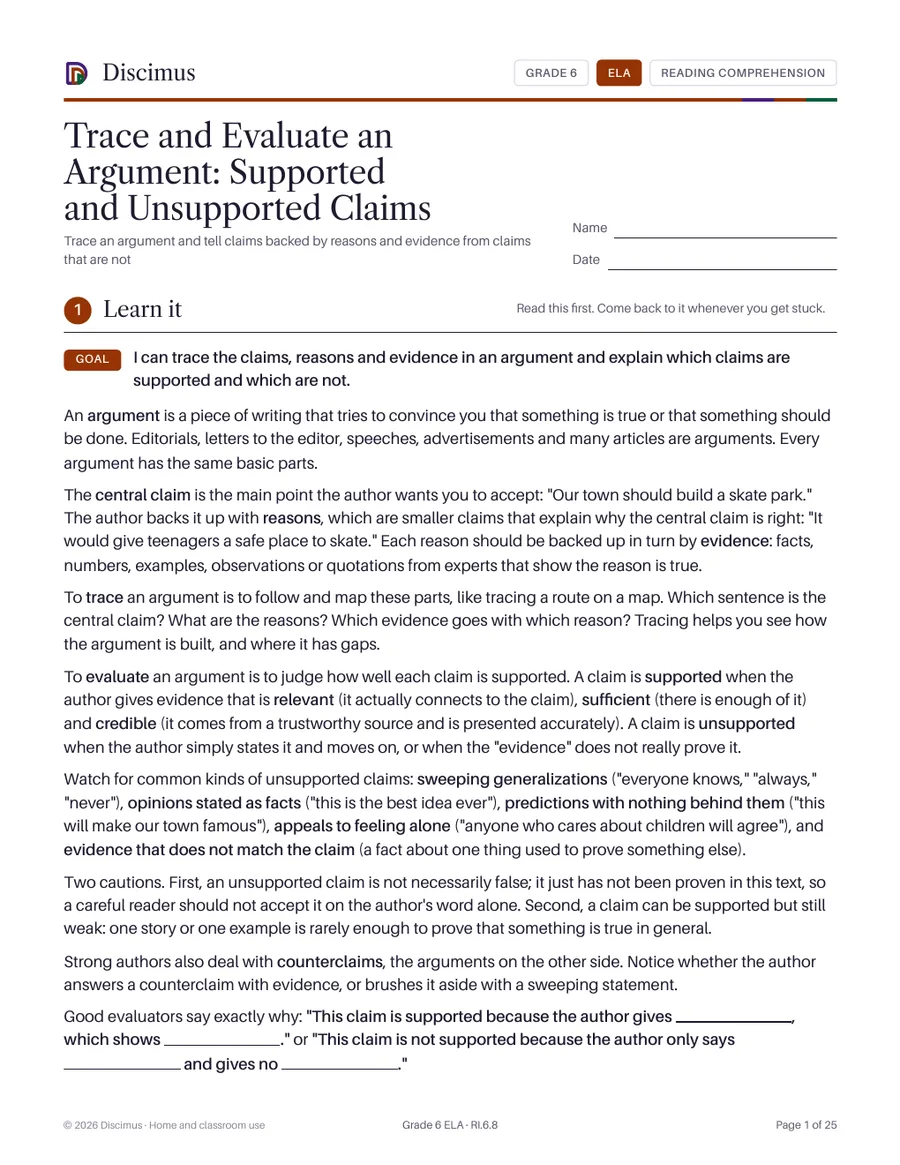
    Trace and Evaluate an Argument: Supported and Unsupported Claims

    Trace an argument and tell claims backed by reasons and evidence from claims that are not
  • ELAGrade 6

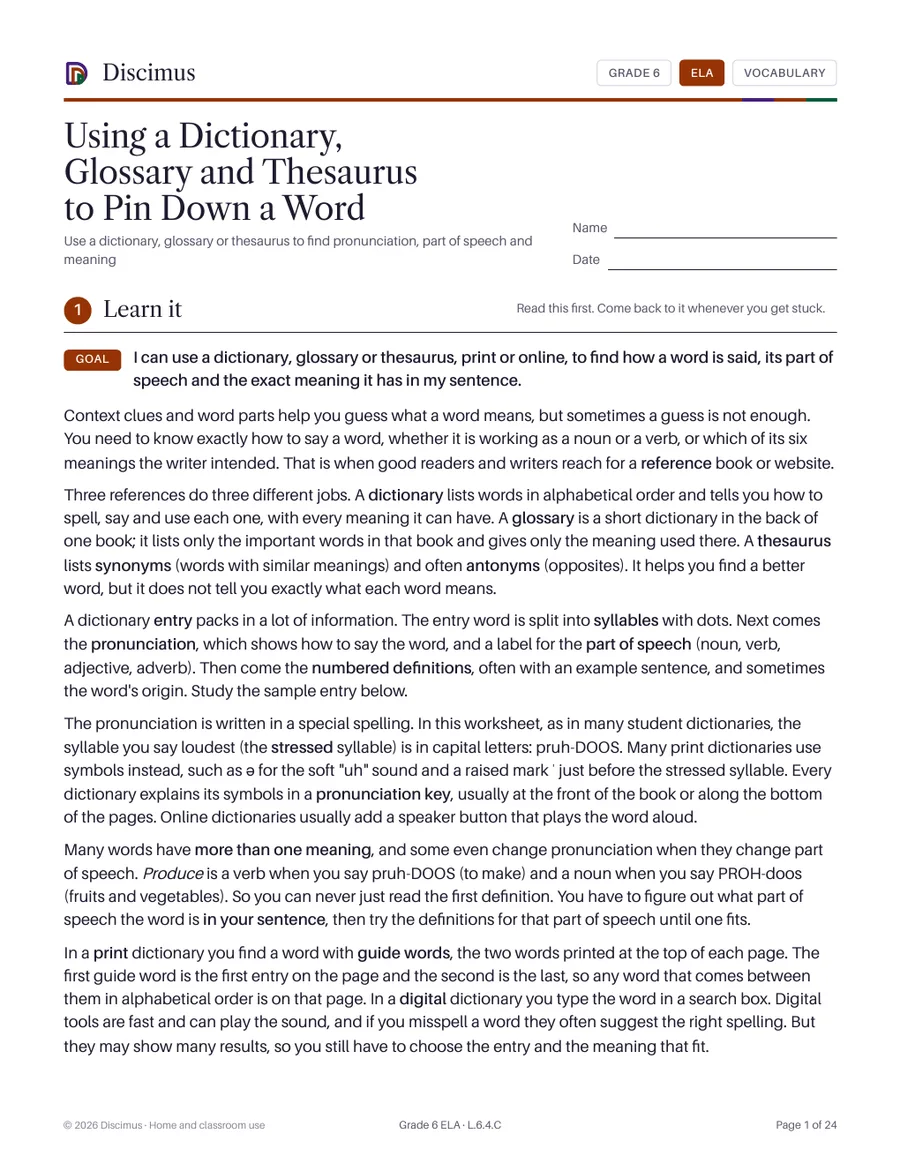
    Using a Dictionary, Glossary and Thesaurus to Pin Down a Word

    Use a dictionary, glossary or thesaurus to find pronunciation, part of speech and meaning
  • ELAGrade 6

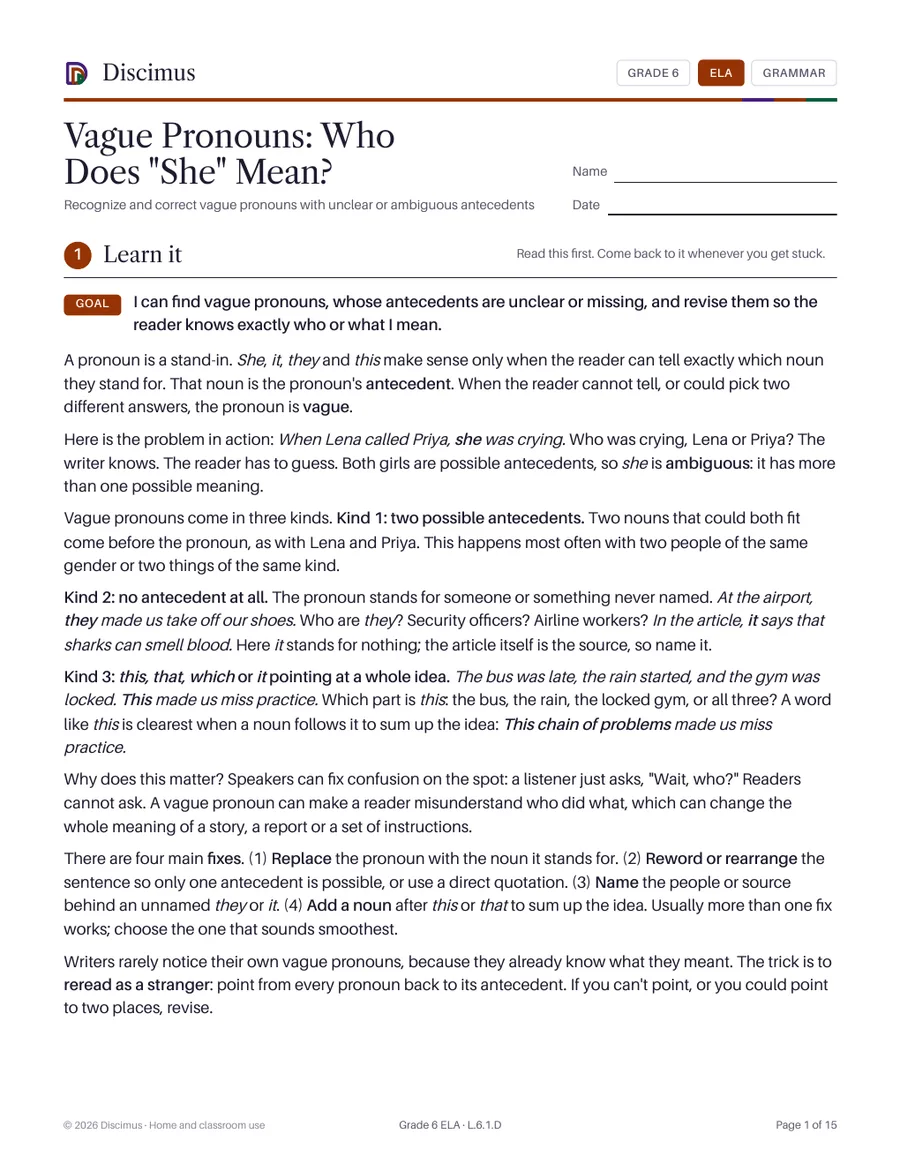
    Vague Pronouns: Who Does "She" Mean?

    Recognize and correct vague pronouns with unclear or ambiguous antecedents
  • ELAGrade 6

    Vary Your Sentences: Length, Openings and Structure

    Vary sentence length, structure and openings to show meaning and keep readers interested
  • ELAGrade 6

    What's the Big Idea? Central Idea and Objective Summary

    Determine a central idea, explain how details convey it and write an objective summary
  • ELAGrade 6

    Word Choice in Literature: Figurative Meaning, Connotation and Tone

    Determine figurative and connotative meanings and analyze how word choice shapes tone
  • ELAGrade 6

    Word Relationships: Cause-Effect, Part-Whole, Item-Category

    Use cause/effect, part/whole and item/category relationships to understand words
  • ELAGrade 6

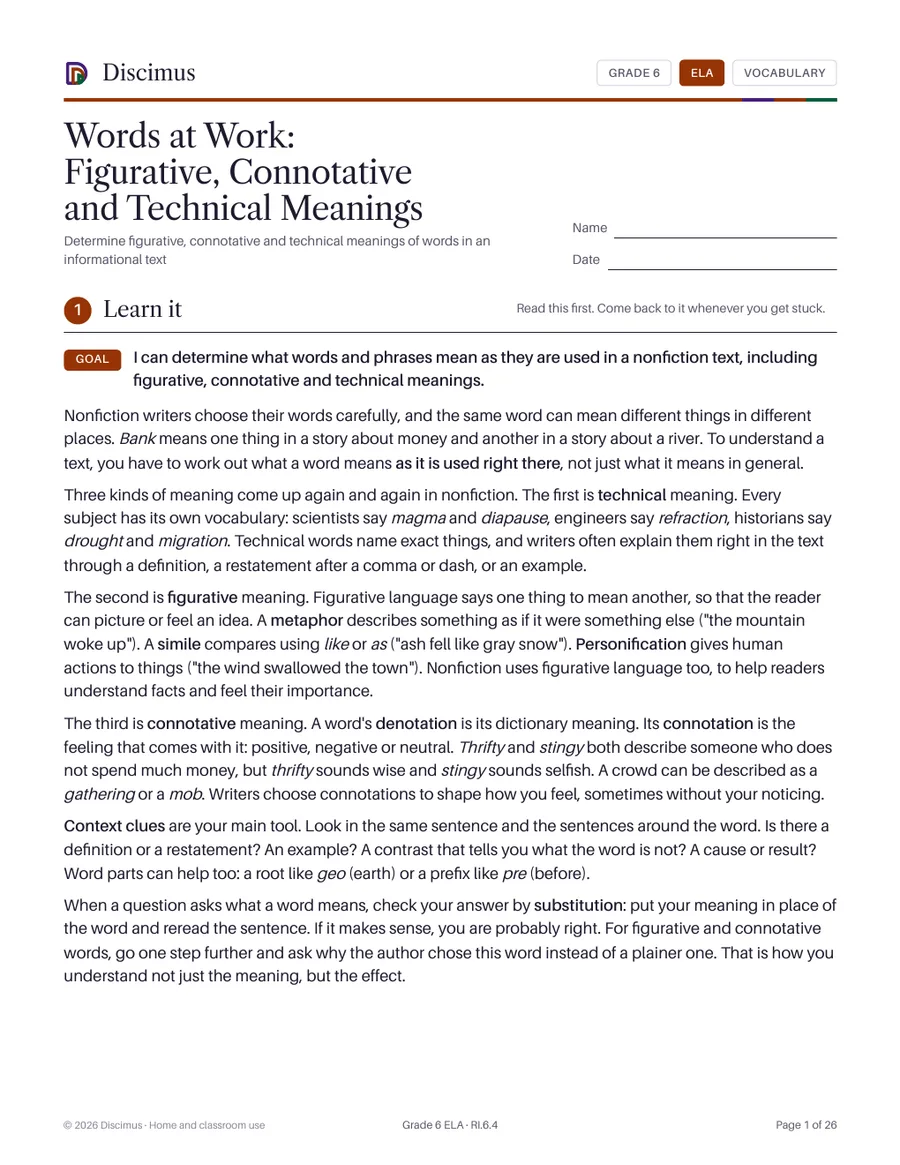
    Words at Work: Figurative, Connotative and Technical Meanings

    Determine figurative, connotative and technical meanings of words in an informational text
  • ELAGrade 6

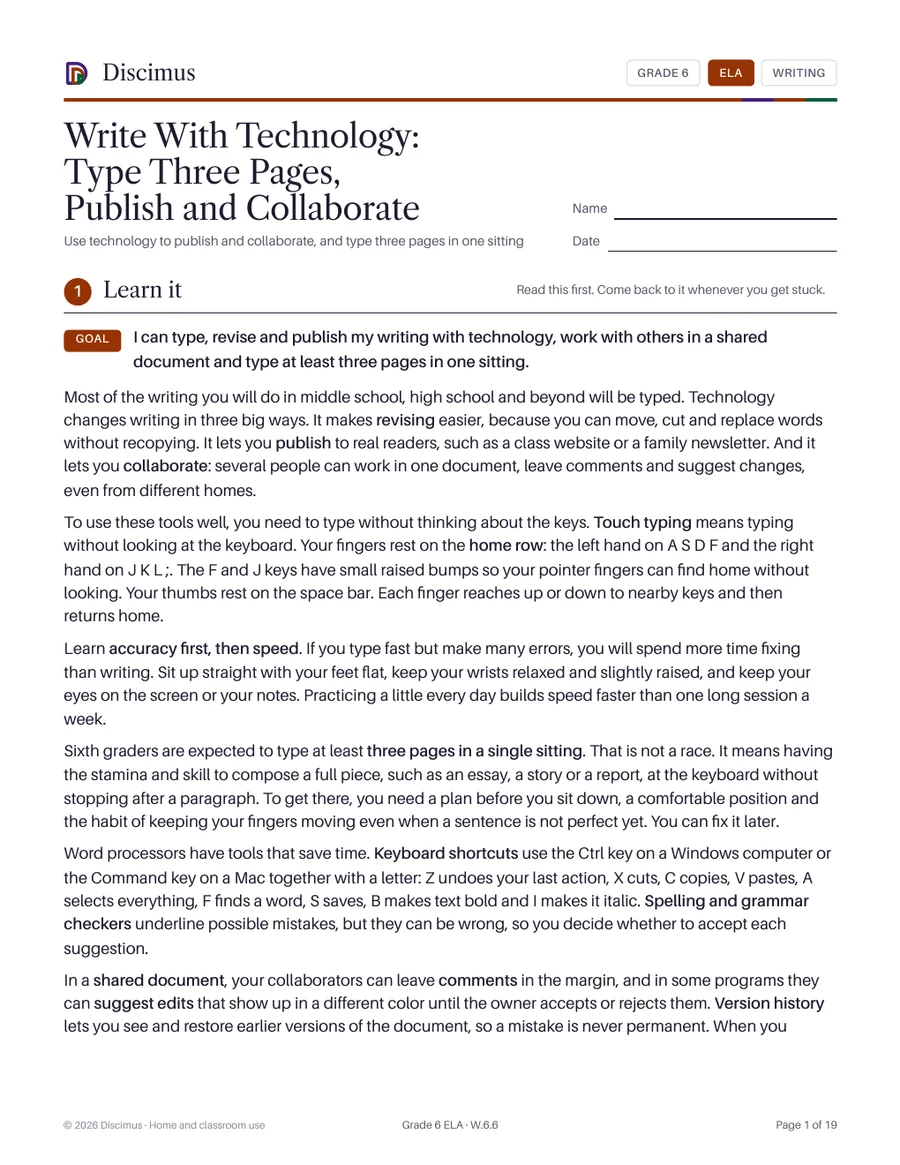
    Write With Technology: Type Three Pages, Publish and Collaborate

    Use technology to publish and collaborate, and type three pages in one sitting
  • ELAGrade 6

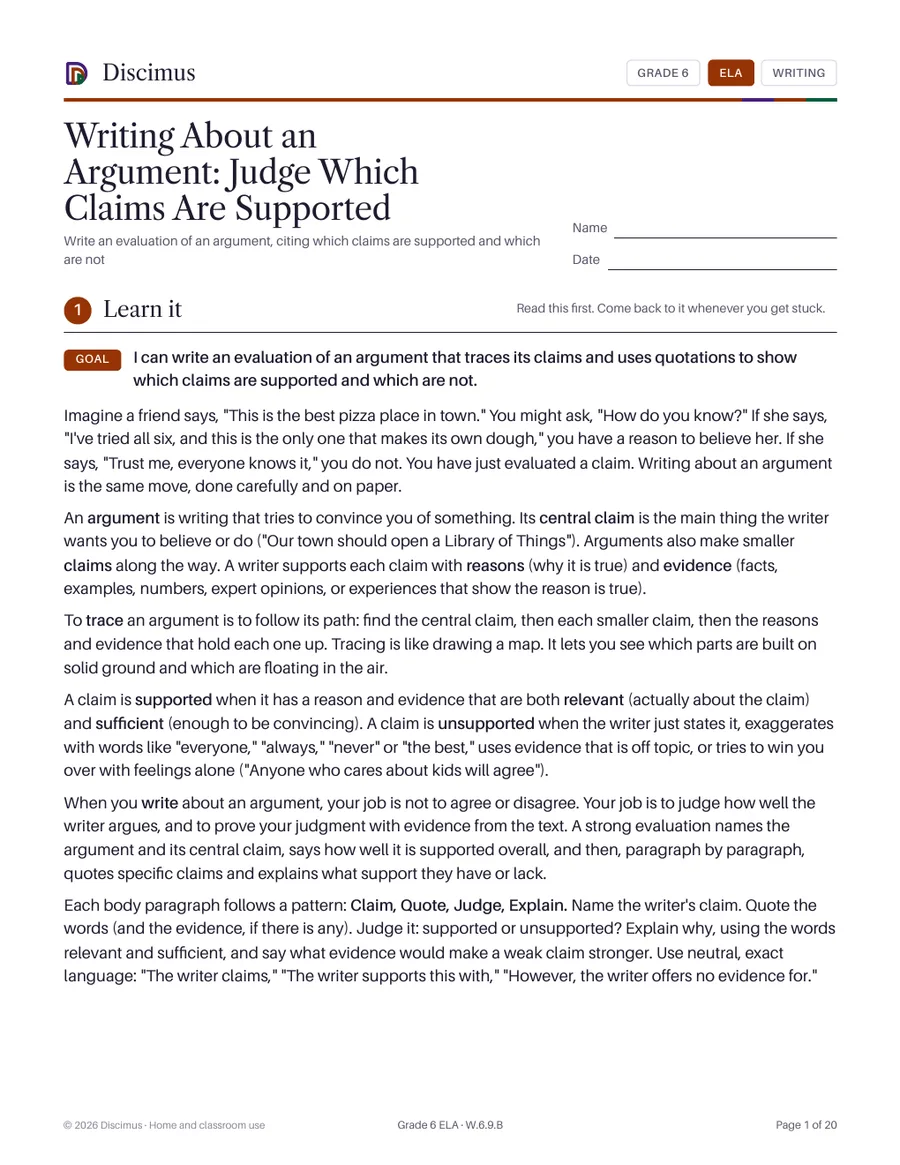
    Writing About an Argument: Judge Which Claims Are Supported

    Write an evaluation of an argument, citing which claims are supported and which are not
  • ELAGrade 6

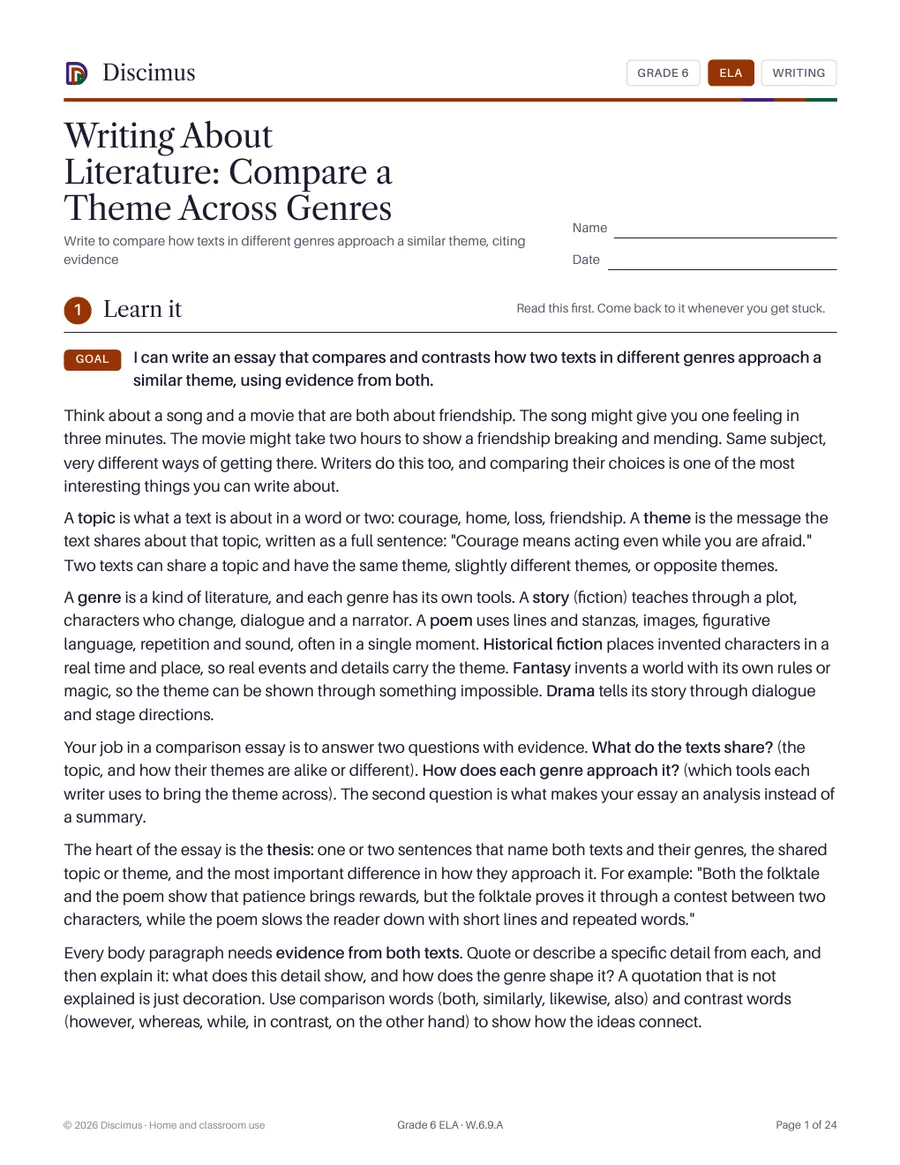
    Writing About Literature: Compare a Theme Across Genres

    Write to compare how texts in different genres approach a similar theme, citing evidence
  • ELAGrade 6

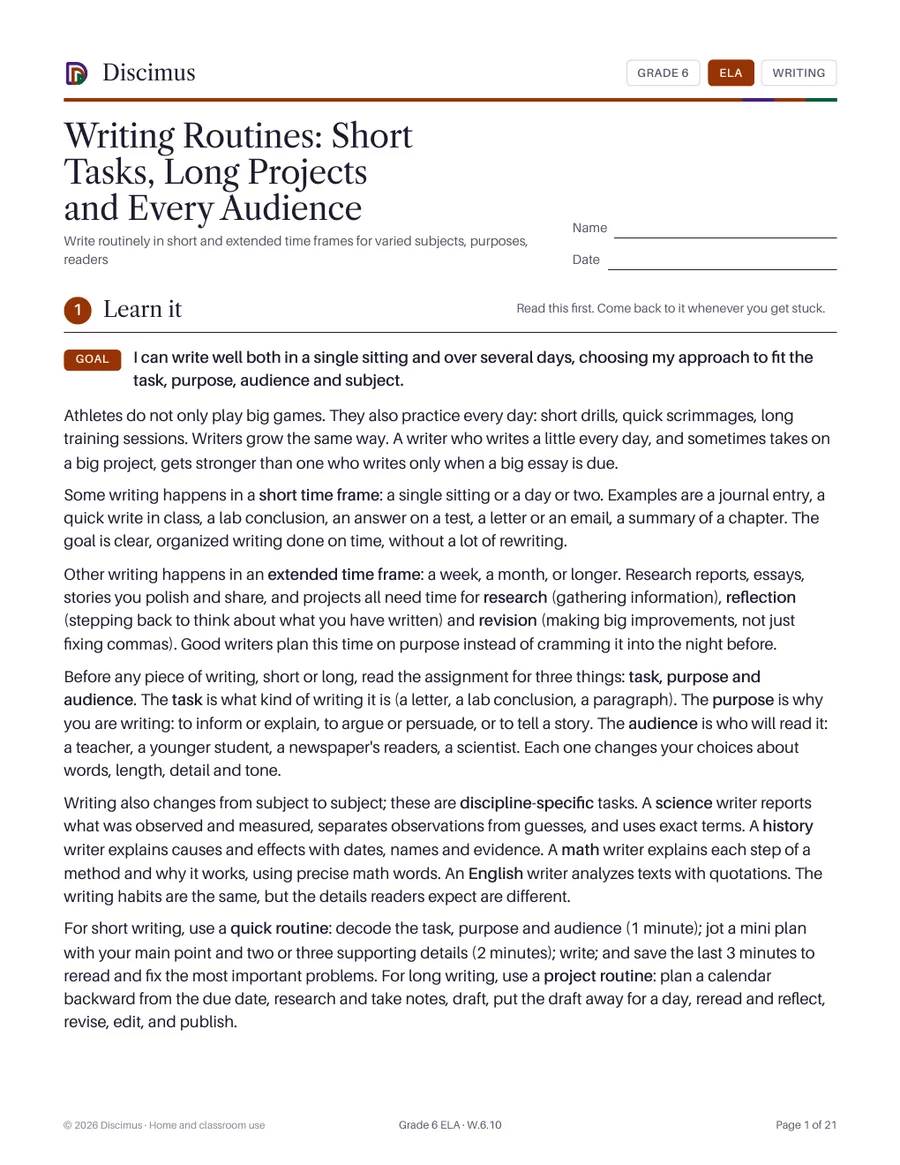
    Writing Routines: Short Tasks, Long Projects and Every Audience

    Write routinely in short and extended time frames for varied subjects, purposes, readers

Discimus

Docendo discimus. By teaching, we learn.

By age

  • Early Childhood
  • Elementary School
  • Middle School
  • High School
  • All grades

By subject

  • Math
  • English Language Arts
  • Science
  • Social Studies
  • Foreign Language
  • Technology

Discimus

  • Membership
  • Occasions
  • Standards
  • About
  • Contact

© 2026 Ceterum. All rights reserved. Worksheets are for home and single-classroom use.

  • Terms
  • Privacy