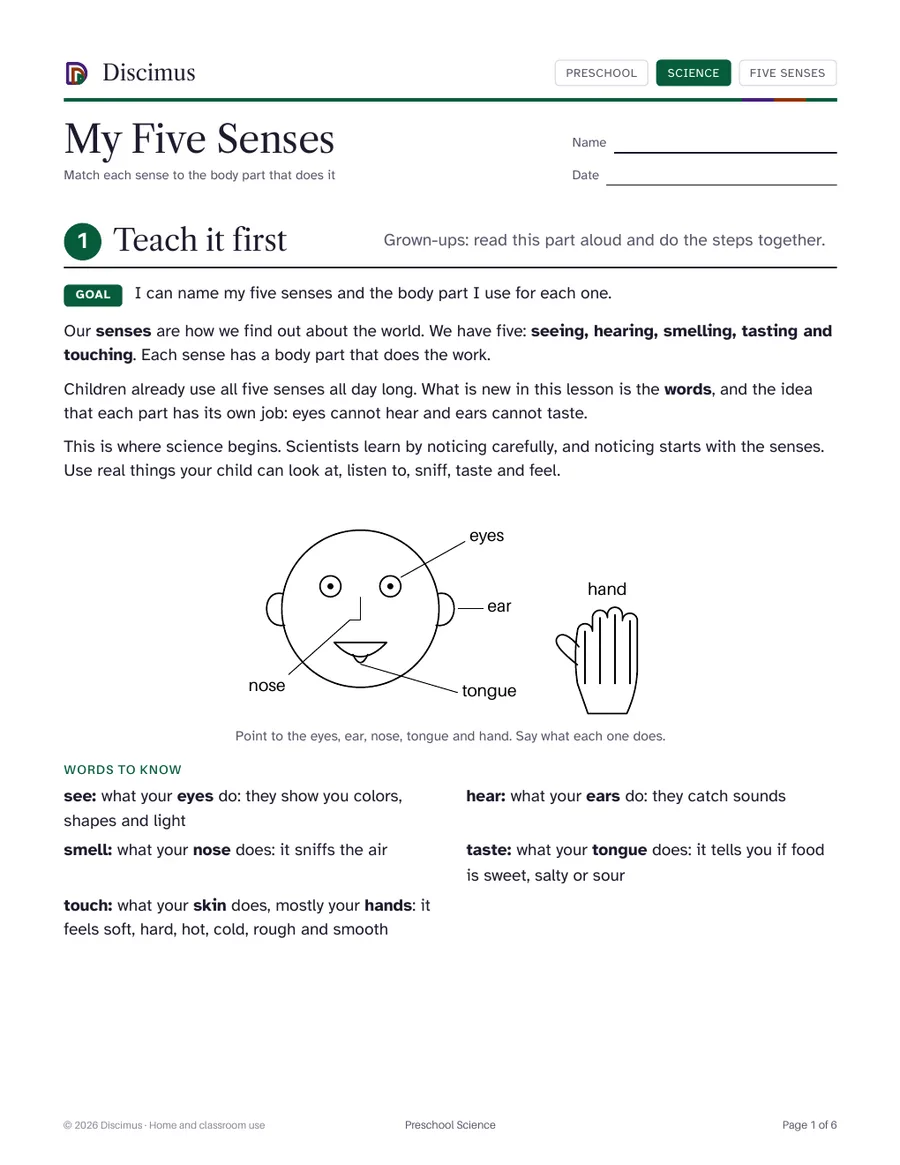
My Five Senses
Match each sense to the body part that does it
Next Generation Science Standards
Life, earth, physical science and the habits of investigation.
Match each sense to the body part that does it
Design, build and test a structure that shades an area from the sun's warming
Use test results to tell if a ramp or wall changes a ball's speed or direction as planned
Make a claim, with evidence, that living things change their environment to meet needs
Plan and do a test comparing strong and gentle, or different-direction, pushes and pulls
Observe and compare how sunlight warms sand, soil, rocks and water
Share solutions that reduce people's impact on land, water, air and living things
Ask questions to learn how weather forecasts help people get ready for severe weather
Observe, record and count local weather to describe patterns over time
Observe plants and animals and describe patterns in what they need to live
Use a model to show how the needs of living things match the places they live
Use texts and media to find patterns in parent and young behavior that help young survive
Design a solution to a human problem by copying how plant and animal parts work
Observe at different times of year to compare the amount of daylight in each season
Test what happens when different materials are placed in the path of a beam of light
Use observations as evidence that young are like, but not exactly like, their parents
Design and build a device that uses light or sound to send a message over a distance
Use observations of the sun, moon and stars to describe and predict sky patterns
Plan and do tests showing vibrating things make sound and sound makes things vibrate
Use observations to explain that things can be seen only when there is light
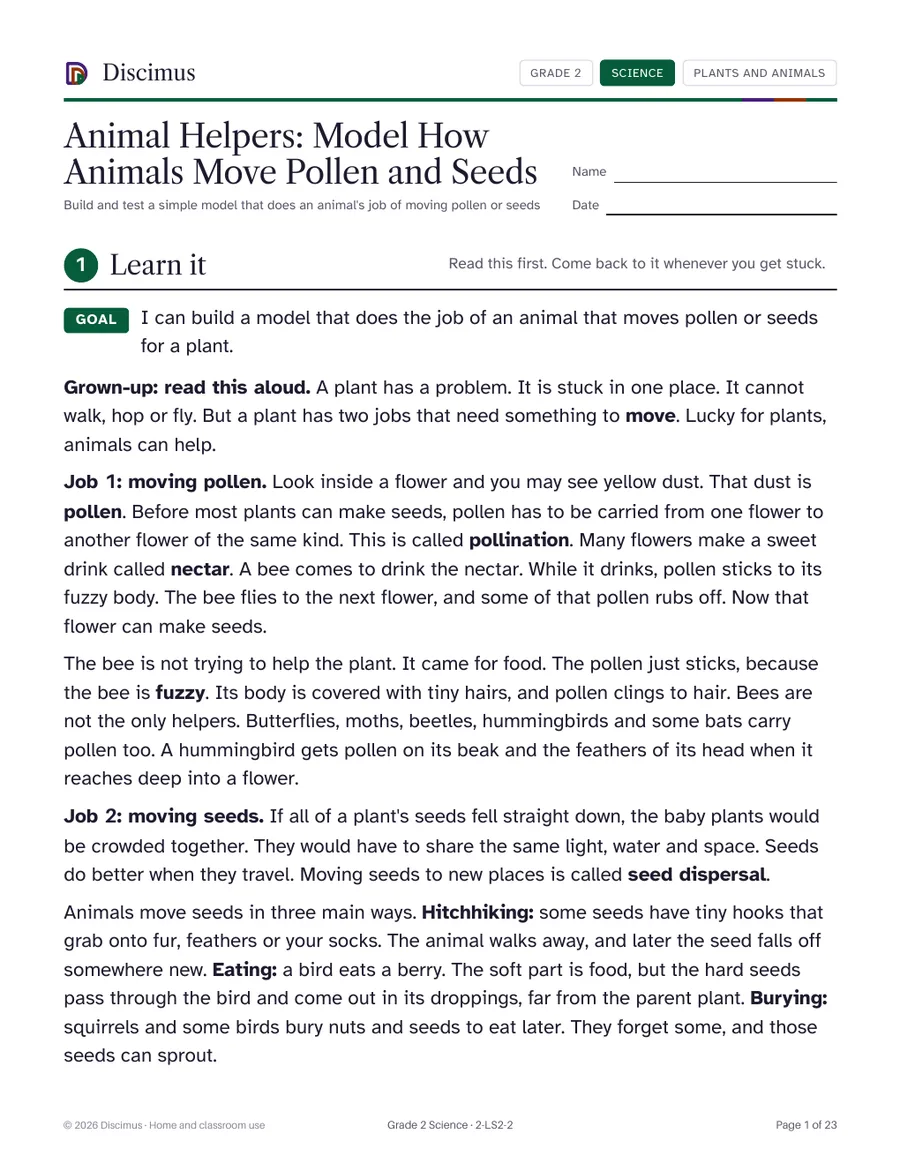
Build and test a simple model that does an animal's job of moving pollen or seeds
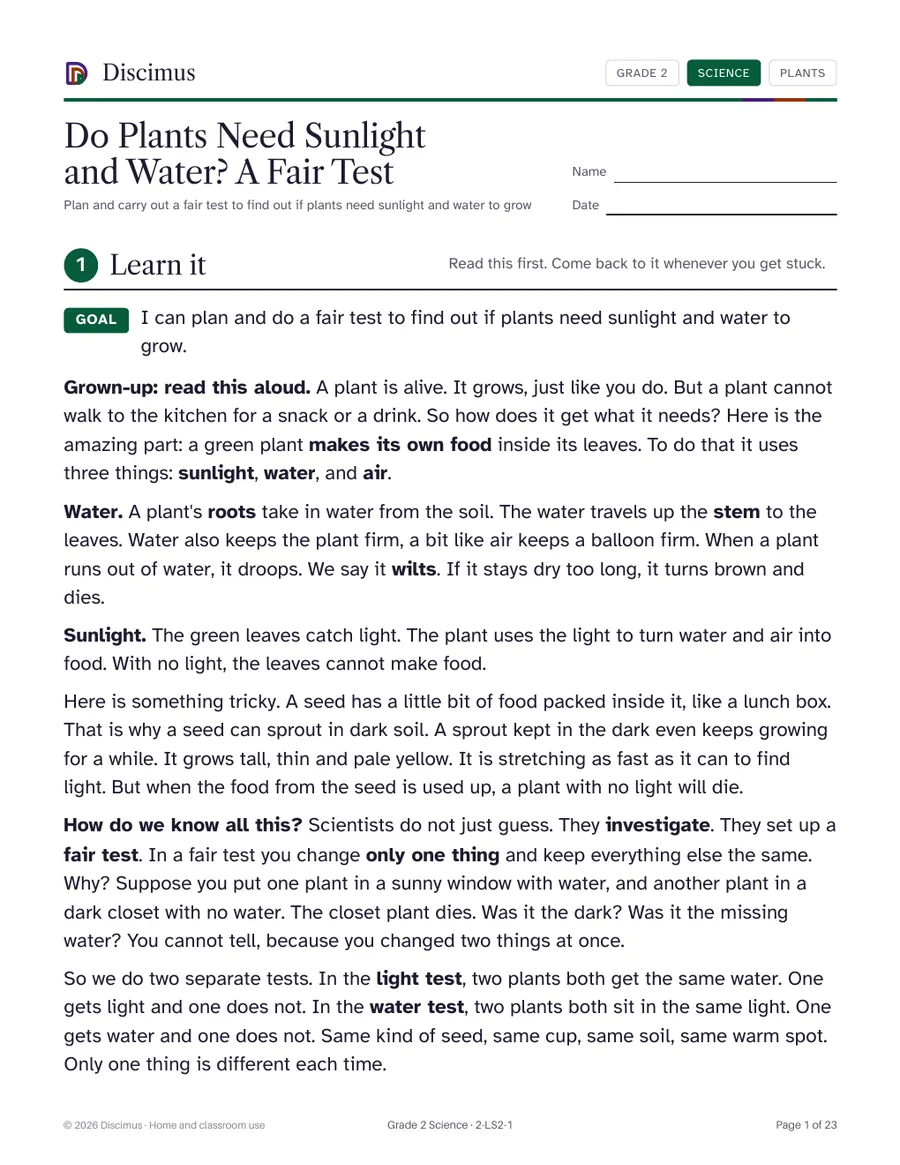
Plan and carry out a fair test to find out if plants need sunlight and water to grow
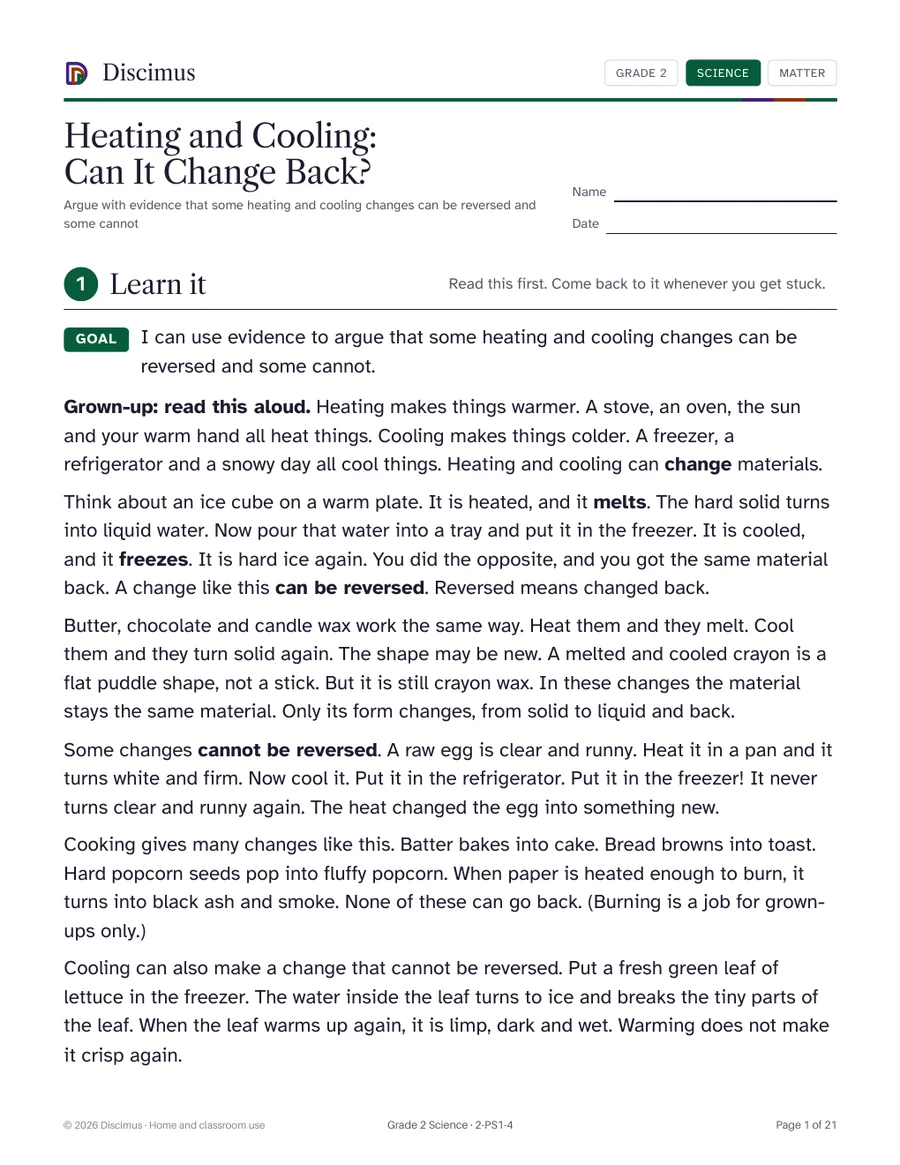
Argue with evidence that some heating and cooling changes can be reversed and some cannot
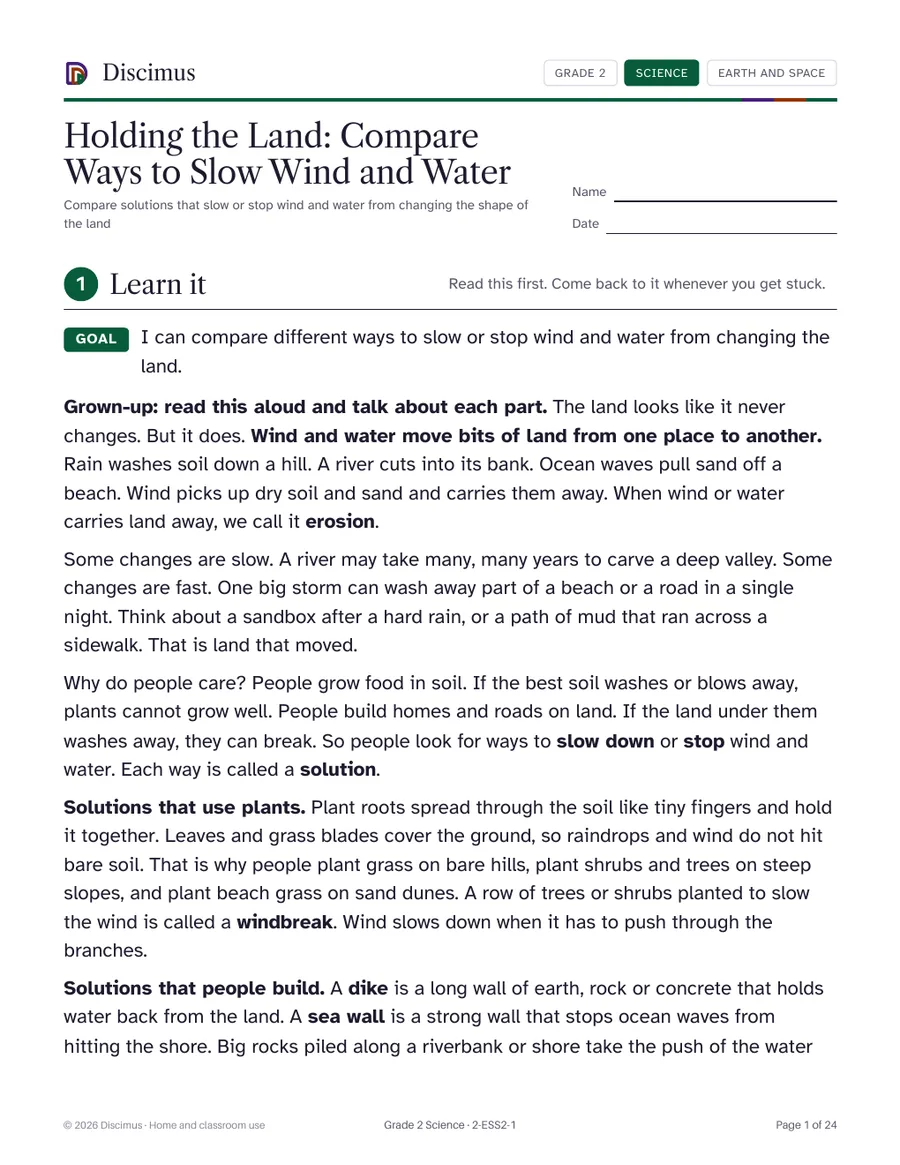
Compare solutions that slow or stop wind and water from changing the shape of the land
Observe plants and animals in two habitats and compare how many kinds live in each
Make and read models (maps and 3D models) of the land and water in an area
Use several sources as evidence that Earth events can happen quickly or slowly
Make a labeled sketch or simple model that shows how an object's shape helps it do its job
Plan and do tests to describe and classify materials by properties you can observe
Observe and explain how an object made of pieces can be rebuilt into a new object
Ask questions, observe and gather information to define a problem an object can solve
Find information on where Earth's water is and whether it is solid or liquid
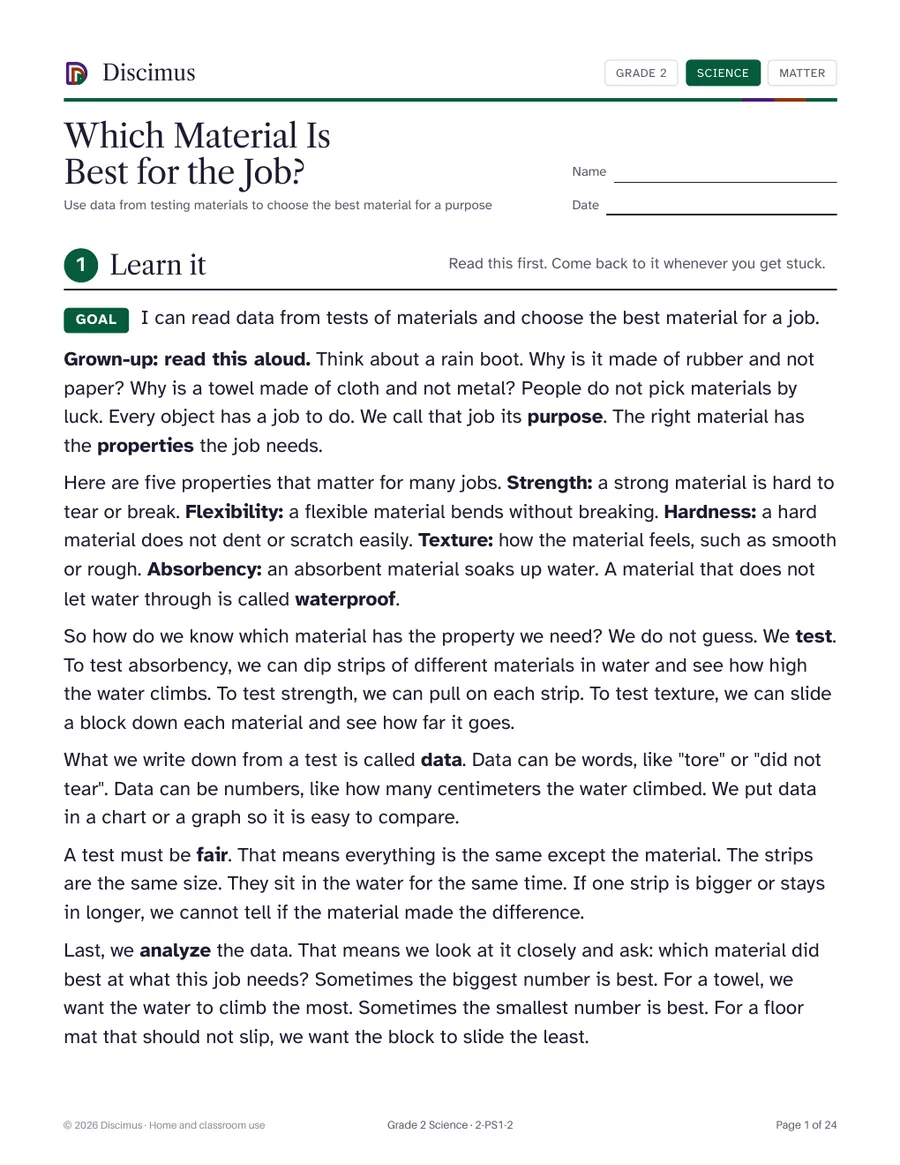
Use data from testing materials to choose the best material for a purpose
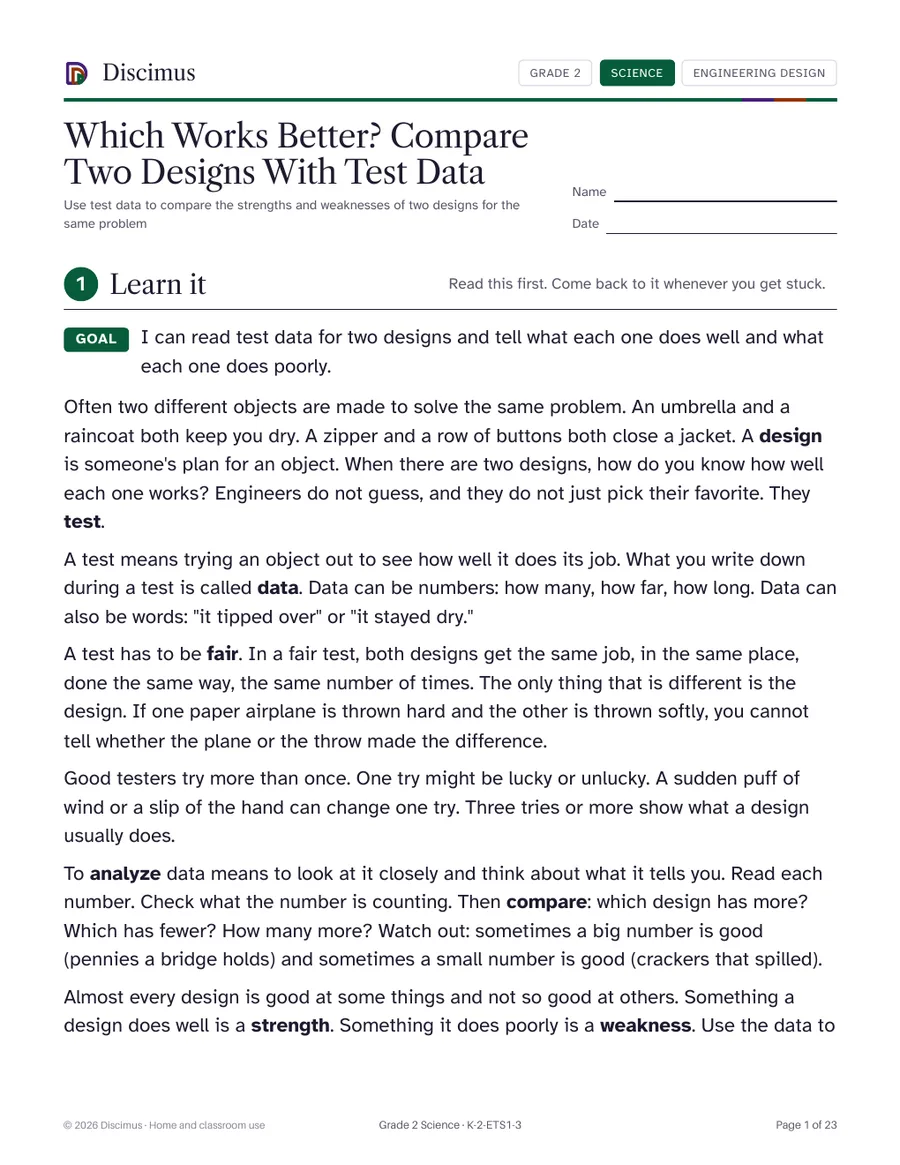
Use test data to compare the strengths and weaknesses of two designs for the same problem
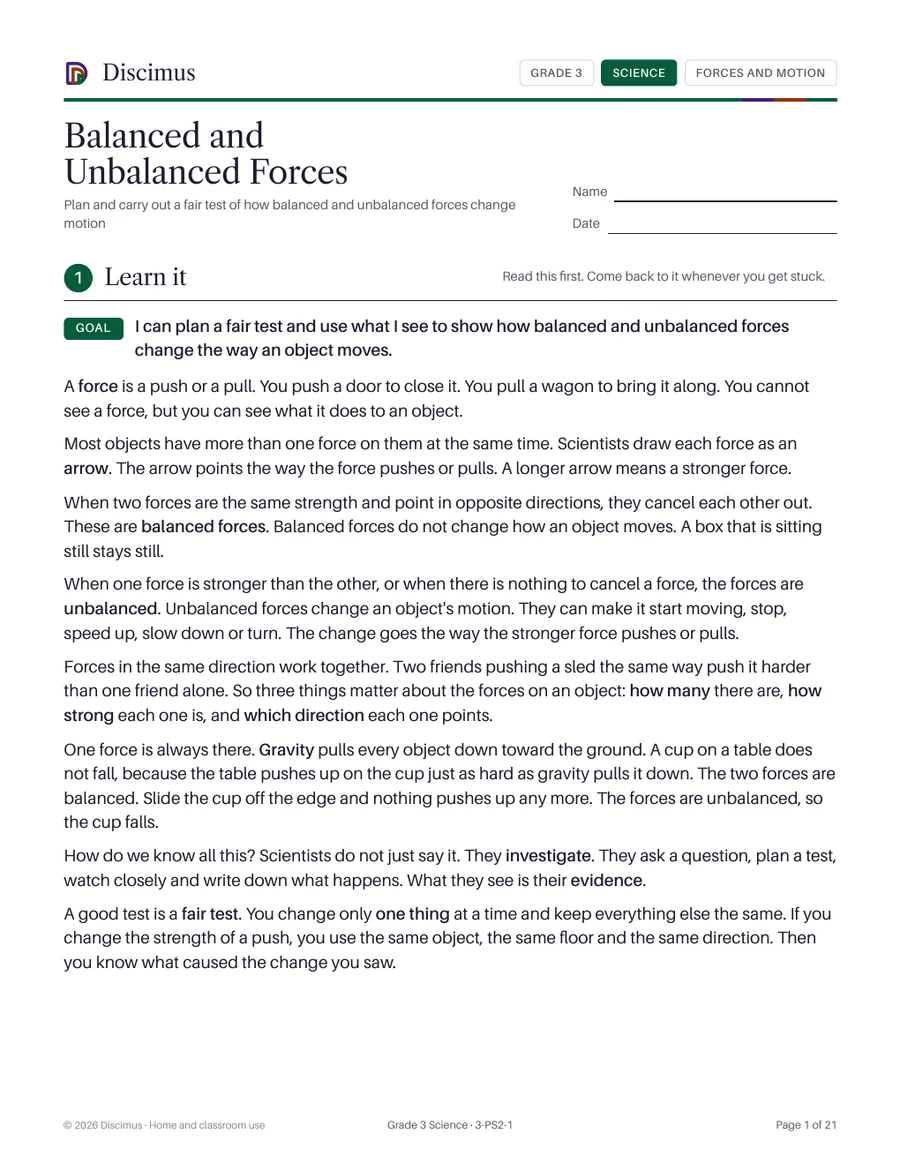
Plan and carry out a fair test of how balanced and unbalanced forces change motion
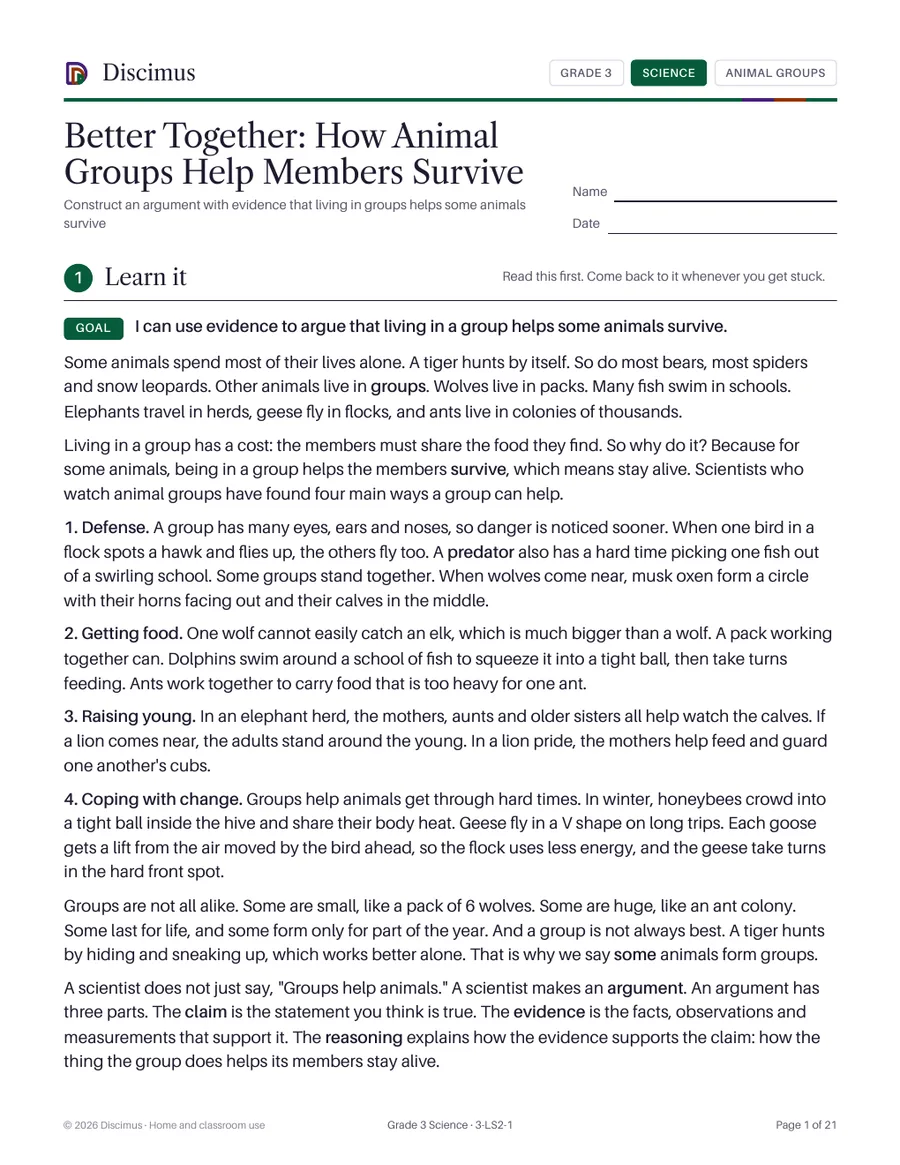
Construct an argument with evidence that living in groups helps some animals survive
Gather and combine information to describe the climates of different world regions
Analyze data for evidence that traits are inherited from parents and vary within a group
Argue from evidence how well different organisms can survive in a particular habitat
Use fossil data as evidence of organisms and environments from long ago
Develop and use models to compare life cycles: birth, growth, reproduction and death
Ask testable cause and effect questions about magnetic and static electric forces
Define a simple design problem magnets can solve, with criteria and constraints
Observe and measure motion, find its pattern and use the pattern to predict future motion
Use evidence to explain how the environment can influence the traits of plants and animals
Explain with evidence how variation in a species helps some survive and reproduce
Show weather data in tables and graphs to describe a season's typical weather
Use criteria, constraints and evidence to judge a design solution for a weather hazard
Make a claim with evidence about how well a solution fixes a habitat change problem
Argue from evidence that plant and animal structures have functions that support life
Create and compare several ways to send information using patterns
Ask questions and predict how energy changes when objects collide
Design, test and improve a device that changes energy from one form to another
Generate and compare solutions that reduce the impact of natural hazards
Use observations as evidence that energy moves by sound, light, heat and electric current
Use evidence to explain that a faster moving object has more energy
Model how light reflects from an object into the eye so the object can be seen
Read data from maps to describe patterns in where Earth's features are found
Use patterns in rock layers and fossils as evidence that a landscape changed over time
Use a model to describe how animals sense information, process it and respond
Model waves to describe amplitude, wavelength and how waves move objects
Measure and observe to give evidence of weathering and the rate of erosion
Combine information to describe energy resources and how their use affects the environment
Define a design problem with testable criteria and constraints on materials, time or cost
Gather and combine information on how communities use science to protect resources
Plan and run fair tests, control variables and use failure points to improve a prototype
Develop a model of how matter moves among plants, animals, decomposers and the environment
Graph data to show patterns in shadows, daylight and the stars seen in each season
Develop a model that shows how two of Earth's four spheres interact
Generate several solutions and compare them against the criteria and constraints
Investigate whether mixing two or more substances forms a new substance
Use observations and measurements of properties to identify an unknown material
Develop a particle model to explain what happens to air, sugar water and salt water
Measure and graph weights to show that matter is conserved when substances change
Argue from evidence that plants get the matter they need to grow mostly from air and water
Describe and graph how much salt water and fresh water Earth's reservoirs hold
Argue from evidence that Earth's gravity pulls objects down, toward Earth's center
Argue from evidence that the sun looks brighter than other stars because it is closer
Use a model to trace the energy in an animal's food back to the sun
Collect and analyze weather data as evidence that moving air masses change the weather
Analyze test data to find each design's best features and combine them in a new design
Explain uneven distributions of mineral, energy and groundwater resources with evidence
Use models to describe how gravity controls orbits in the solar system and the galaxy
Develop and use a model to explain how the parts of a cell help the whole cell function
Design a method to monitor a human impact on the environment and reduce it
Define a design problem's criteria and constraints precisely enough to test a solution
Argue from data how population and per-capita resource use change Earth's systems
Analyze fossil, rock, continent-shape and seafloor data as evidence of past plate motion
Use a Sun, Earth and Moon model to explain lunar phases, eclipses and seasons
Explain how rock strata and fossils are used to order events in Earth's history
Analyze data to compare the sizes, layers, features and orbits of solar system objects
Explain from evidence how slow and sudden geoscience processes change Earth's surface
Use a model to collect test data, change one variable at a time and find the best design
Develop a rock cycle model showing how materials cycle and what energy drives the cycle
Develop a model of the water cycle that shows state changes, the Sun's energy and gravity
Analyze natural hazard data to forecast events and choose technologies that reduce harm
Evaluate competing designs against criteria and constraints with a decision matrix
Model how unequal heating and Earth's rotation drive winds and currents that set climates
Ask questions that clarify evidence for the causes of rising global temperatures
Explain anatomical similarities in living and fossil organisms to infer relationships
Argue from evidence how animal behaviors and plant structures aid reproduction
Analyze a science text's structure and how each major section builds understanding
Compare information from experiments, simulations and video with a text on the same topic
Compare embryo pictures across species to find relationships the adults do not show
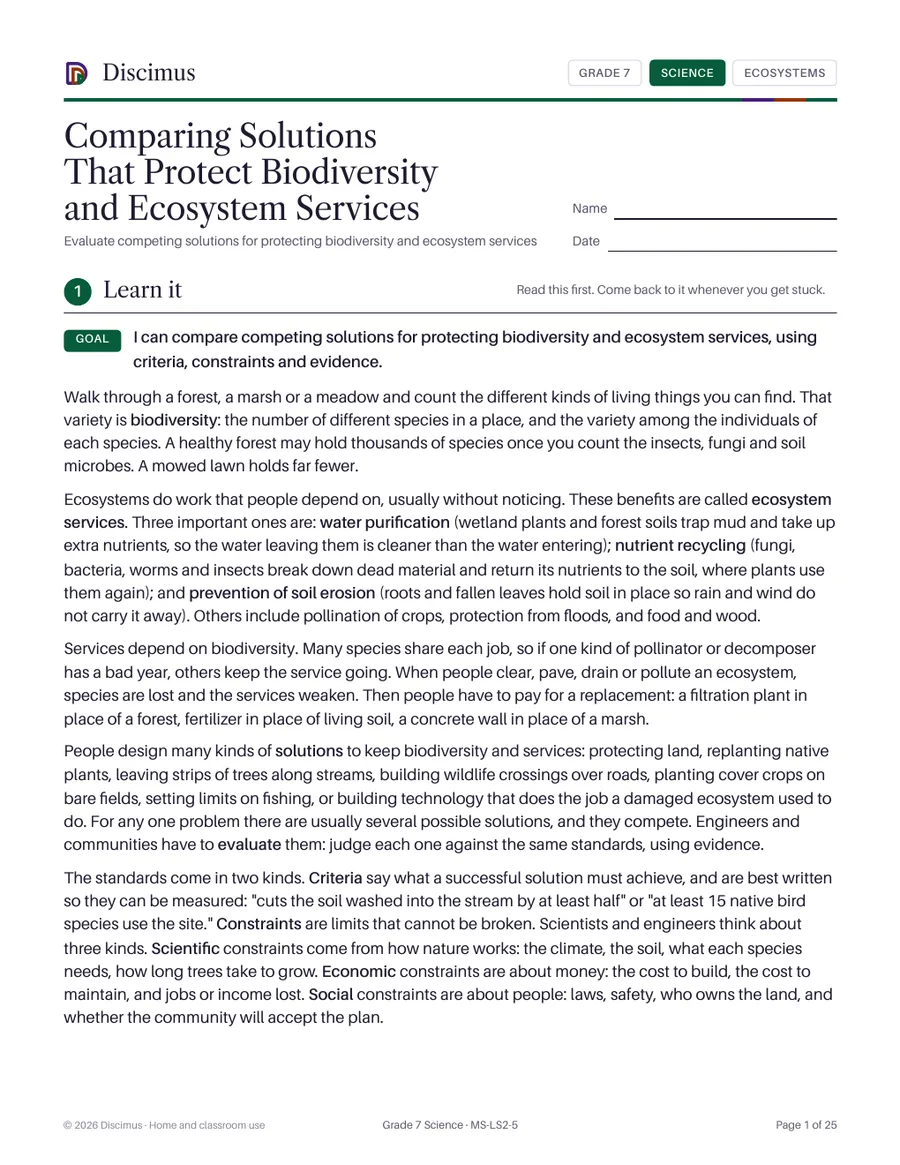
Evaluate competing solutions for protecting biodiversity and ecosystem services
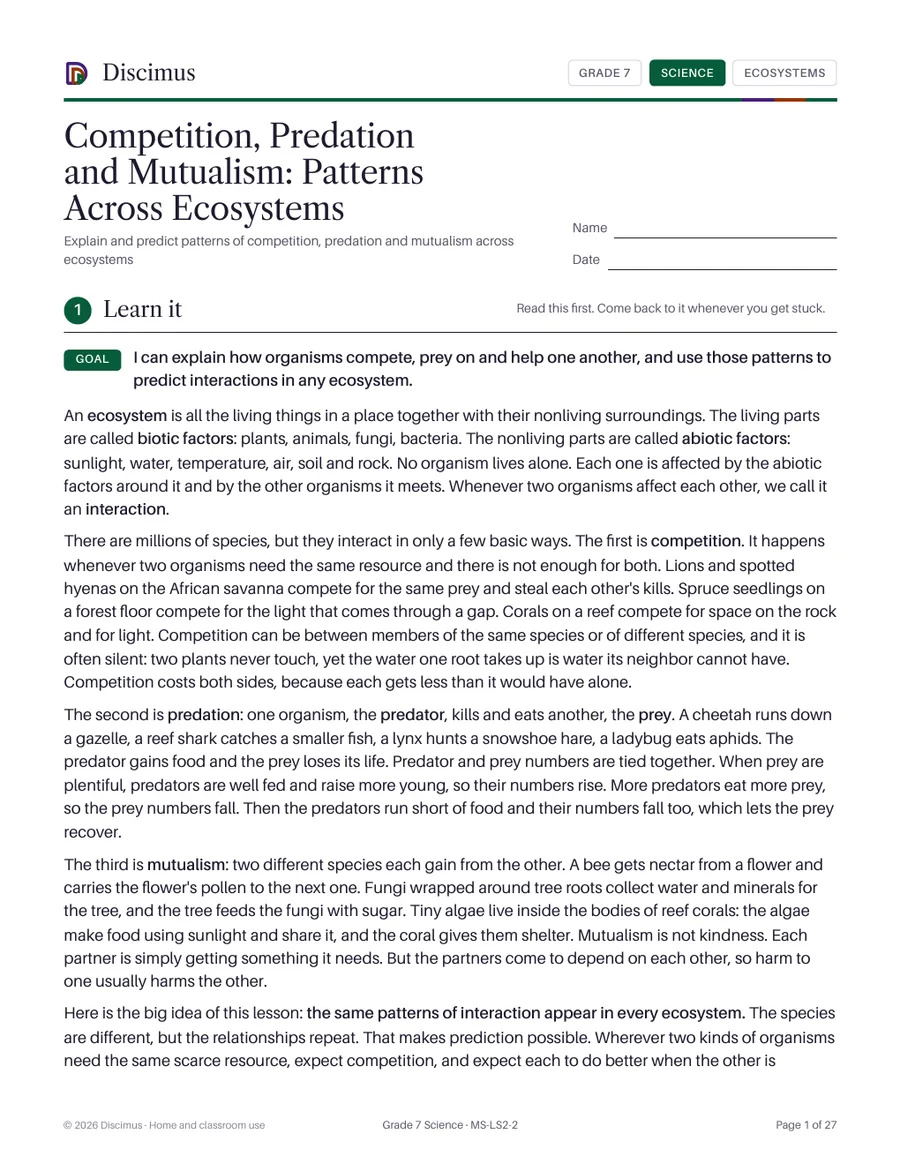
Explain and predict patterns of competition, predation and mutualism across ecosystems
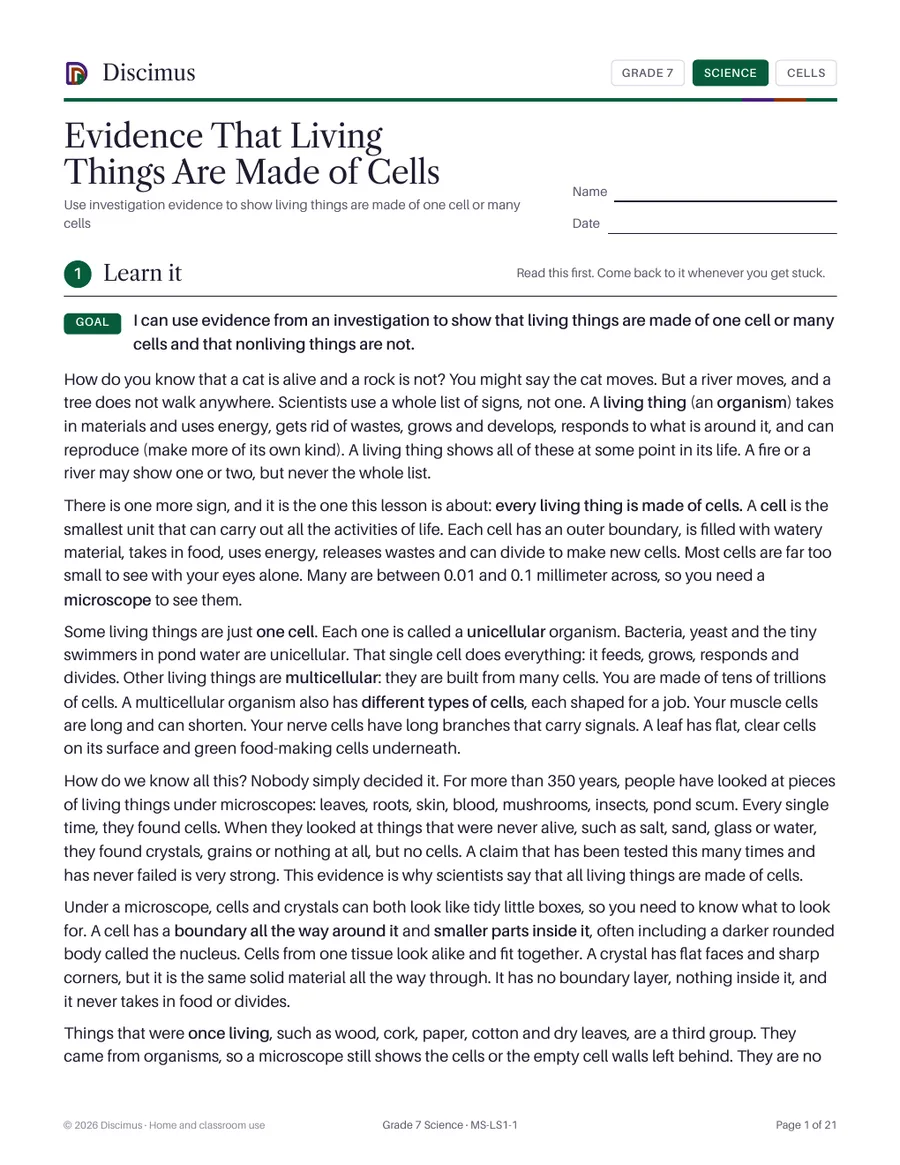
Use investigation evidence to show living things are made of one cell or many cells
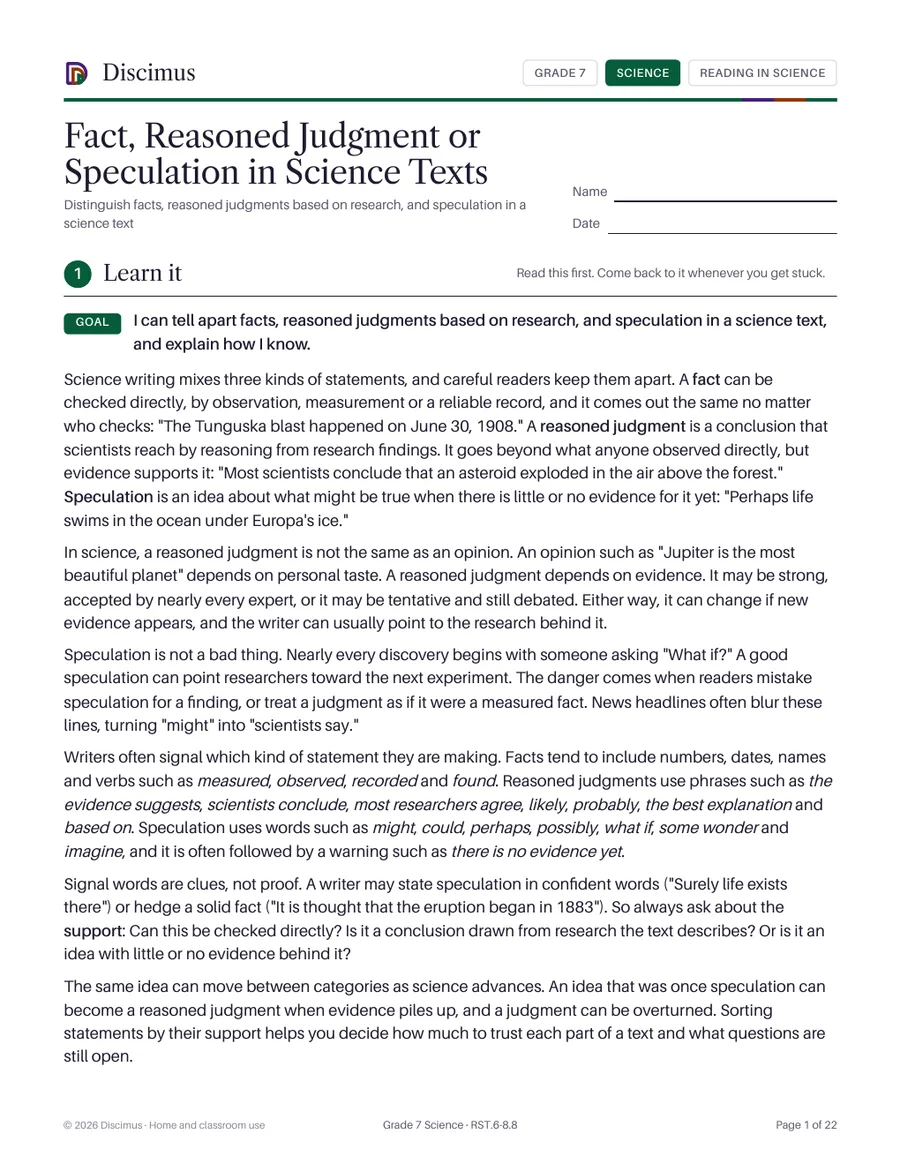
Distinguish facts, reasoned judgments based on research, and speculation in a science text
Explain with probability how inherited variations change the odds of survival
Argue from data that a physical or biological change in an ecosystem affects populations
Explain from evidence how environmental and genetic factors affect an organism's growth
Model how food molecules are broken apart and rearranged for growth and energy release
Gather and synthesize information on technologies that change inherited traits
Model why asexual reproduction gives identical offspring and sexual gives variation
Develop a model of matter cycling and energy flowing through an ecosystem
Model how a gene mutation may change a protein and help, harm or not affect an organism
Explain from evidence how photosynthesis cycles matter and moves energy through organisms
Cite specific evidence, including data, to support analysis of science texts
Analyze rock layer and fossil data for patterns of diversity, extinction and change
Read and understand grade 6 to 8 science and technical texts independently
Analyze data for evidence of how resource availability affects organisms and populations
Combine numbers and details in a science text with a table, graph, diagram or flowchart
Gather and combine information on how receptors signal the brain for behavior or memory
 Free sample
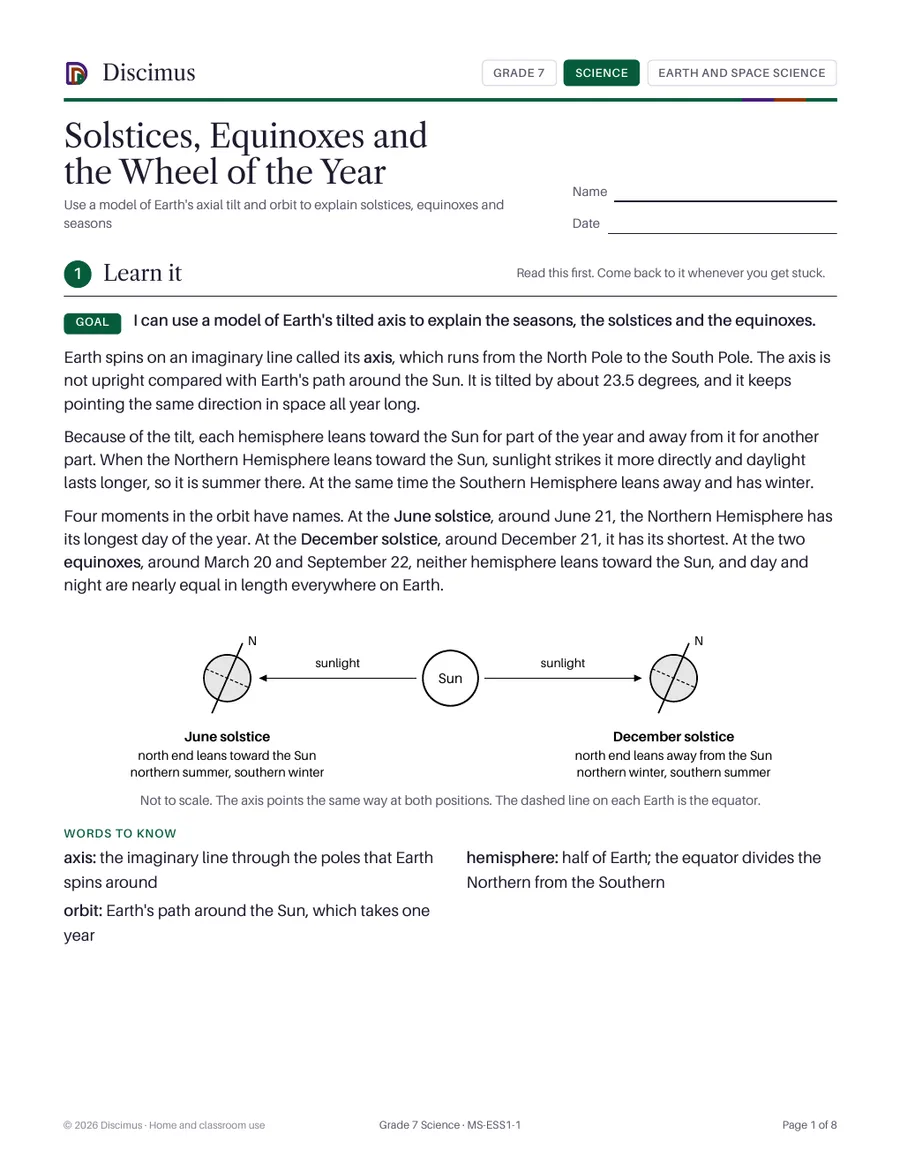
Use a model of Earth's axial tilt and orbit to explain solstices, equinoxes and seasons
Determine the meaning of symbols, key terms and technical words in a science context
Follow a multistep science procedure precisely in experiments, measurements and tasks
Find the central idea or conclusion of a science text and write an objective summary
Argue from evidence that the body is a system of interacting systems built from cells
Use percents, means, models and graphs to explain how traits rise or fall over generations
Analyze why a science author explains, describes a procedure or discusses an experiment
Use several sources to explain why digital signals are more reliable than analog
Develop and read models of the atoms in simple molecules and extended structures
Apply Newton's third law to design and test a solution to a collision problem
Ask testable questions about data on what affects electric and magnetic force strength
Argue from evidence that a change in kinetic energy means energy was transferred
Design, test and improve a device that absorbs or releases heat by a chemical process
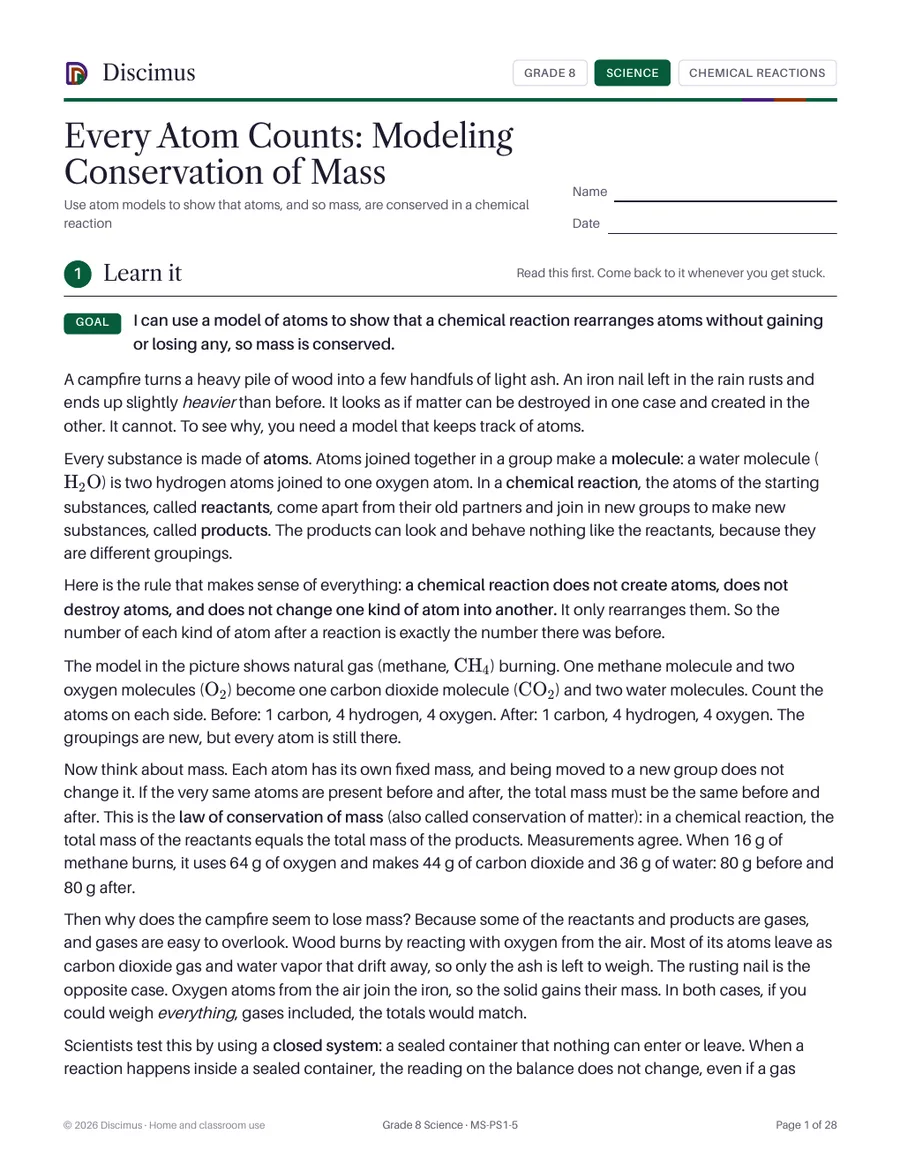
Use atom models to show that atoms, and so mass, are conserved in a chemical reaction
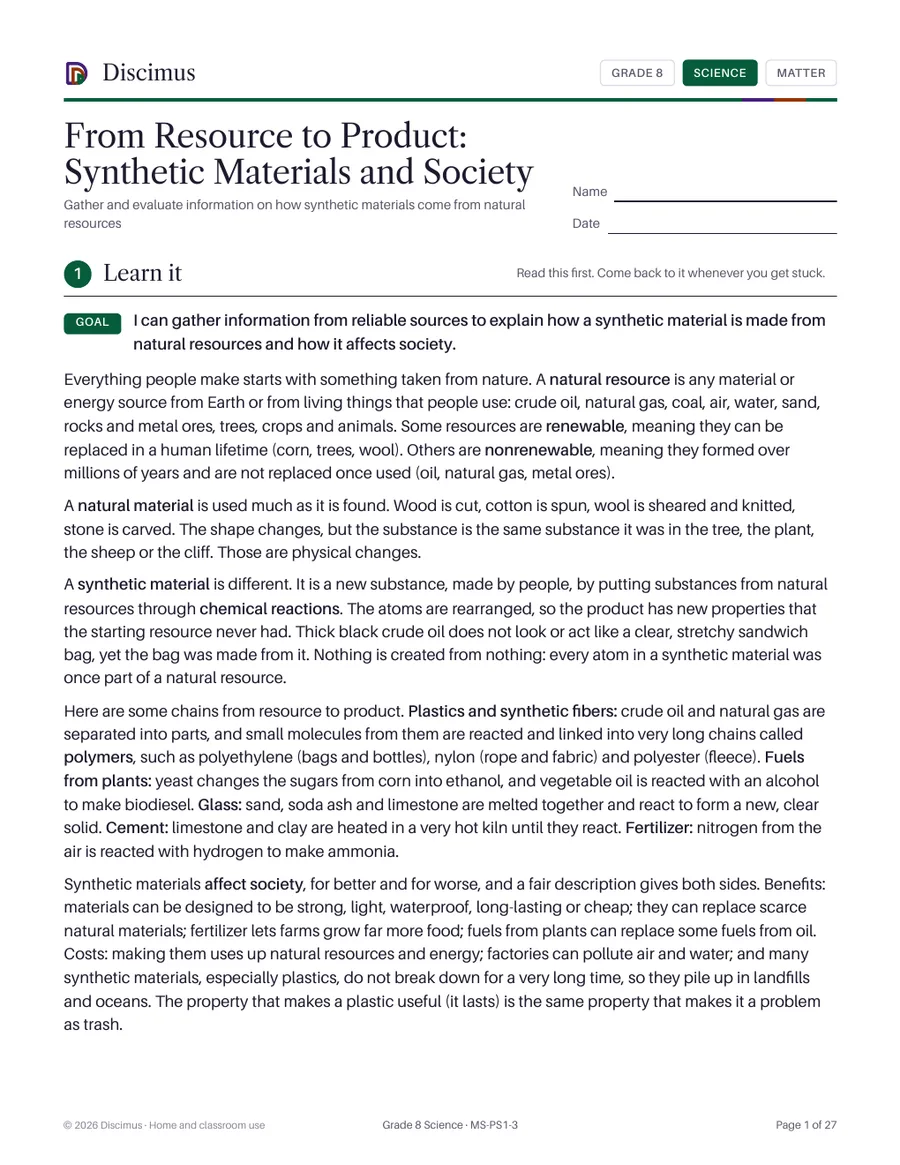
Gather and evaluate information on how synthetic materials come from natural resources
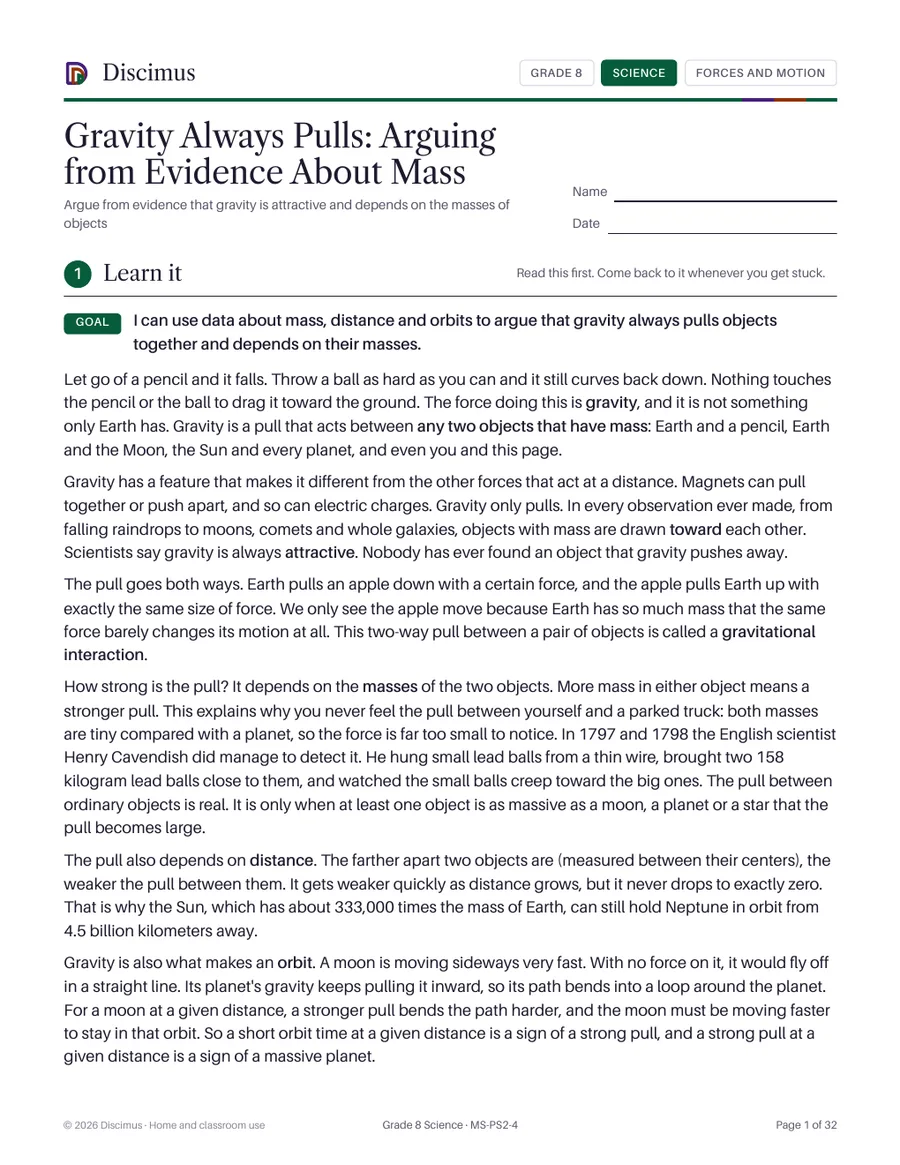
Argue from evidence that gravity is attractive and depends on the masses of objects
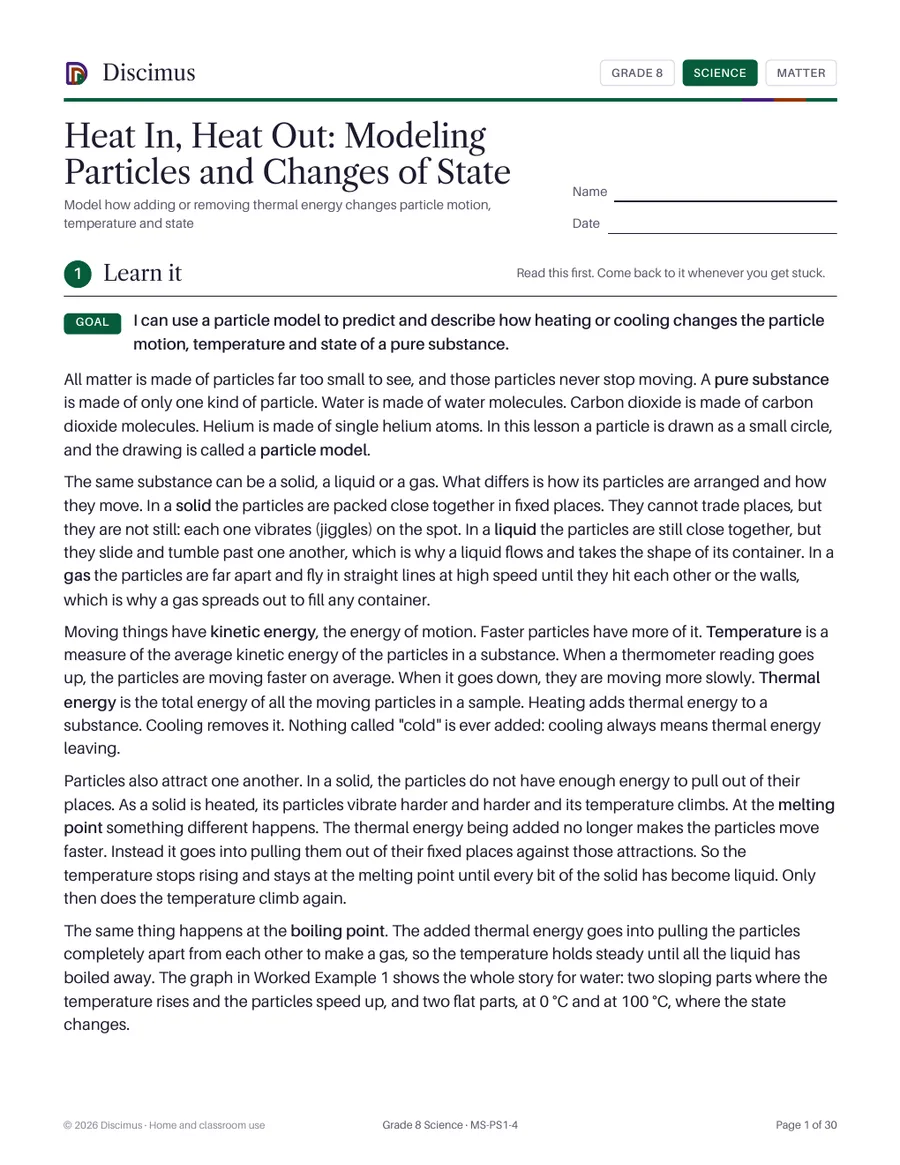
Model how adding or removing thermal energy changes particle motion, temperature and state
Investigate non-contact forces as evidence of fields and evaluate the experimental design
Design, build and test a device that minimizes or maximizes thermal energy transfer
Construct and interpret graphs showing how kinetic energy depends on mass and on speed
Plan an investigation showing how net force and mass change an object's motion
Plan a fair test linking energy transferred, type of matter and mass to temperature change
Model how the arrangement of two interacting objects changes stored potential energy
Use before-and-after property data to decide whether a chemical reaction occurred
Model how light and sound are reflected, absorbed or transmitted by different materials
Describe waves by amplitude, wavelength, frequency and speed; relate amplitude to energy
Use a model to show how photosynthesis changes light energy into stored chemical energy
Model how photosynthesis and respiration cycle carbon among Earth's spheres
Use proportions to show energy flows and matter is conserved among trophic levels
Design, evaluate and refine a solution that reduces a human impact on biodiversity
Ask testable questions about how DNA and chromosomes code for inherited traits
Explain from evidence how four factors together cause a population to evolve
Explain with evidence how a DNA base sequence determines protein structure and function
Explain with evidence how sugar's atoms join other elements to build large molecules
Explain from evidence how natural selection leads to adaptation of populations
Explain, from evidence, how matter cycles and energy flows with and without oxygen
Explain how DNA, anatomy and embryo evidence each support common ancestry and evolution
Use a model to show respiration breaks and forms bonds and transfers energy
Use averages, trends and graphs to support and revise explanations of population change
Use a model to show how mitosis and differentiation build and maintain a complex organism
Use proportions, probability and graphs to show an advantageous trait rising in proportion
 Free sample
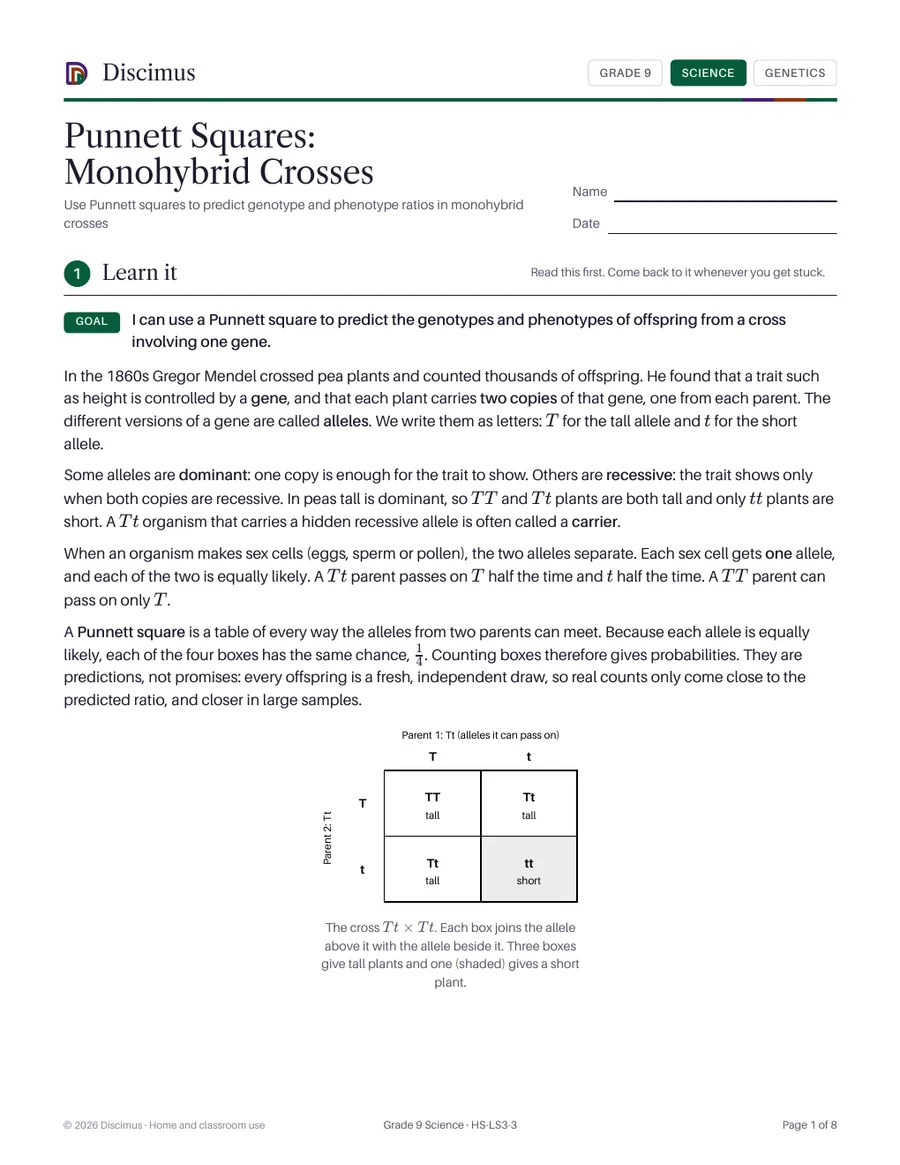
Use Punnett squares to predict genotype and phenotype ratios in monohybrid crosses
Evaluate evidence for how group behavior affects survival and reproduction
Create, test and revise a simulation to compare solutions that protect biodiversity
Plan and carry out an investigation showing that feedback mechanisms maintain homeostasis
Evaluate claims, evidence and reasoning about ecosystem stability and change
Develop and use models of the levels of organization and interacting systems in organisms
Evaluate evidence that environmental change causes increases, new species and extinctions
Defend a claim with evidence about the three sources of inheritable genetic variation
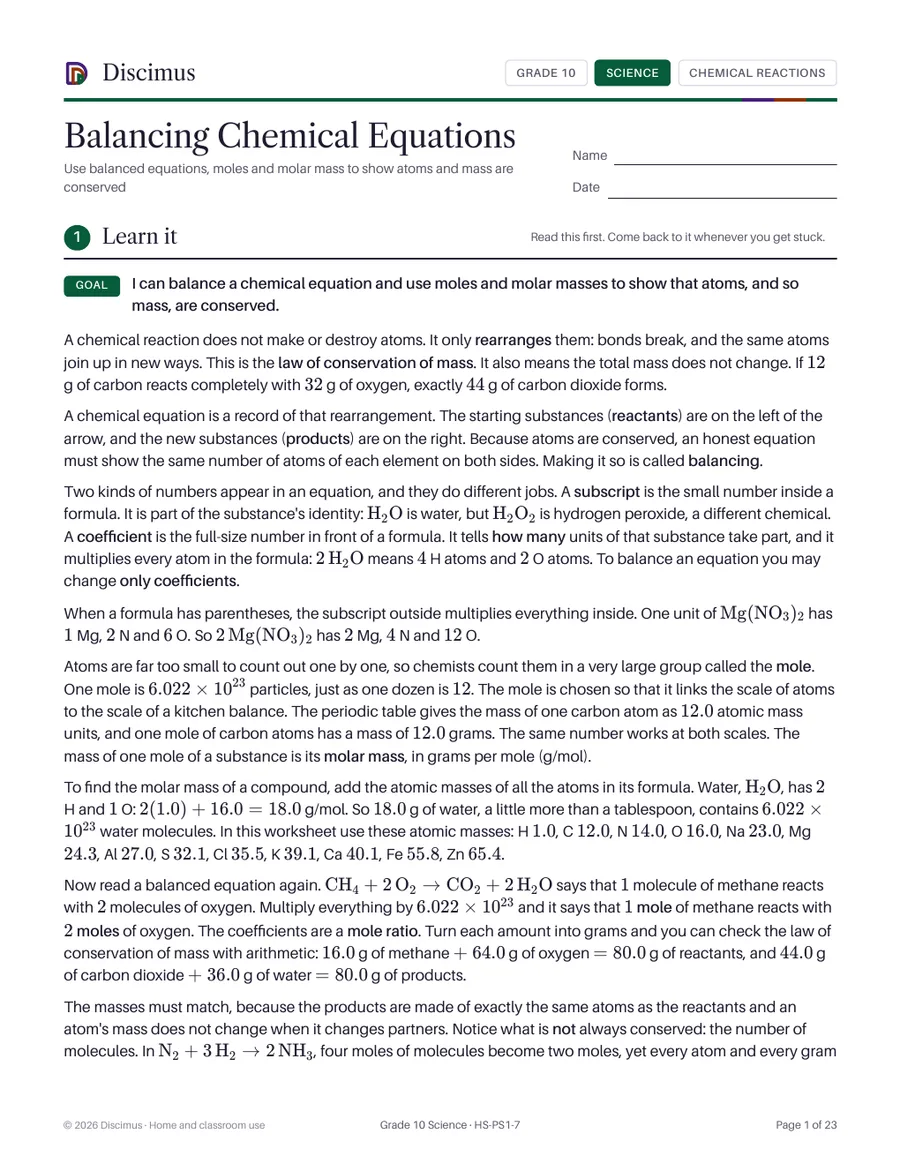
Use balanced equations, moles and molar mass to show atoms and mass are conserved
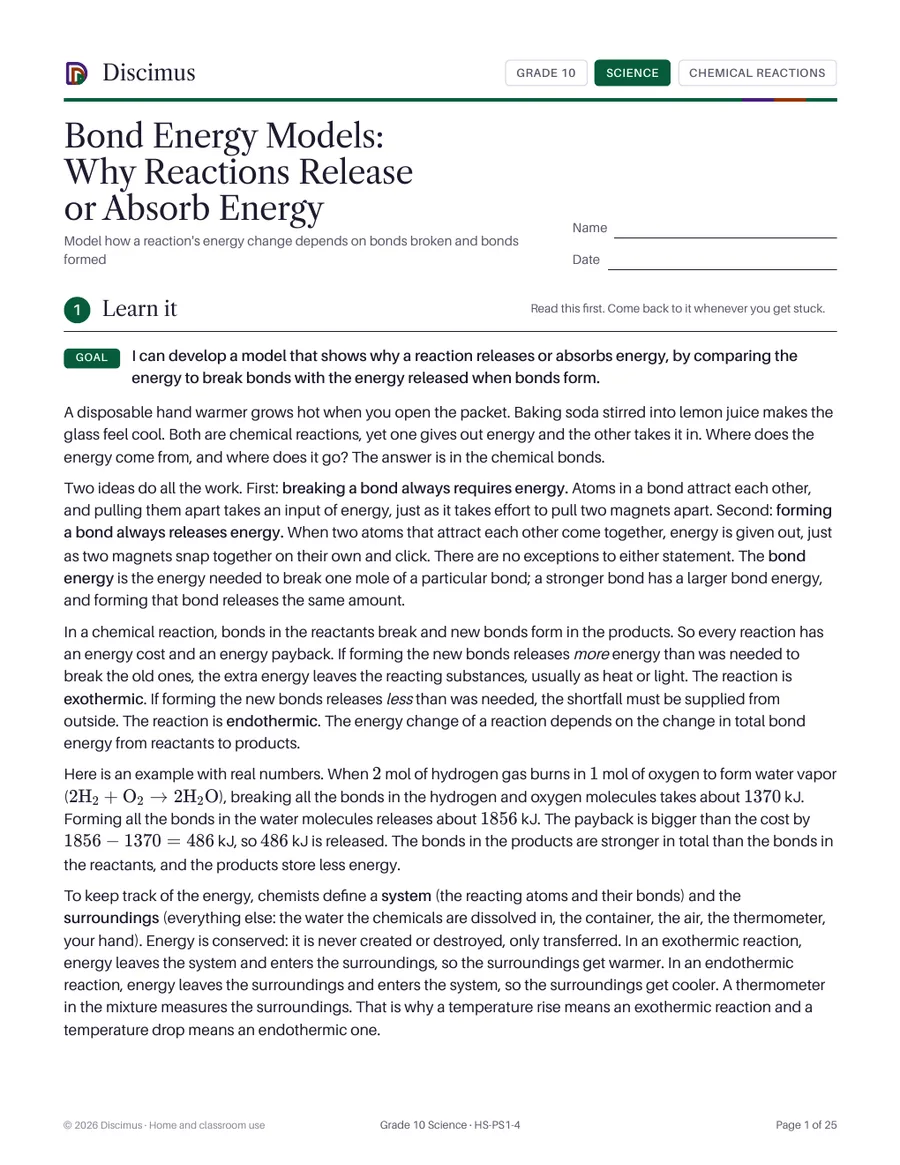
Model how a reaction's energy change depends on bonds broken and bonds formed
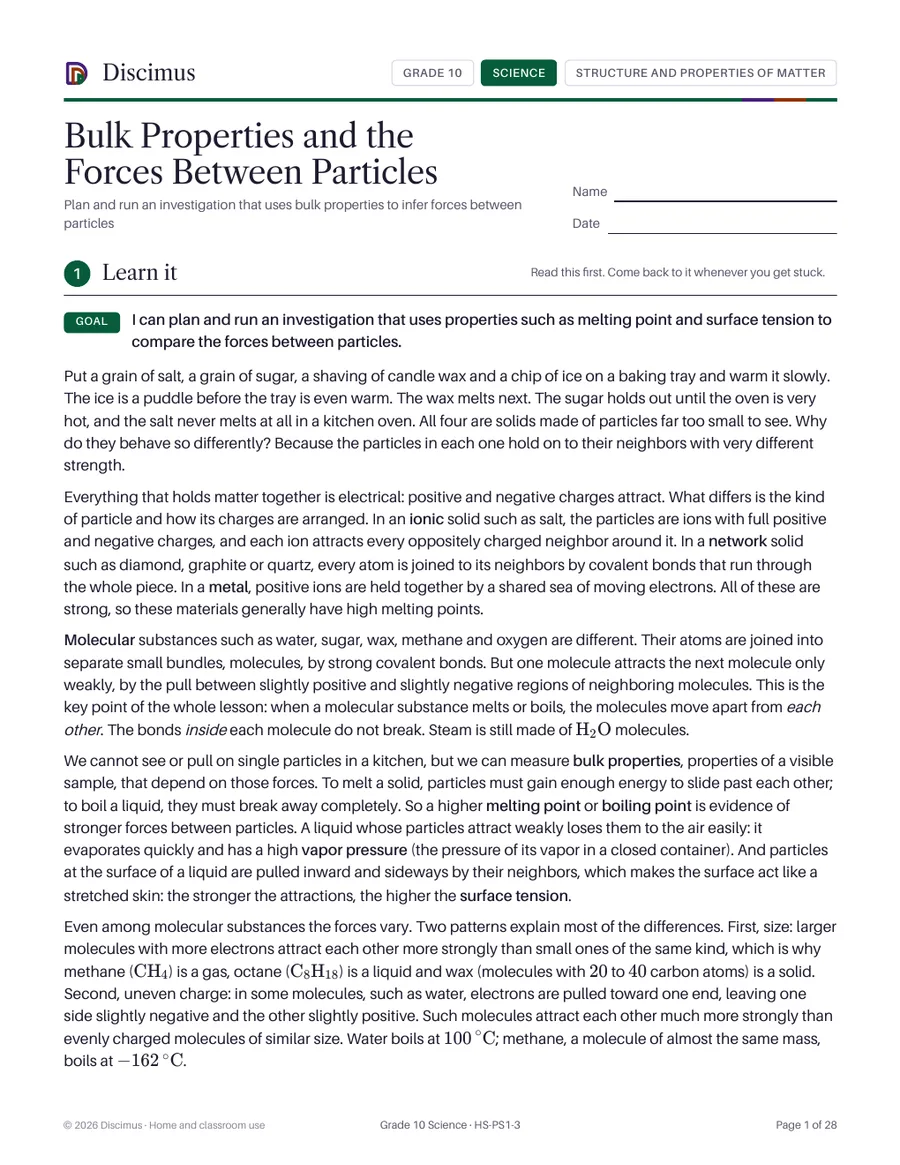
Plan and run an investigation that uses bulk properties to infer forces between particles
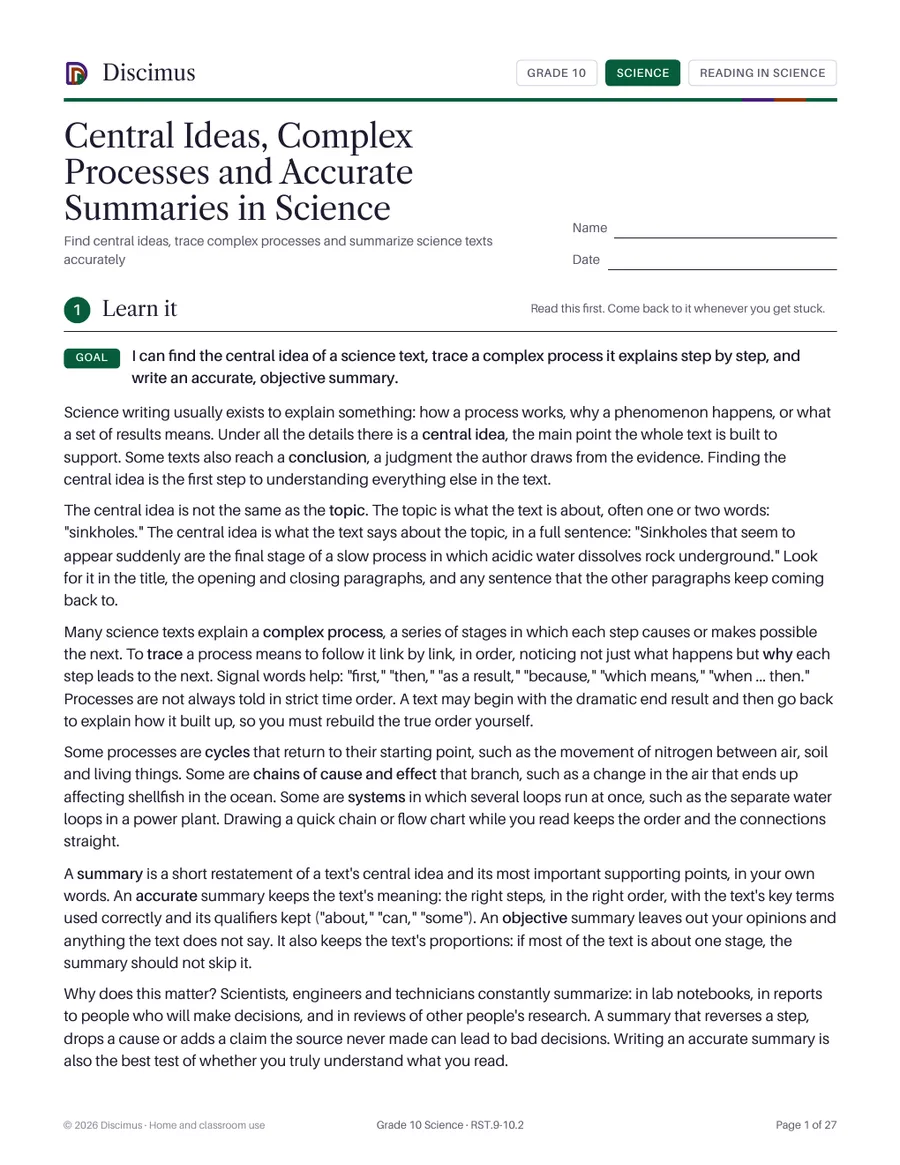
Find central ideas, trace complex processes and summarize science texts accurately
Explain and revise why a simple reaction forms its products, using valence electrons
Follow complex multistep procedures precisely, including special cases and exceptions
Analyze how a science text structures relationships among key terms and concepts
Choose a change in conditions that shifts an equilibrium toward more product
Model changes in the nucleus and the energy scale of fission, fusion and radioactive decay
Cite precise evidence, with numbers, conditions and qualifiers, from science texts
Explain how temperature and concentration change reaction rate using particle collisions
Read and understand grade 9 to 10 science and technical texts independently
Assess how well reasoning and evidence support a science claim or recommendation
Translate science information between words, tables, graphs and equations
Compare findings across science sources and experiments, noting support or contradiction
Determine the meaning of symbols, key terms and domain-specific words in science contexts
Analyze a science author's purpose and define the question the text addresses
Predict properties of main-group elements from valence electrons and periodic trends
Use momentum equations to show that total momentum of two objects is conserved
Design, test and refine a device that converts energy, judged by output for a given input
Evaluate questions about the advantages and drawbacks of digital transmission and storage
Build a computational model to calculate an unknown energy change in a system
Model everyday energy as the motion of particles and their relative positions in fields
Model the forces and energy changes of two objects interacting through a field
Investigate thermal energy transfer between hot and cold components using Q = mcΔT
Plan and conduct investigations linking electric current and magnetic fields
Evaluate evidence for wave and particle models of light and choose the more useful model
Explain how molecular-level structure and forces give designed materials their function
Use Newton's law of gravitation and Coulomb's law to calculate and predict forces
Analyze motion data to show that net force, mass and acceleration obey Newton's second law
Use photon energy to judge the validity and reliability of claims about radiation
Design, evaluate and refine a device that lowers the force on an object in a collision
Use v = fλ to support claims about wave speed, frequency and wavelength in different media
Explain how devices use wave behavior to send and capture information and energy
Design a solution by breaking a complex problem into smaller sub-problems
Model how internal and surface processes build and wear down land and sea-floor features
Follow complex multistep science procedures precisely and analyze results using the text
Build and use a quantitative box model of carbon cycling among Earth's four spheres
Use published model results to show how human CO₂ is changing links among Earth's systems
Use rock ages, meteorites and cratering to construct an account of Earth's early history
Work out the meaning of symbols, key terms and technical phrases in a science context
Use an energy budget model to explain how changes in energy flow change Earth's climate
Evaluate and refine a technology that reduces a human impact on natural systems
Evaluate a solution using prioritized criteria, trade-offs, constraints and impacts
Explain the Big Bang theory with evidence from redshift, the CMB and cosmic composition
Use geoscience data to show how one surface change causes feedbacks in other Earth systems
Use climate data and model results to forecast a rate of climate change and its impacts
Specify qualitative and quantitative criteria and constraints for a global challenge
Construct an evidence-based argument that life and Earth's systems have changed each other
Cite evidence from science texts, noting key distinctions, gaps and inconsistencies
Model Earth's layers from evidence and explain how thermal convection cycles matter
Use growth models, graphs and density to explain what sets carrying capacity
Use Kepler's laws and Newton's law of gravitation to predict orbital periods and speeds
Read and understand grades 11 to 12 science and technical texts independently
Find central ideas and summarize complex science processes in simpler, accurate words
Evaluate a science text's hypothesis, data, analysis and conclusions
Integrate and evaluate text, data and media sources to answer a science question
Synthesize texts, experiments and simulations into one explanation and resolve conflicts
Analyze purpose in a science explanation, procedure or experiment and find open issues
Run simple simulations linking resource management, human sustainability and biodiversity
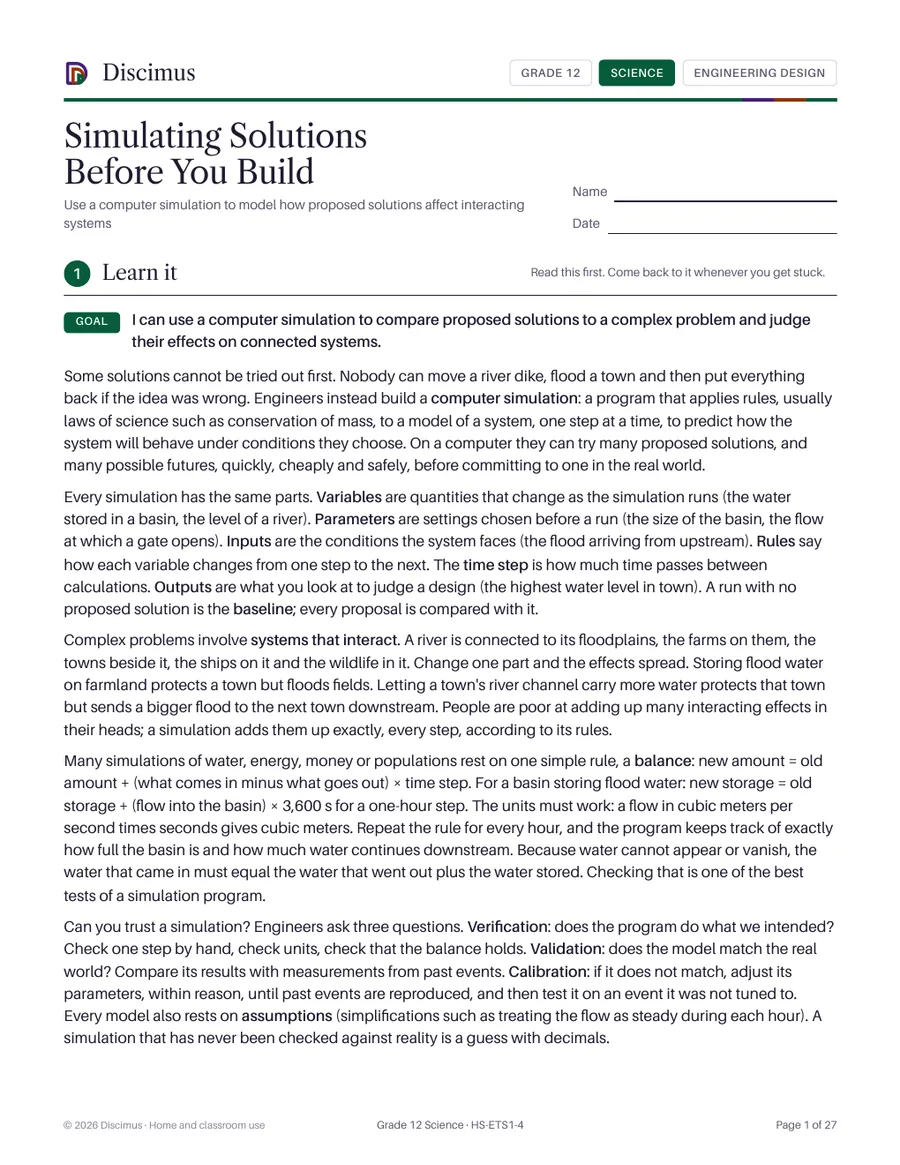
Use a computer simulation to model how proposed solutions affect interacting systems
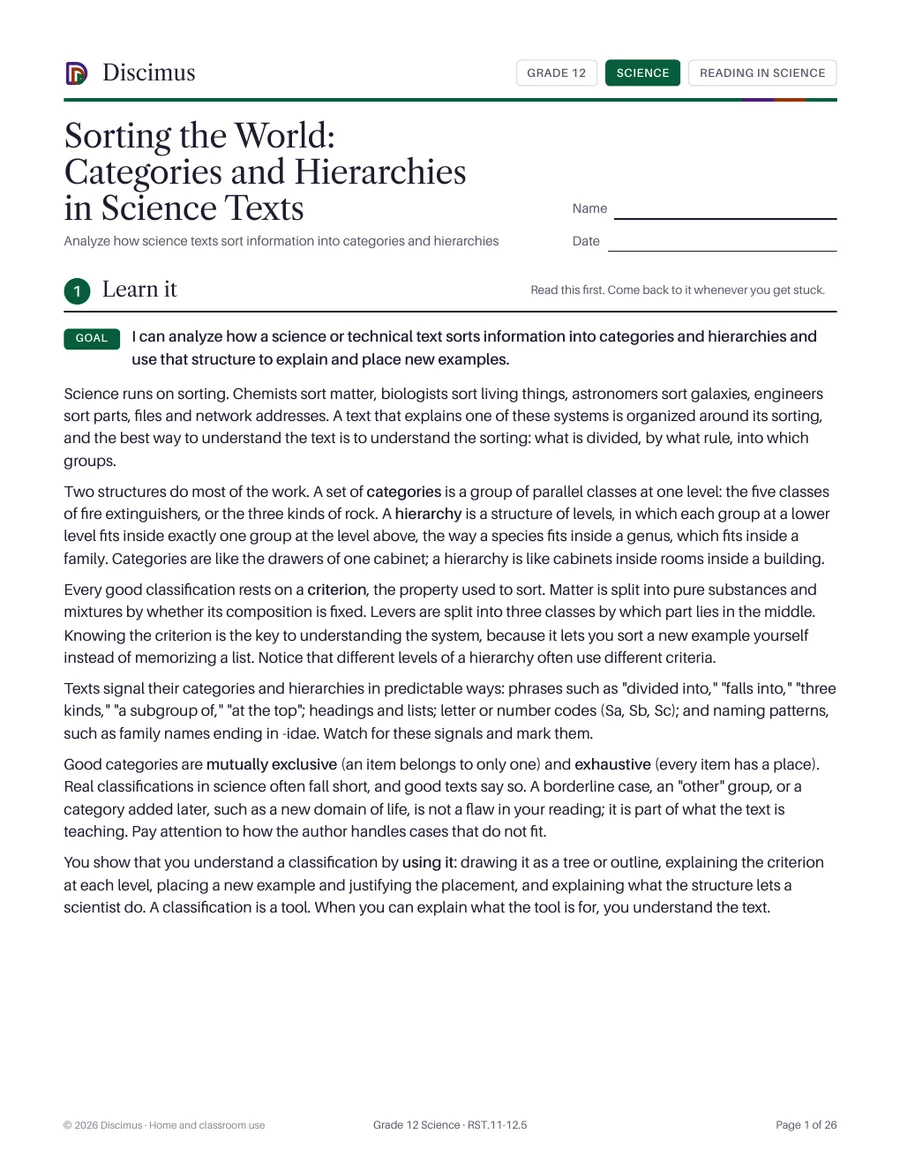
Analyze how science texts sort information into categories and hierarchies
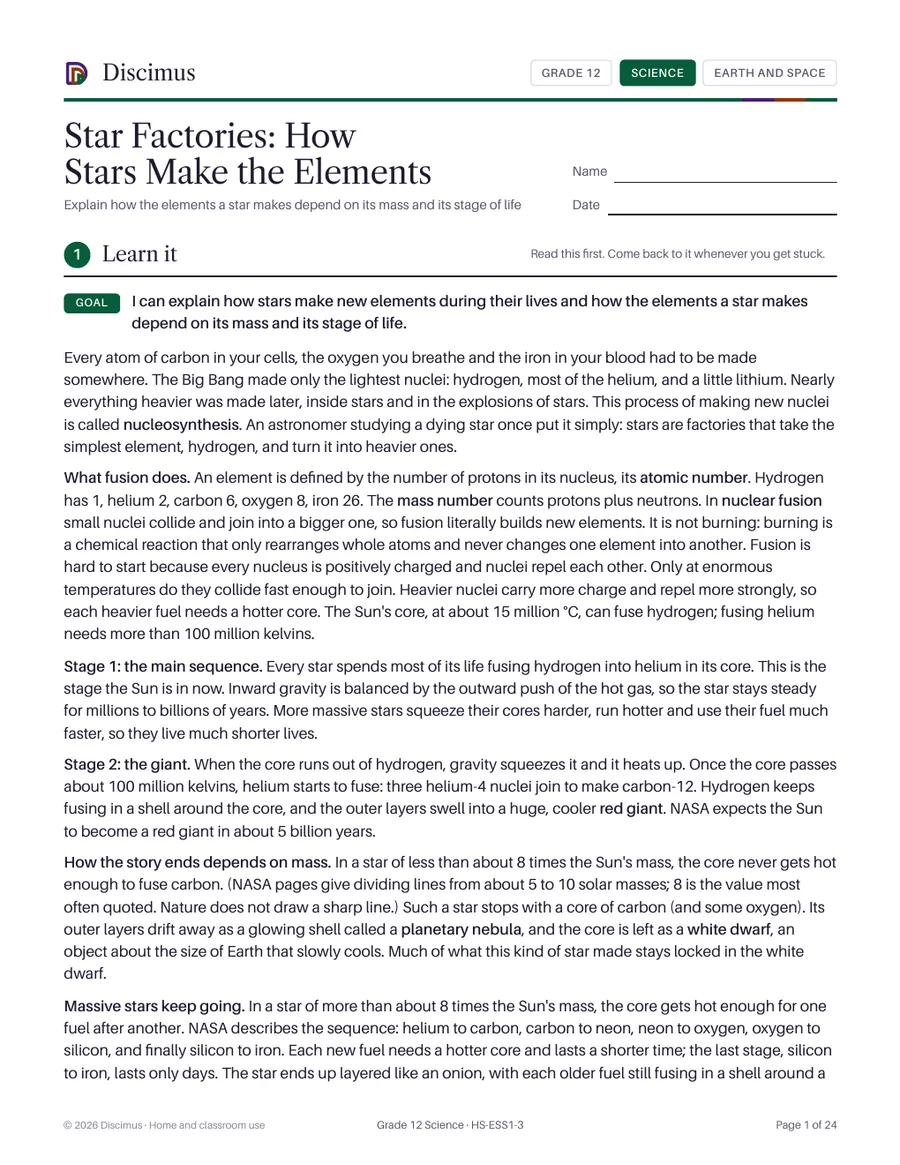
Explain how the elements a star makes depend on its mass and its stage of life
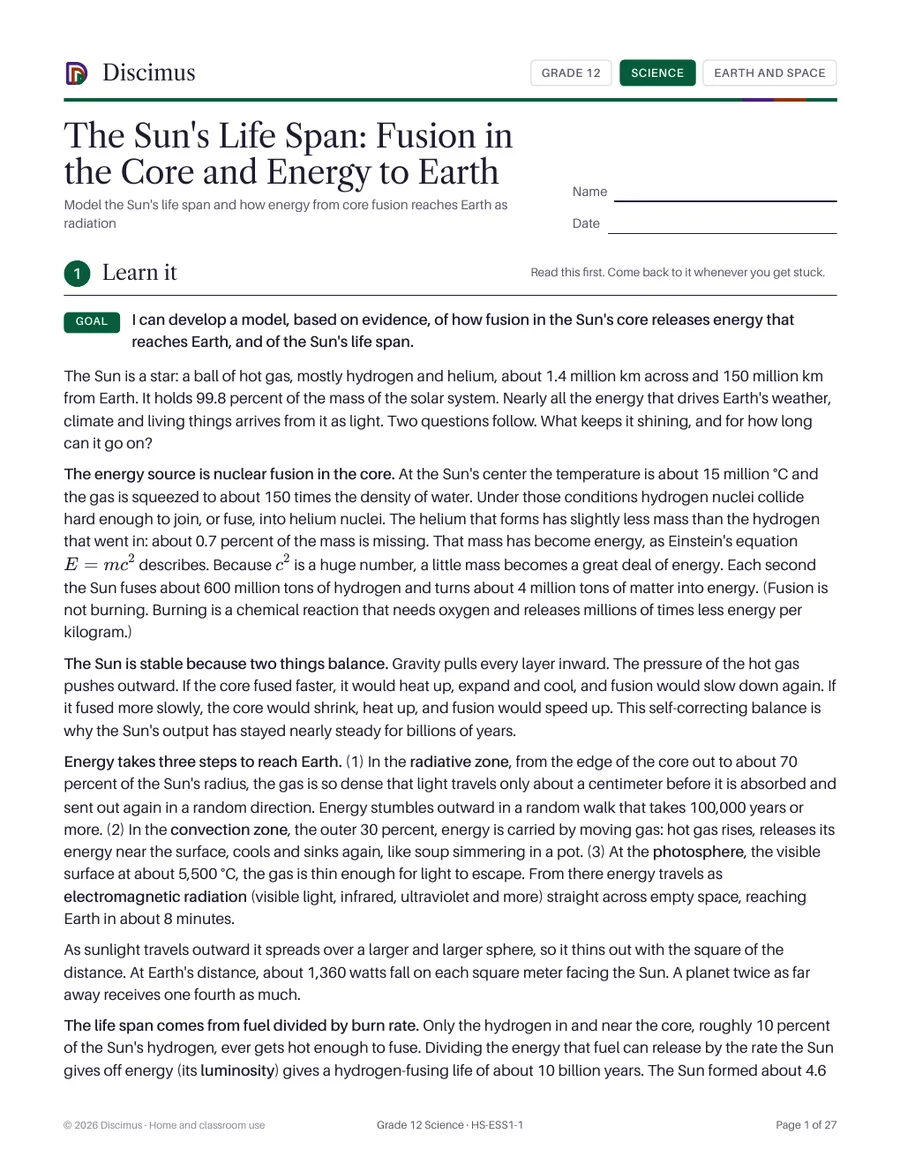
Model the Sun's life span and how energy from core fusion reaches Earth as radiation
Plan and carry out investigations of how water's properties change Earth materials
Evaluate competing designs for using energy and mineral resources with cost-benefit ratios
Explain from evidence how resources, hazards and climate change have shaped human activity
Use plate tectonics to explain the ages of oceanic and continental crustal rocks