Helpers in My Community
Identify community helpers and what they do
C3 Framework for Social Studies
History, geography, civics and economics.
Identify community helpers and what they do
Compare how city, suburb and country families get needs from nearby and from far away
Use a globe and simple maps to name nature features and people features of a place
Tell ways a flood, big storm, earthquake or wildfire can change life for people in a place
Tell how people change a place, and whether a change helps or hurts it
Tell how a place's natural features and the things people make there change over time
Tell how weather and climate change people's clothes, homes, work and play in a place
Connect a place's land, water and weather to the jobs and businesses found there
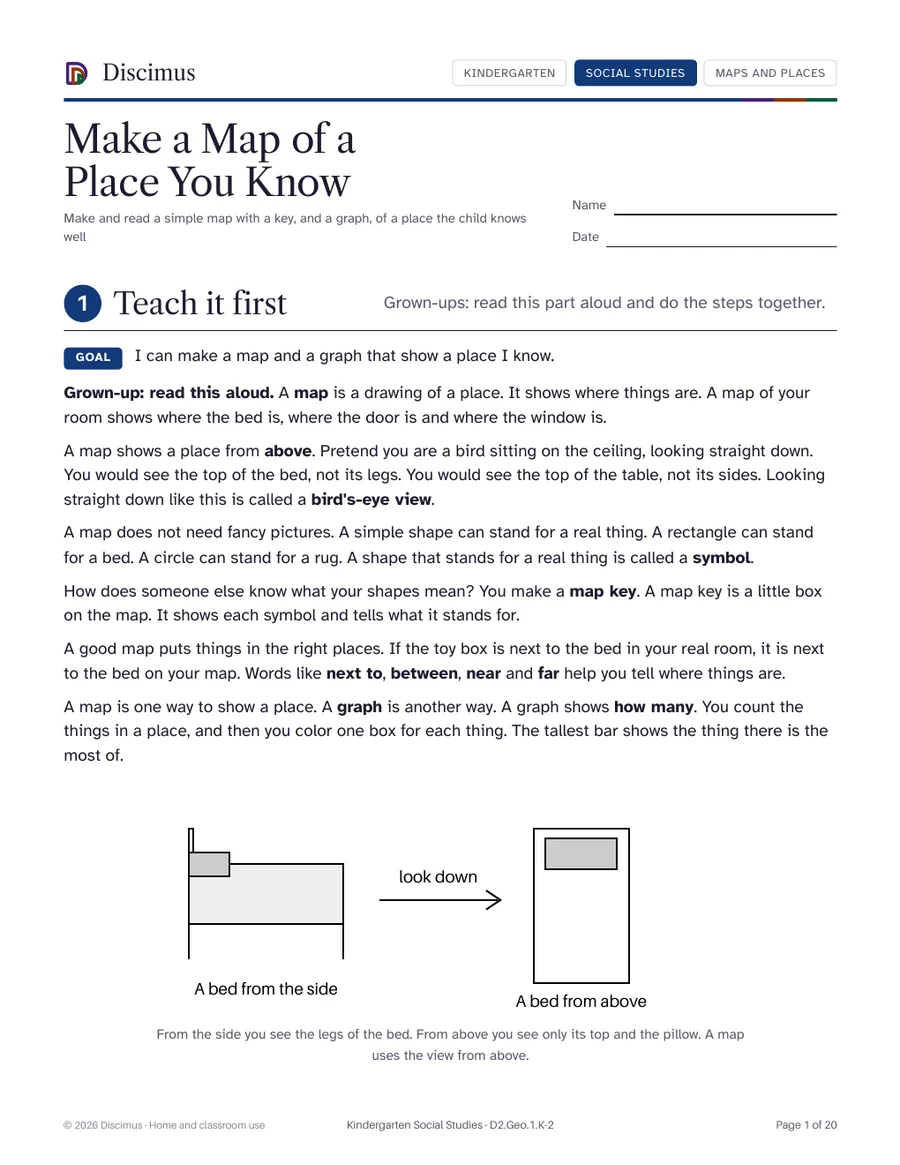
Make and read a simple map with a key, and a graph, of a place the child knows well
Explain that we must choose because there is not enough of everything we want
Tell why and how people, goods and ideas move from one place to another
Tell where things we use came from and how using them links us to people far away
Name the nature and people clues that make a specific place special
Ask questions about a source from the past and how it connects to life long ago
Ask who, what, when, where, why and how questions about people who made a big change
Explain how a source teaches about the past: look closely, think, wonder and check
Use civic virtues such as honesty, respect and responsibility in school settings
Name and sort kinds of historical sources: written, pictures, objects and spoken memories
Describe equality, fairness, and respect for fair rules and fairly chosen leaders
Explain how workers, volunteers, neighbors and kids, not only leaders, help a community
Describe how a community splits up shared jobs and what the people in charge do
Identify rules in school places and explain how each rule works and why
Compare daily life long ago with life today: what changed, what stayed the same and why
Explain how a class can work together to make a fair decision
Tell my own point of view and compare it with how other people see the same thing
Describe what a person in authority may decide and must do for the people in their care
Describe how people have worked to make their communities better, long ago and today
Compare how people long ago and people today think and feel about the same thing, and why
Put three or more events in time order and show them on a simple timeline
Use a map, a graph and pictures to describe a place and why things are where they are
Follow discussion rules, listen and respond to others, and help a group make a decision
Compare two accounts of the same event: what is the same, what is different, and why
Explain what a government is and name some of its jobs in a town, a state and a country
Use clues to choose which reason more likely explains an event from the past
Find who made a source, and when and where, from clues on the source itself
Think of possible reasons why something happened or changed in the past
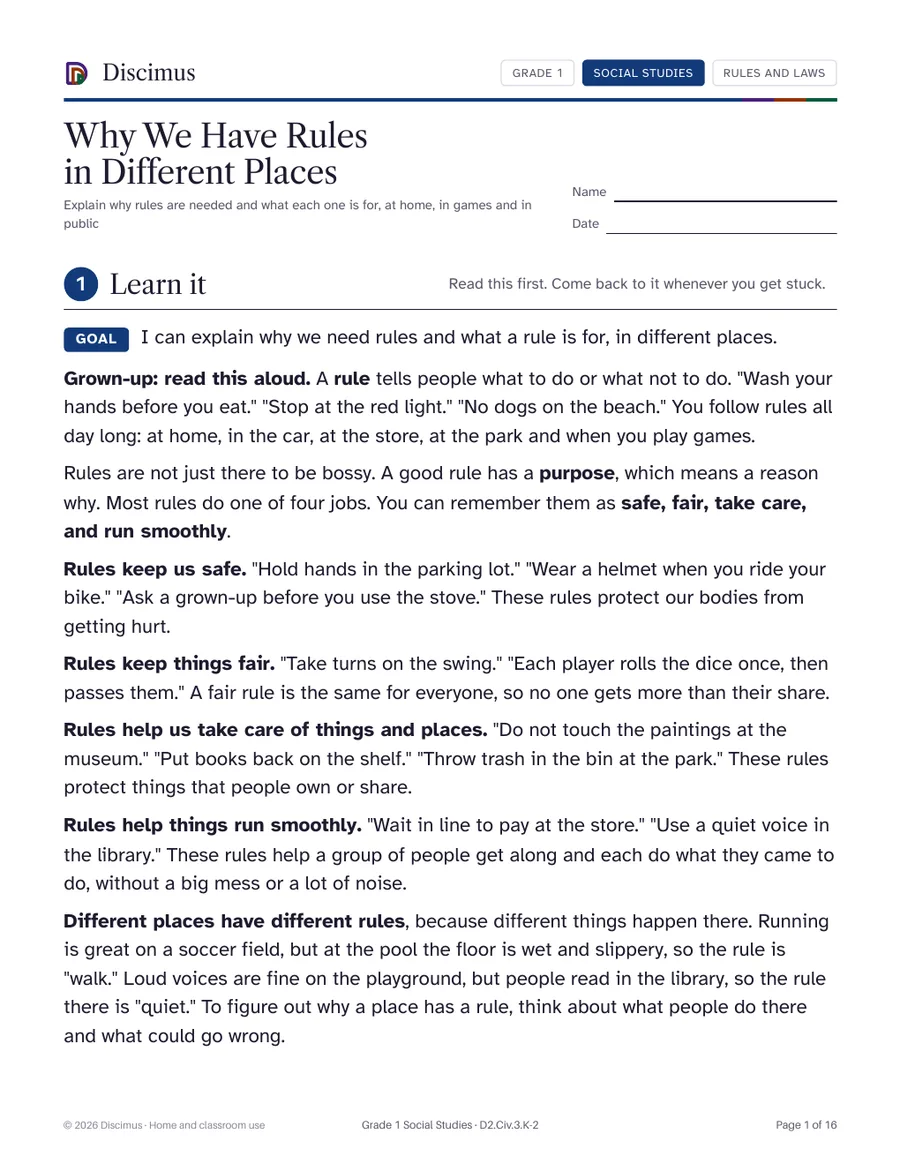
Explain why rules are needed and what each one is for, at home, in games and in public
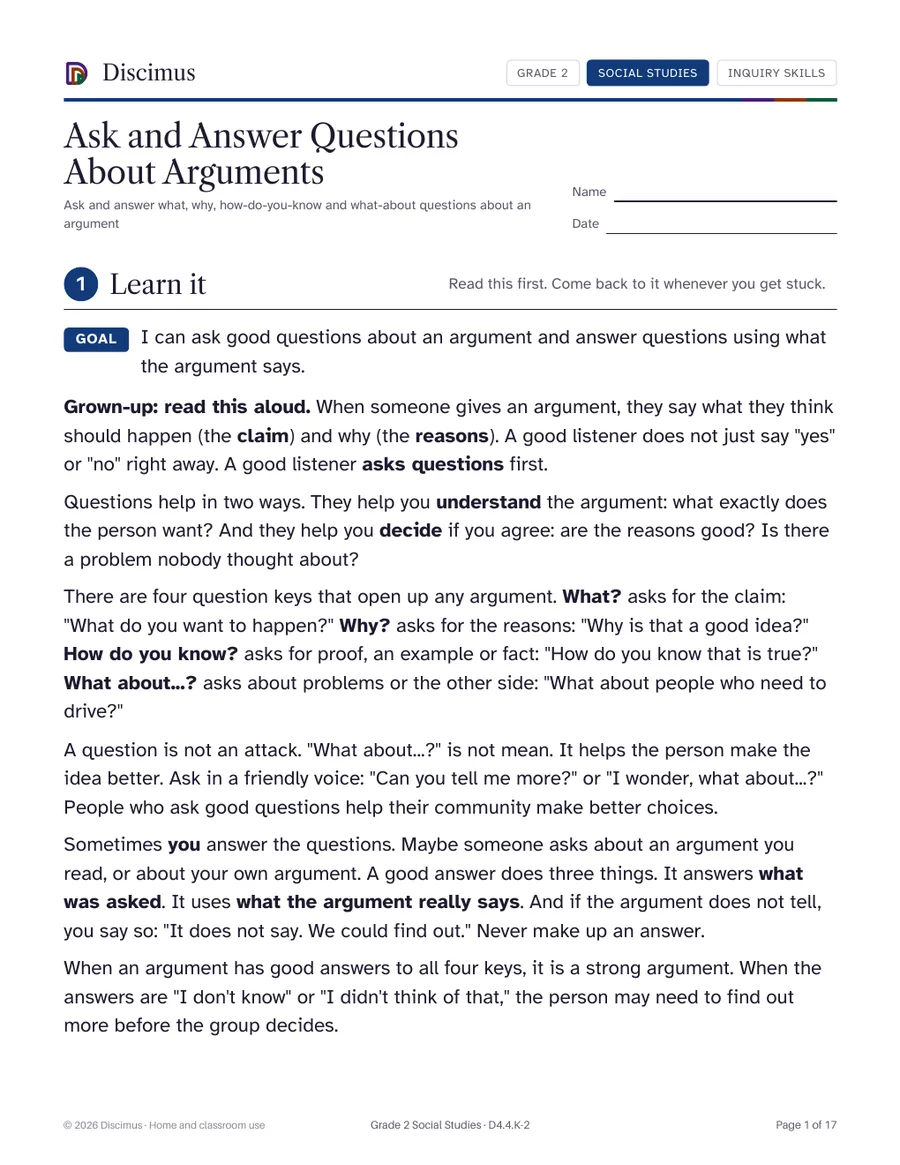
Ask and answer what, why, how-do-you-know and what-about questions about an argument
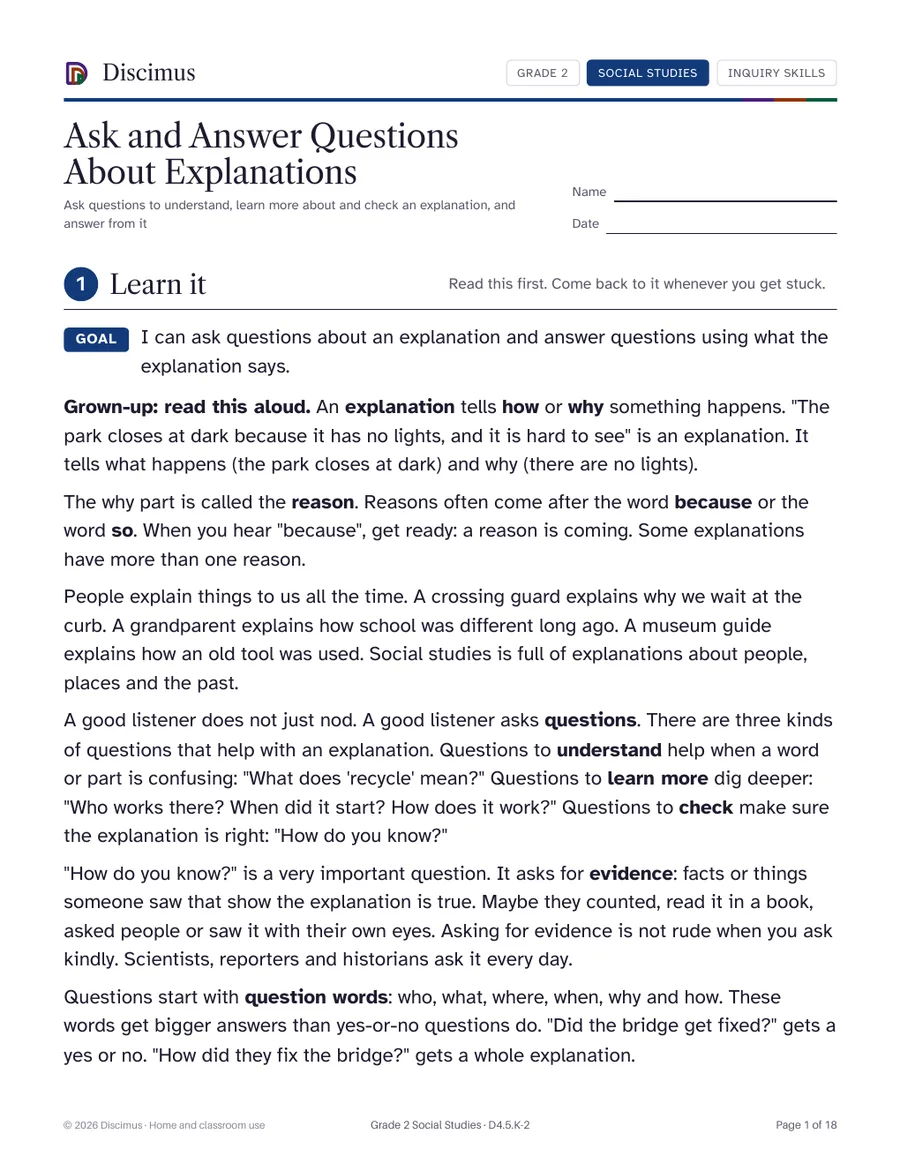
Ask questions to understand, learn more about and check an explanation, and answer from it
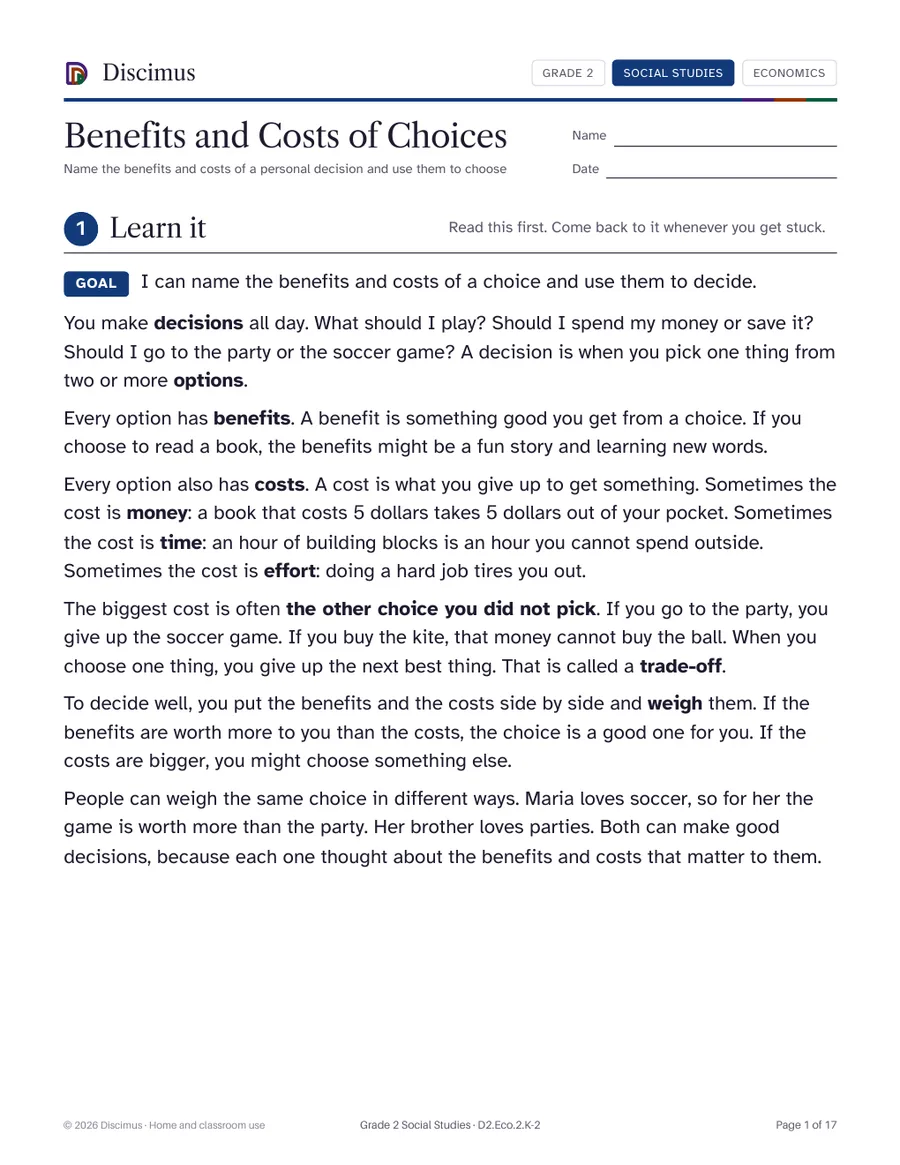
Name the benefits and costs of a personal decision and use them to choose
Choose the kinds of sources (maps, photos, people, objects) that help answer a question
Explain how something in a community happens, in order, with the facts that matter
Evaluate a source by telling facts from opinions and saying how a fact could be checked
Find the facts and big-idea words (concepts) that help answer a supporting question
Name civics, economics, geography and history ideas that connect to a big question
Describe goods and services made in our community and ones from other communities
Describe goods and services that town, state and national governments provide
Explain how people earn income by working for an employer or selling goods and services
Use listening, consensus and voting to make a fair group decision and act on it
Describe products made abroad and sold here, and products made here and sold abroad
State a claim about a shared choice and back it with two or more reasons that fit
Choose sources by who made them and how they are set up, then gather relevant facts
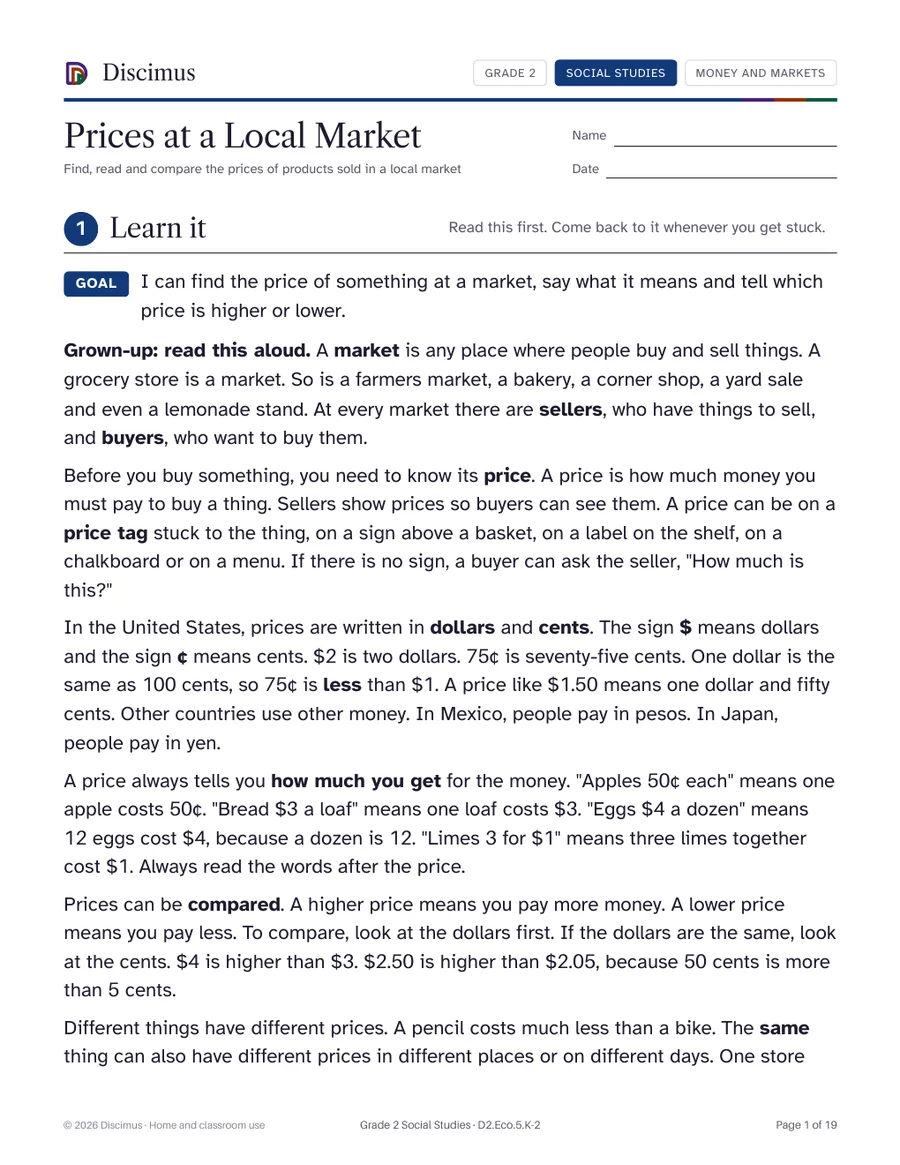
Find, read and compare the prices of products sold in a local market
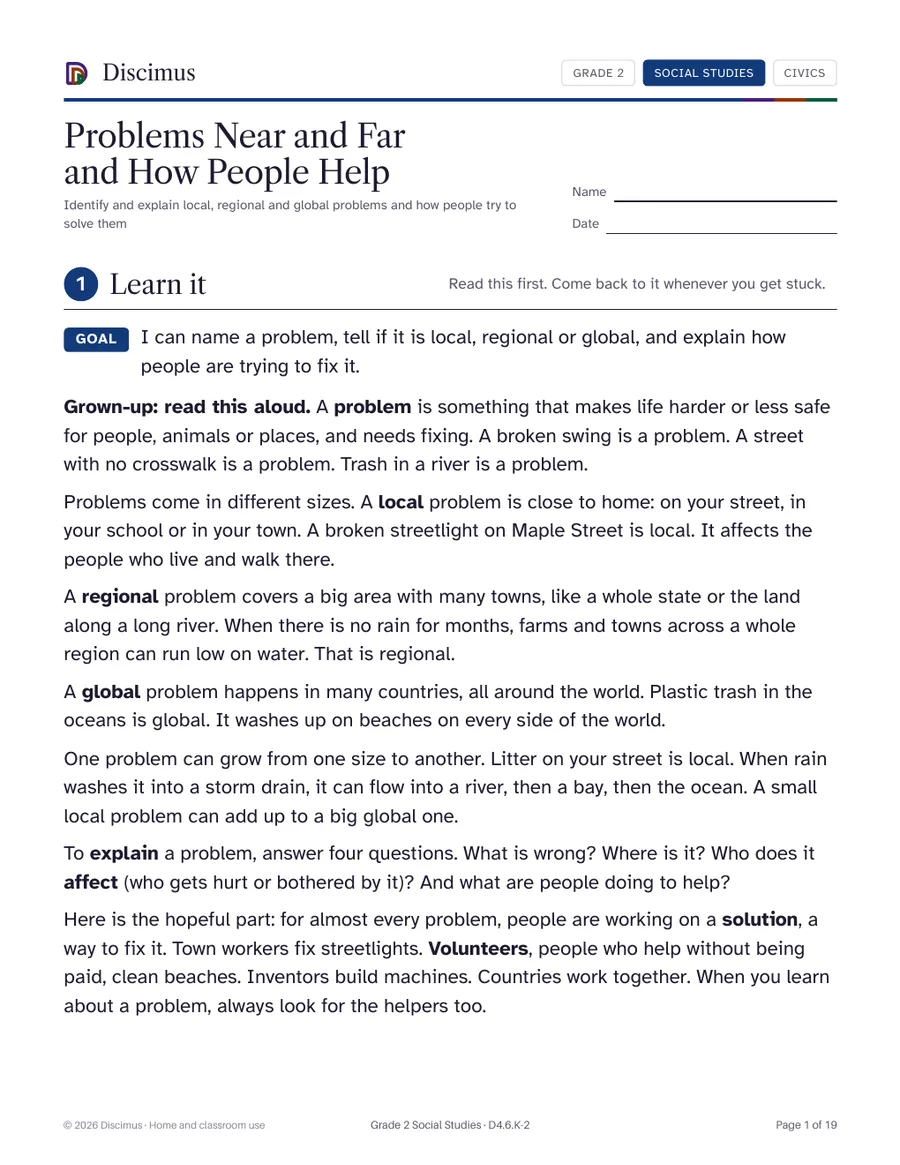
Identify and explain local, regional and global problems and how people try to solve them
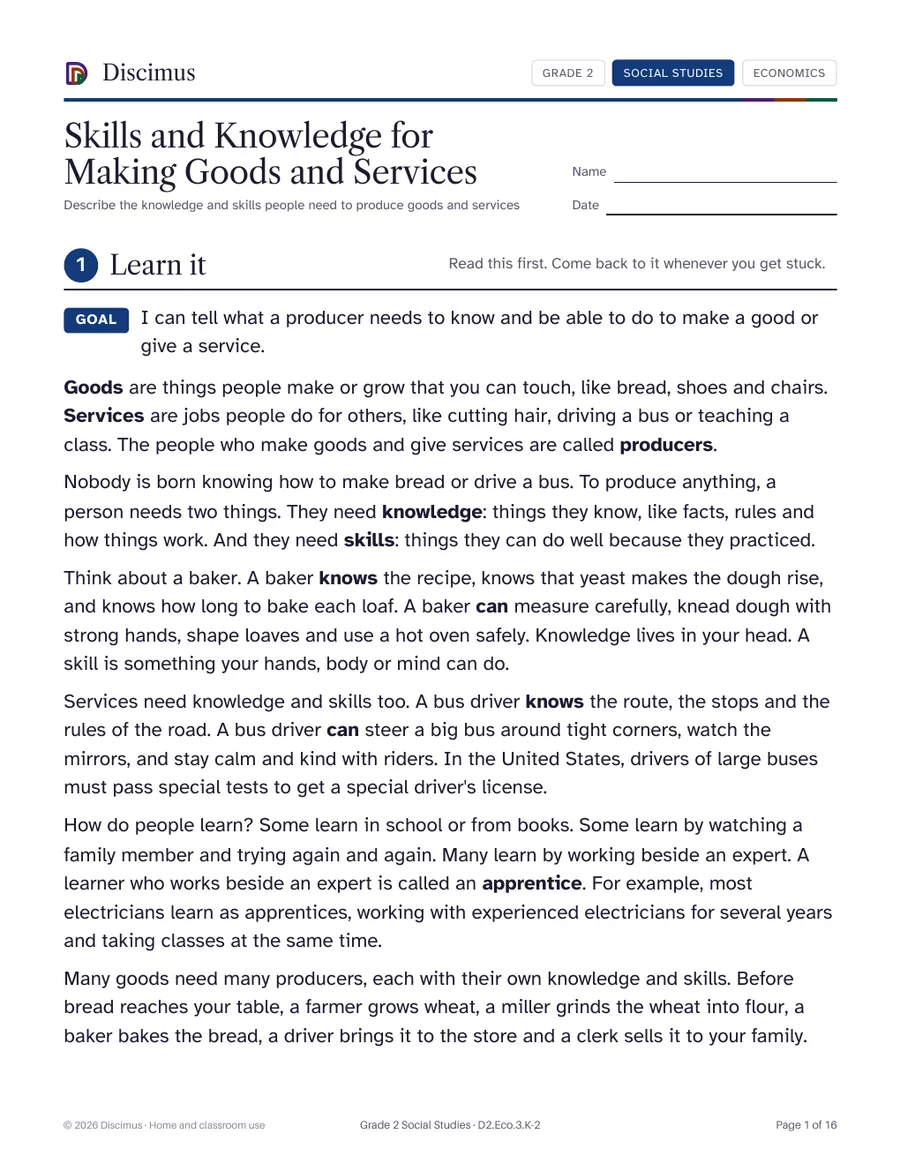
Describe the knowledge and skills people need to produce goods and services
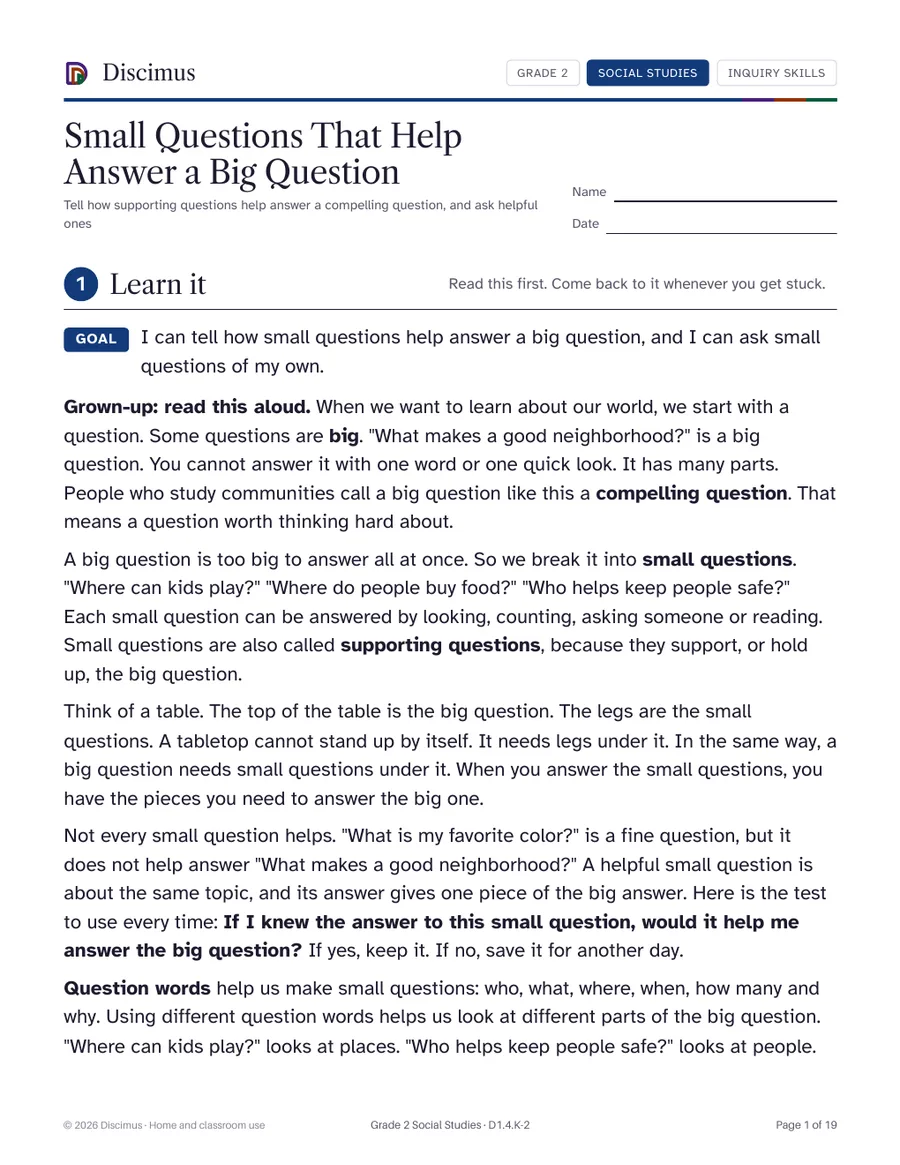
Tell how supporting questions help answer a compelling question, and ask helpful ones
Sum up an argument's claim and main reasons, then share it on paper, aloud or on a screen
Give examples of capital goods and human capital and tell how workers use both
Identify safe, fitting ways to take action on local, regional and global problems
Describe how banks keep money safe, help people save and lend money to others
Describe the costs a producer pays to make and sell a good or a service
Explain why a big (compelling) question matters to me, with reasons from my own life
Explain why people in one country trade goods and services with people in other countries
Explain the reasons people save money and what saving asks them to give up now
Explain how natural and technological disasters change towns and make people move
Identify the civic virtues and democratic principles that guide government and communities
Explain how nature and ways of life shape where people live in a region
Explain how a group's culture shapes the way it changes and adapts to its environment
Explain the steps communities follow to make a policy that solves a public problem
Explain how where people settle and move relates to natural resources and their use
Apply civic virtues and democratic principles to real choices in a class, co-op or club
Explain how a democracy relies on responsible participation and how people should join in
Explain the origins, jobs and structure of governments, including U.S. and state ones
Explain how groups make rules that create responsibilities and protect freedoms
Explain how laws change society and the peaceful ways people work to change laws
Make maps of known and unknown places with a title, key, compass rose, grid and scale
Explain how nature and culture shape the movement of people, goods and ideas
Illustrate the ways people have worked to change society, long ago and today
Explain how a natural or human-made disaster in one place affects people in other places
Use the steps of deliberation to reach a fair, well-reasoned group decision
Use maps, graphs and images to explain how a place's location shapes its environment
Explain how the environmental and cultural characteristics of a place change over time
Explain the origins and purposes of rules, laws and key parts of the U.S. Constitution
Describe how links with nearby and faraway places change where work happens in a place
Compare the procedures groups use to make decisions in classrooms, schools and governments
Explain why world regions have different climates, plants and animals
Identify the values, beliefs, experiences and perspectives behind views on civic issues
Describe how people benefit from and are challenged by working together in groups
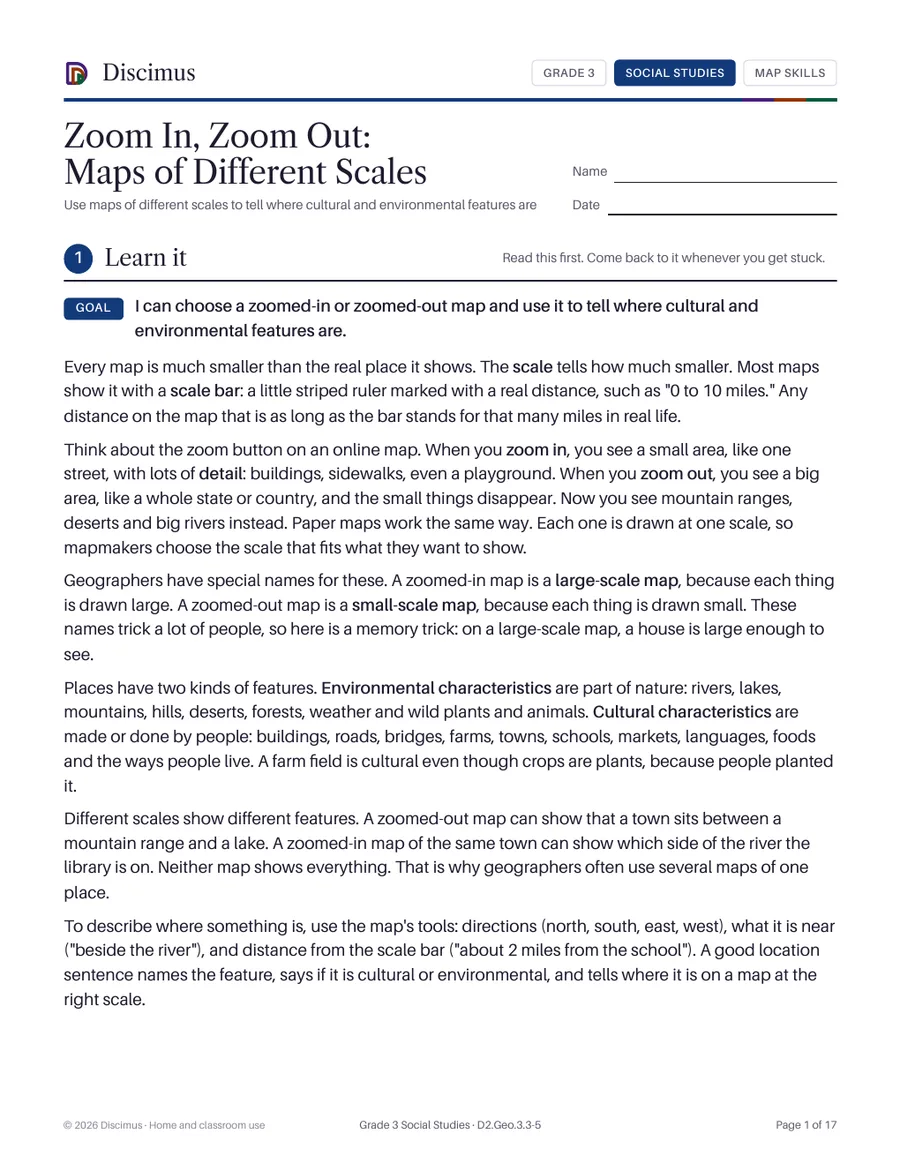
Use maps of different scales to tell where cultural and environmental features are
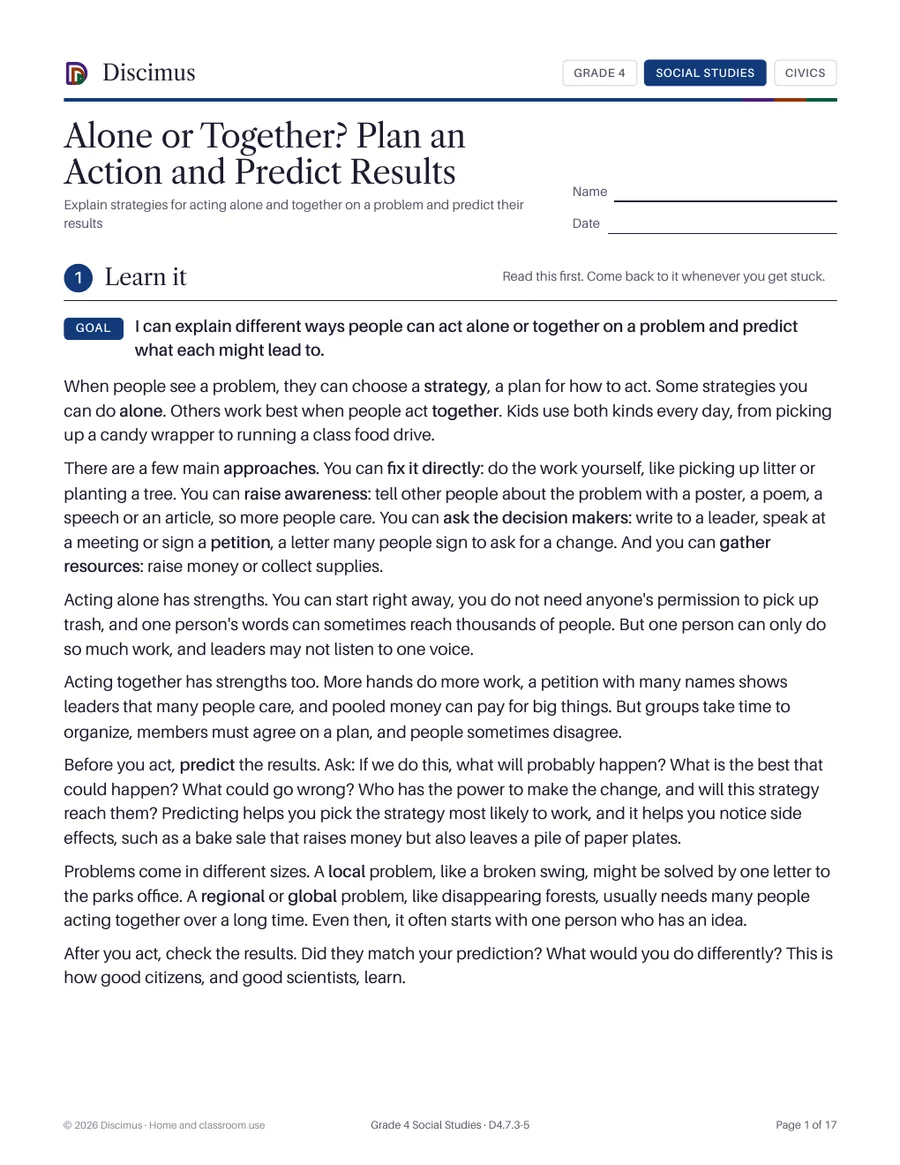
Explain strategies for acting alone and together on a problem and predict their results
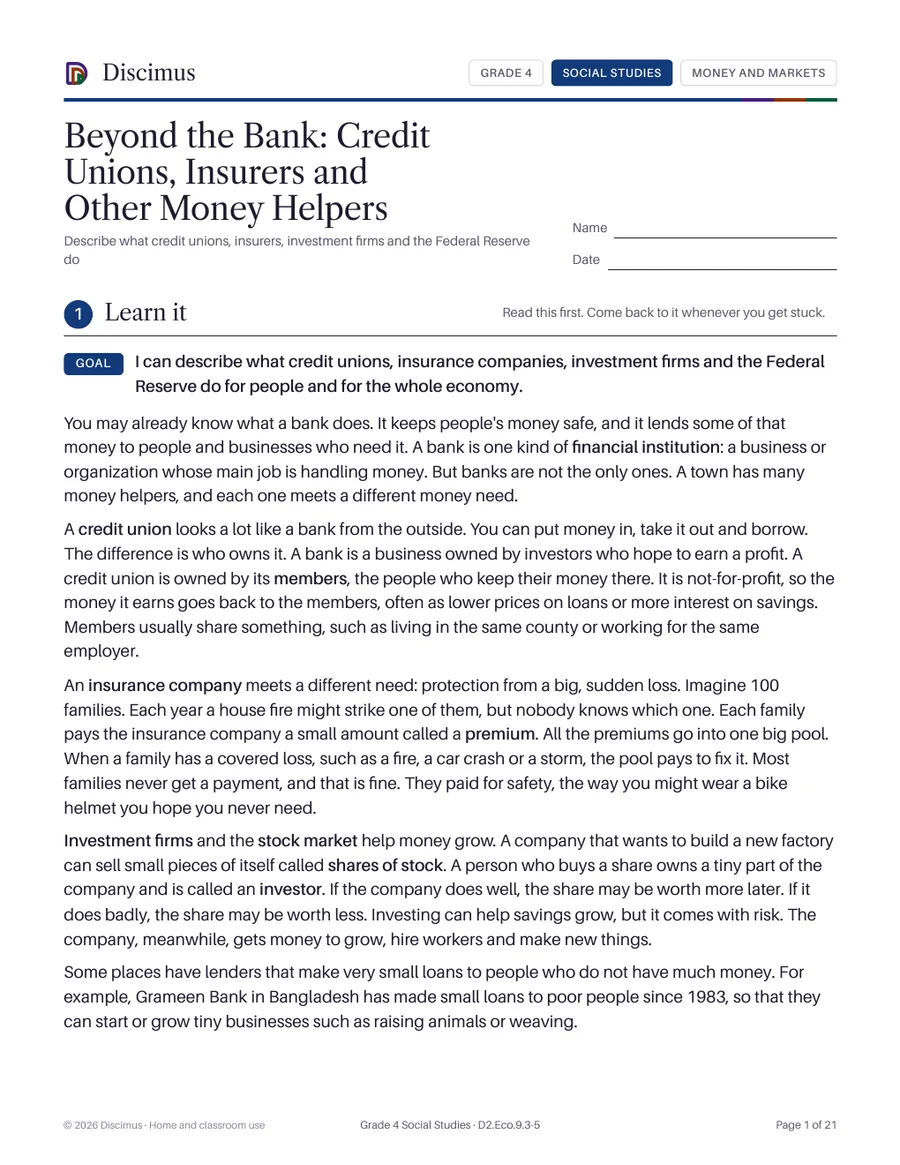
Describe what credit unions, insurers, investment firms and the Federal Reserve do
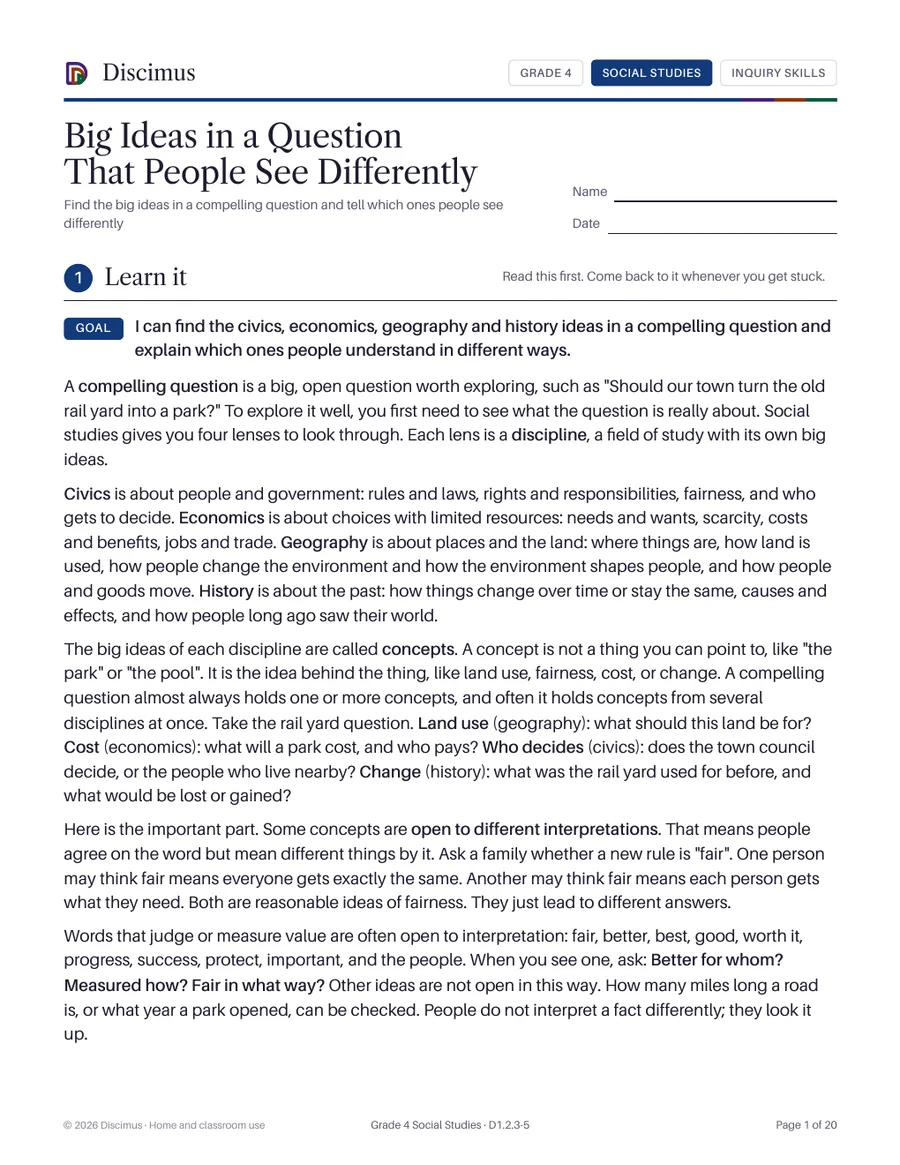
Find the big ideas in a compelling question and tell which ones people see differently
Build an argument with a claim, evidence from several sources, and reasoning
Use evidence from sources to make and support a claim that answers a compelling question
Compare the benefits and costs of a choice, including its opportunity cost
Choose sources that answer inquiry questions, including sources from people who disagree
Critique an argument by testing its evidence, reasoning and fairness
Use discussion, meeting steps and voting rules to make and act on decisions at school
Explain how or why something happened using sequence, reasoning, examples and data
Tell facts from opinions and use the difference to judge how credible each source is
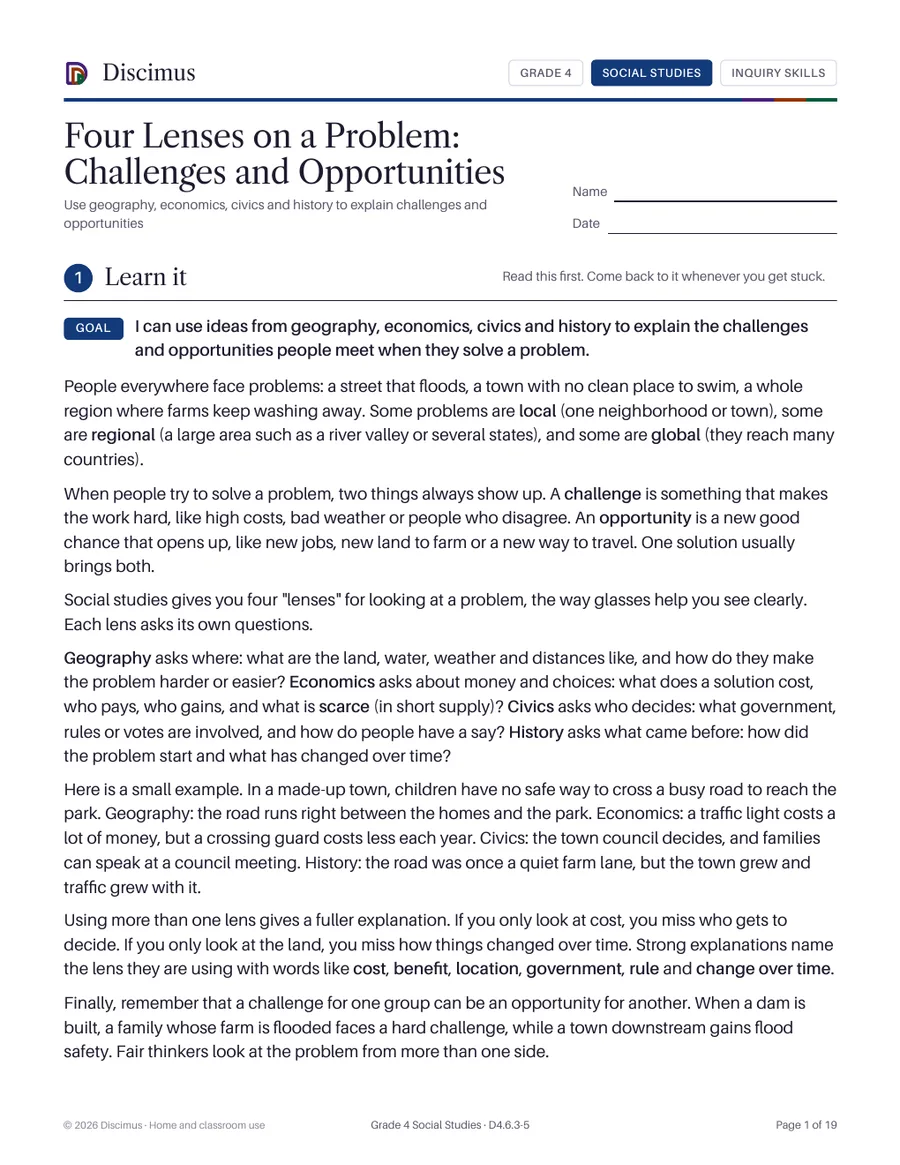
Use geography, economics, civics and history to explain challenges and opportunities
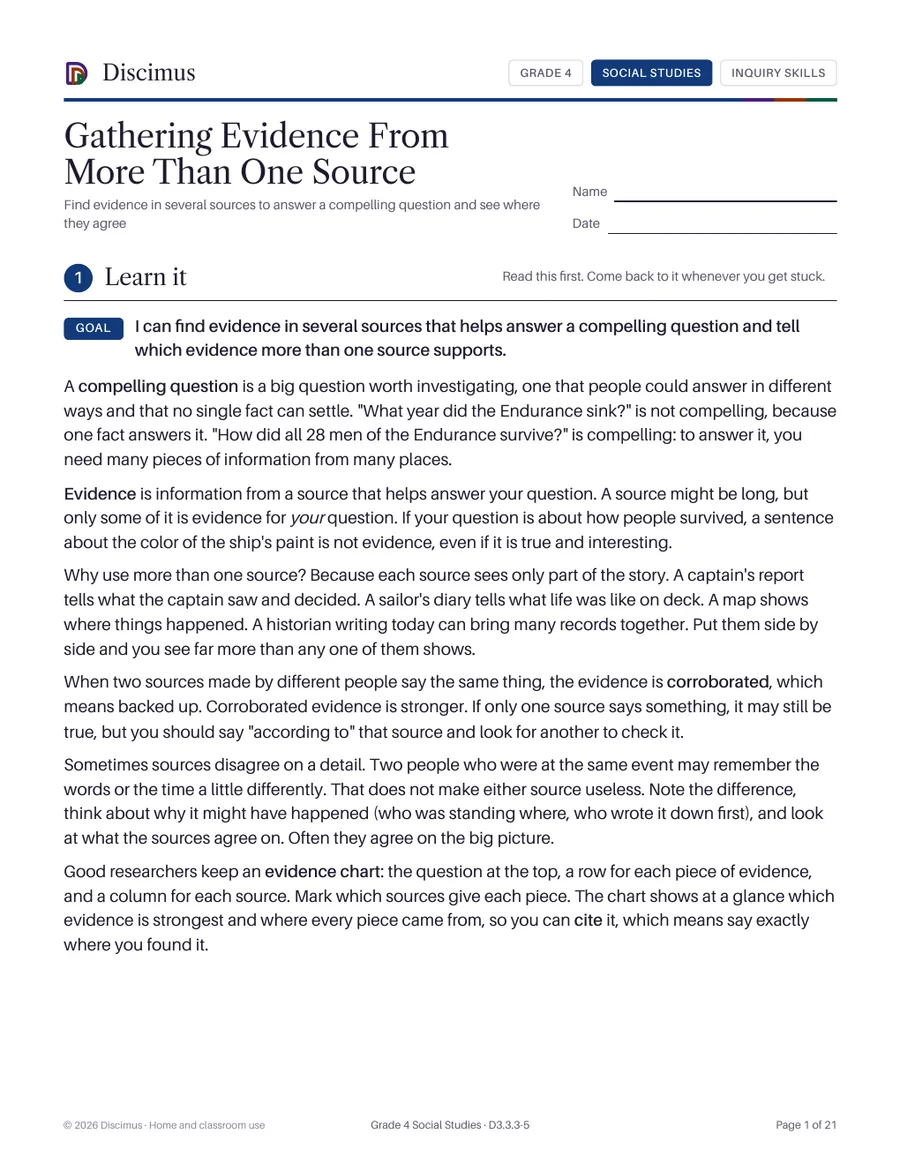
Find evidence in several sources to answer a compelling question and see where they agree
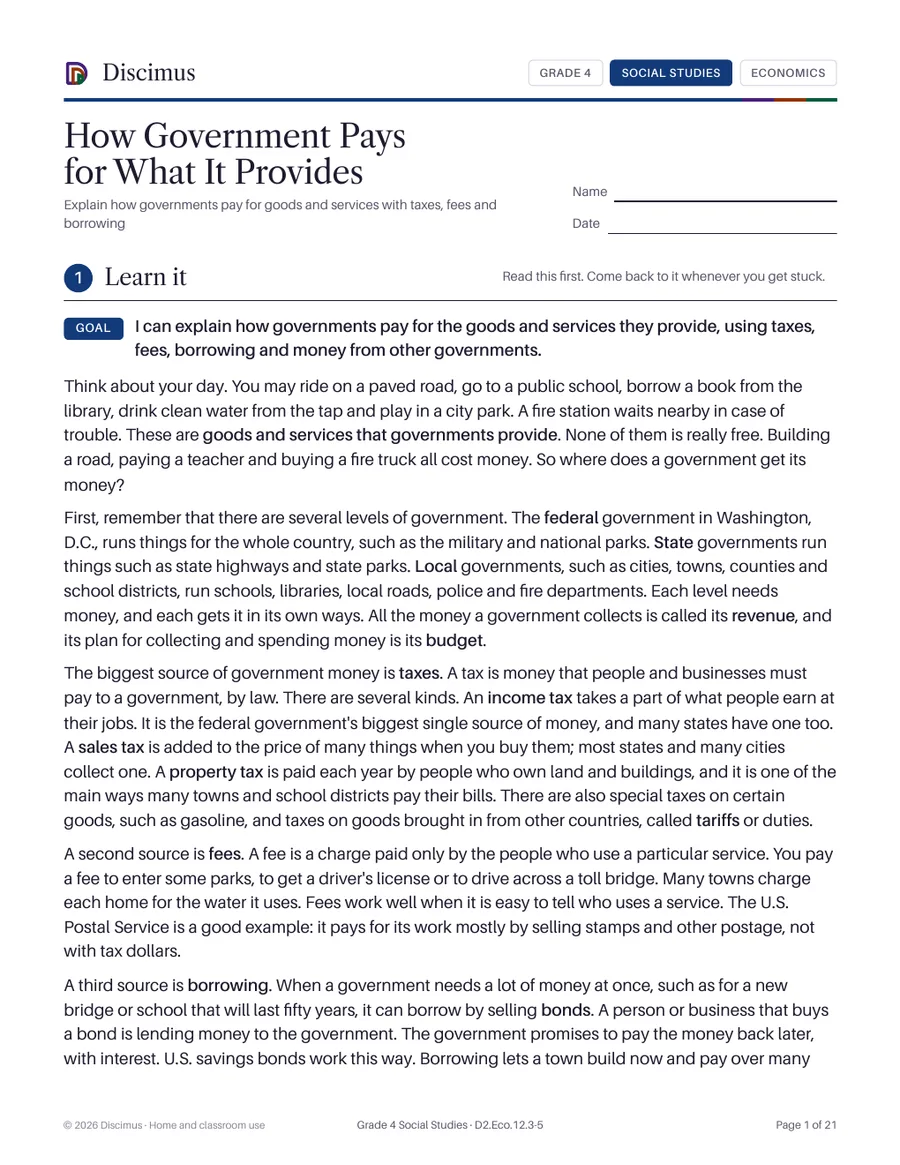
Explain how governments pay for goods and services with taxes, fees and borrowing
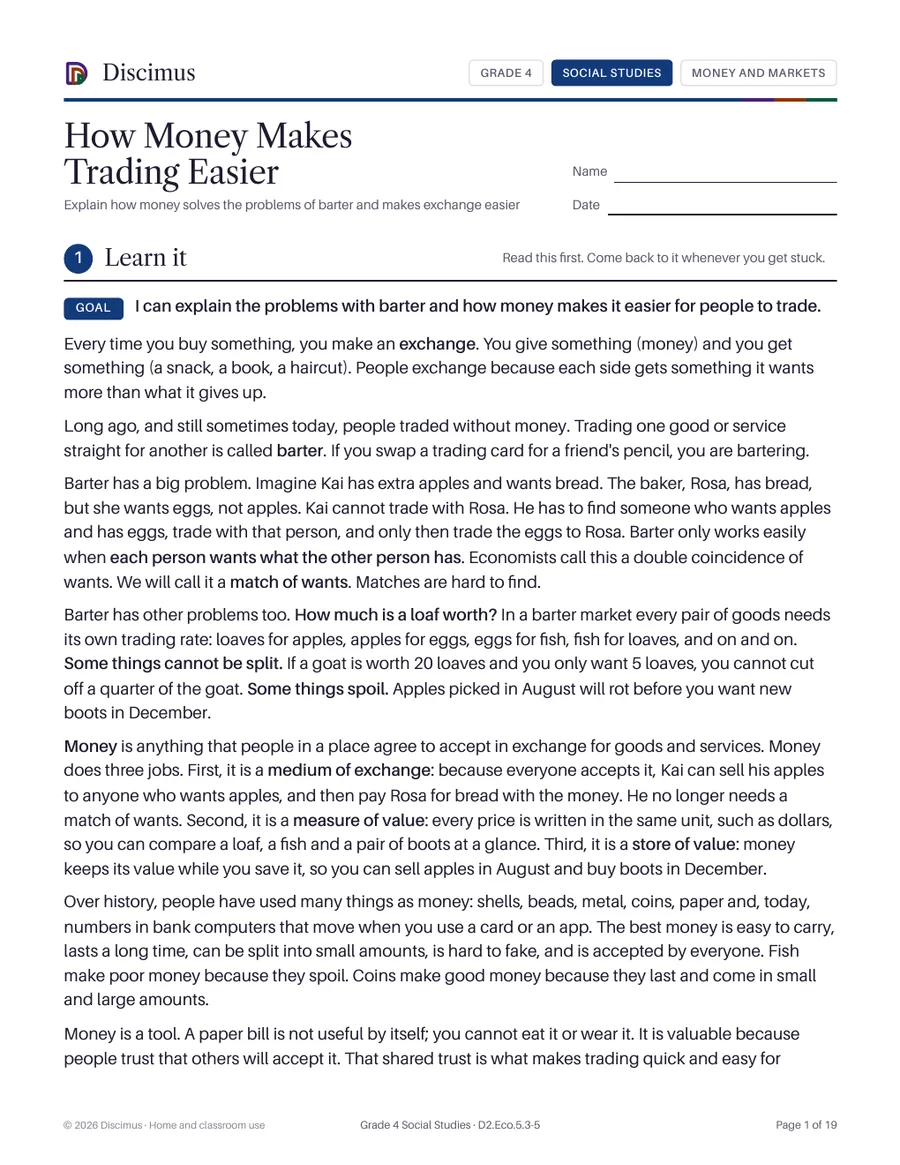
Explain how money solves the problems of barter and makes exchange easier
Calculate profit and explain how profit and loss change what sellers make and sell
Explain inflation, deflation and unemployment and recognize each in prices and job data
Explain what an interest rate is and find the interest a saver earns or a borrower pays
Critique an explanation by checking its question, facts, evidence and because-links
Explain how investing in skills raises productivity and can raise future income
Explain how trade makes nations depend more and more on one another
Explain how better capital goods and more human capital raise productivity
Identify the natural resources, human capital and physical capital used in production
Find the big ideas in a supporting question and tell which ones are open to interpretation
Choose useful sources for a question by checking each one's origin, structure and context
Identify positive and negative incentives and explain how they change people's decisions
Summarize an argument or explanation and present it to a real audience in a fitting format
Identify external benefits and costs that fall on people outside a choice or trade
Explain how supporting questions help answer a compelling question in an inquiry
Explain how growing trade between nations affects different groups within each nation
Explain why a compelling question is important to peers, adults and the wider community
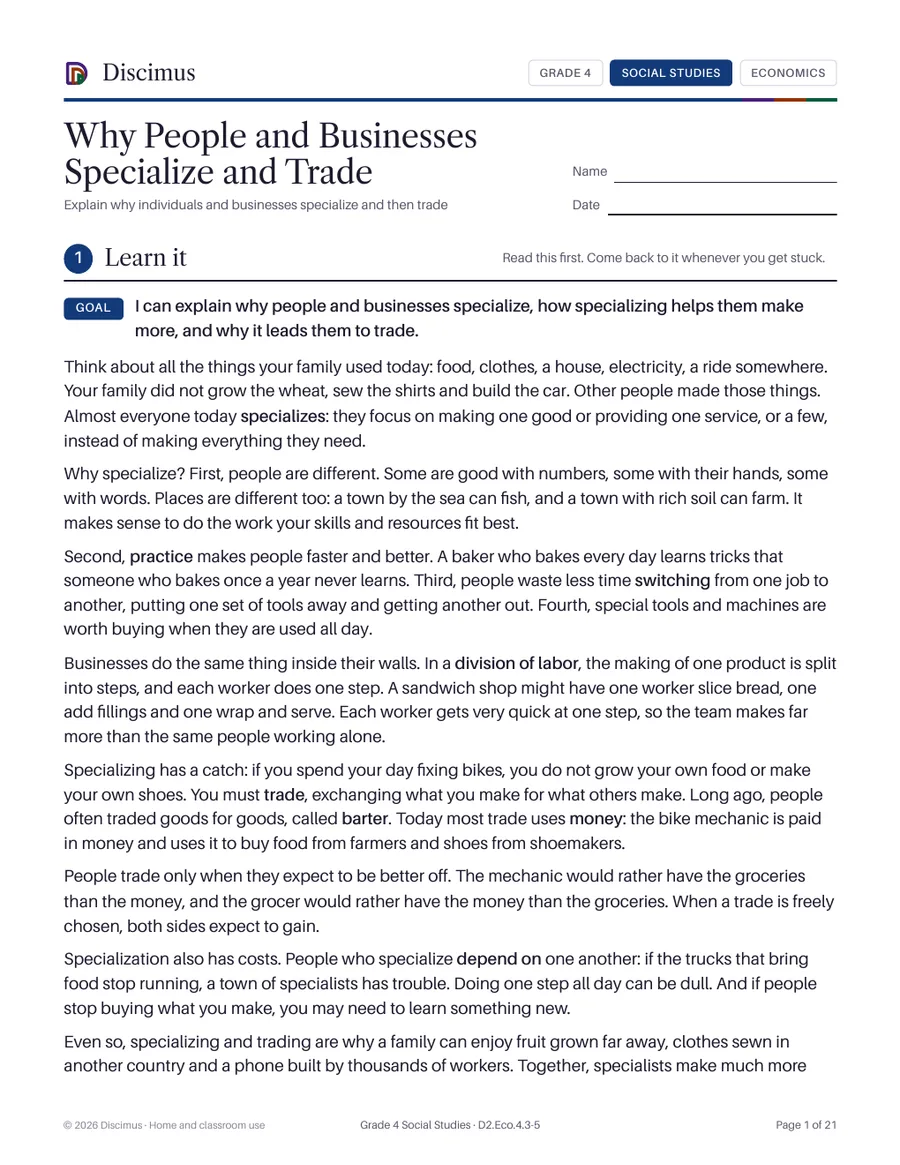
Explain why individuals and businesses specialize and then trade
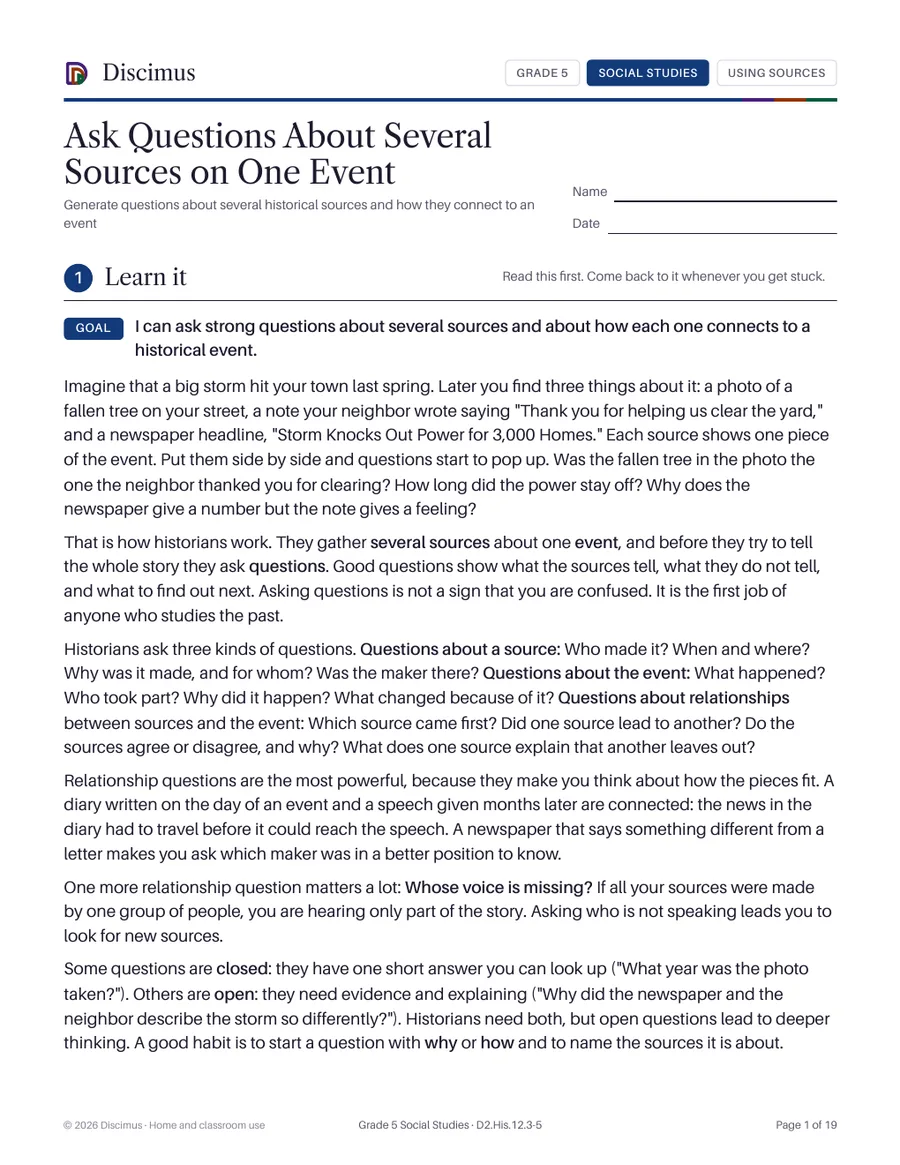
Generate questions about several historical sources and how they connect to an event
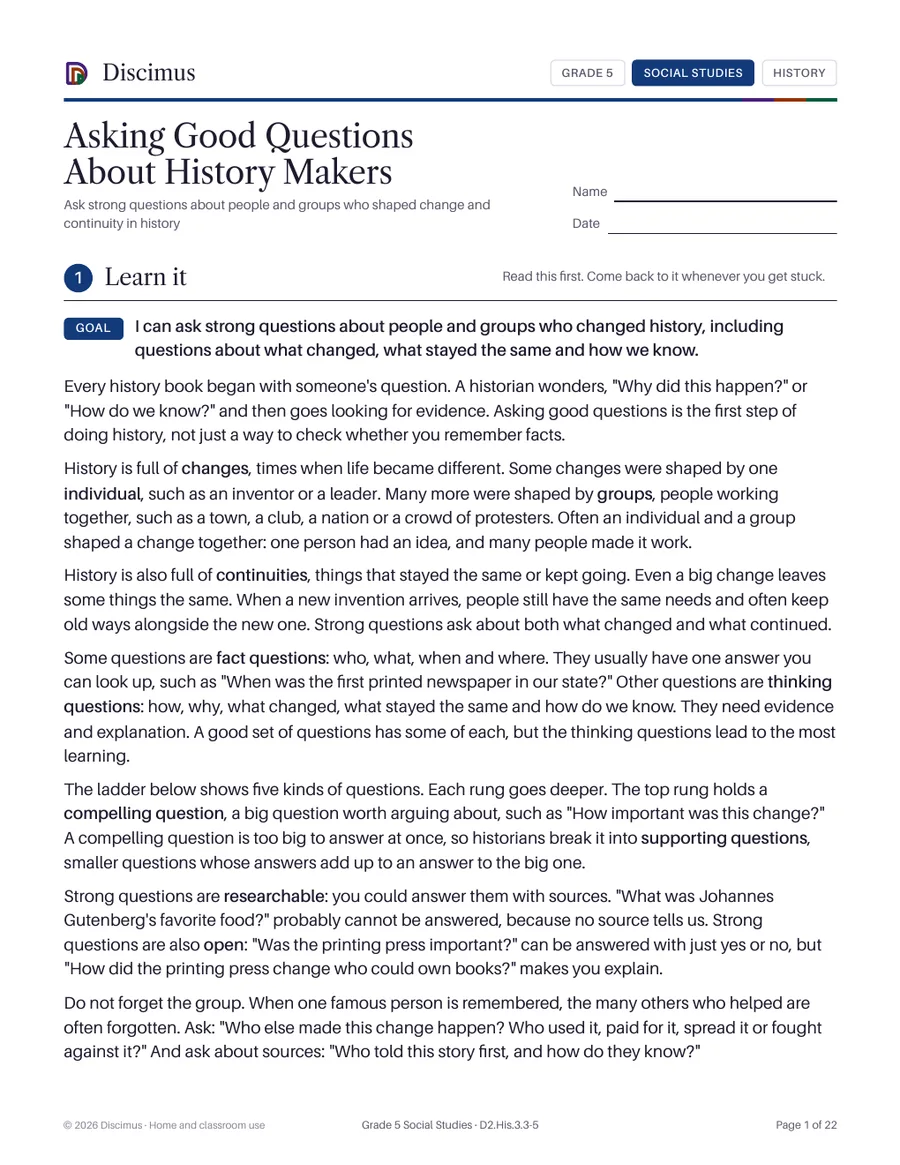
Ask strong questions about people and groups who shaped change and continuity in history
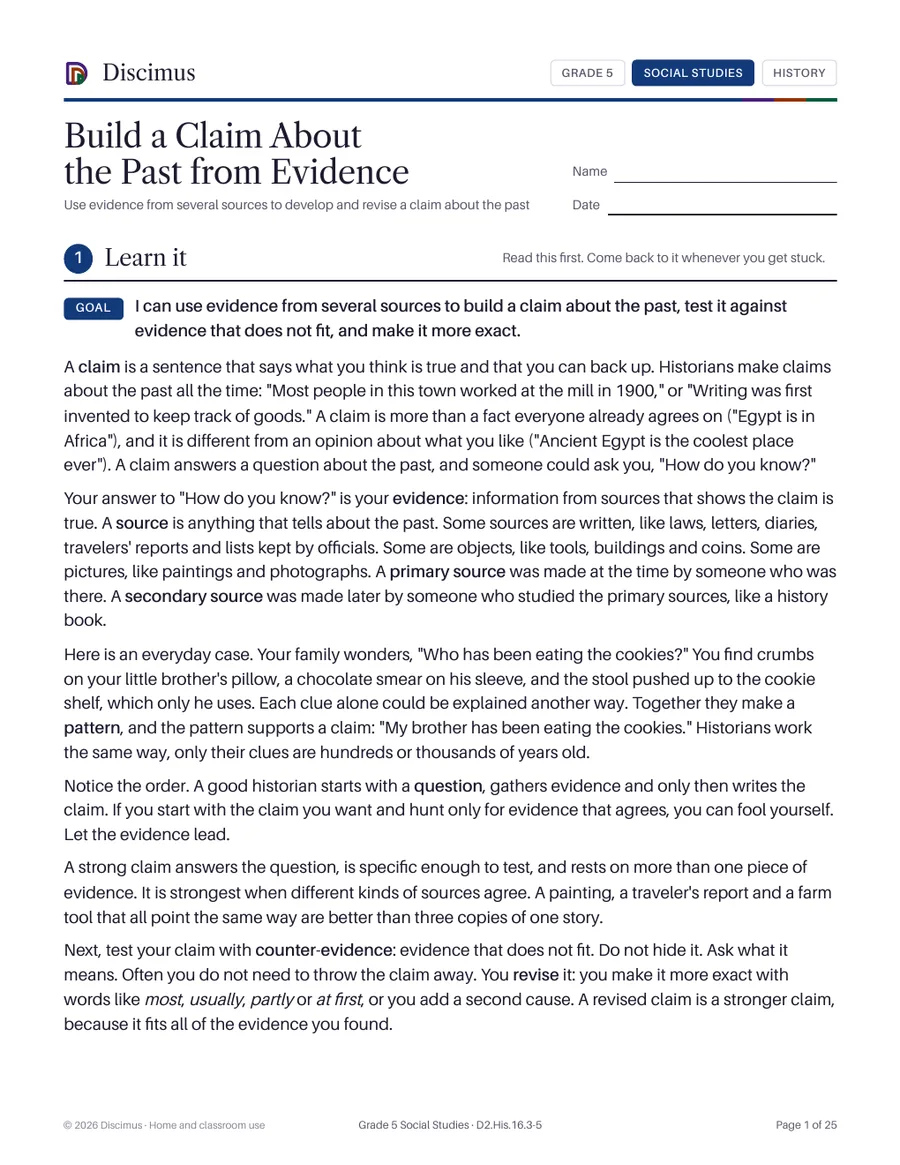
Use evidence from several sources to develop and revise a claim about the past
Summarize how different kinds of historical sources are used to explain past events
Compare information provided by different historical sources about the same past event
Explain why people living at the same time in history had different perspectives
Judge a source's usefulness for a topic from its maker, date, place, audience and purpose
Build and use a parallel timeline to compare events happening at the same time
Explain the probable causes and effects of a historical event or development with evidence
Compare daily life on a Great Plains homestead in the 1870s and 1880s with life today
Distinguish officials' powers and responsibilities across branches, levels and places
Explain connections between historical context and people's perspectives at the time
Find and summarize the central claim and main points of a secondary history work
Infer a historical source's intended audience and purpose from clues inside the source
Describe how people's perspectives shaped the historical sources they created
Compare places by their mix of cultural and environmental traits and explain why
Build an argument from several sources and state its strengths and limitations
Critique the structure of an explanation: thesis, pattern, links, evidence and conclusion
Critique an argument's credibility by checking its source, evidence and reasoning
Choose the kinds of sources an inquiry needs, including sources from several viewpoints
Develop a claim and a counterclaim and weigh the strengths and limitations of each
Support a claim with evidence from several sources and name each source's limitations
Explain why something happened with sequence, examples and data, and judge the explanation
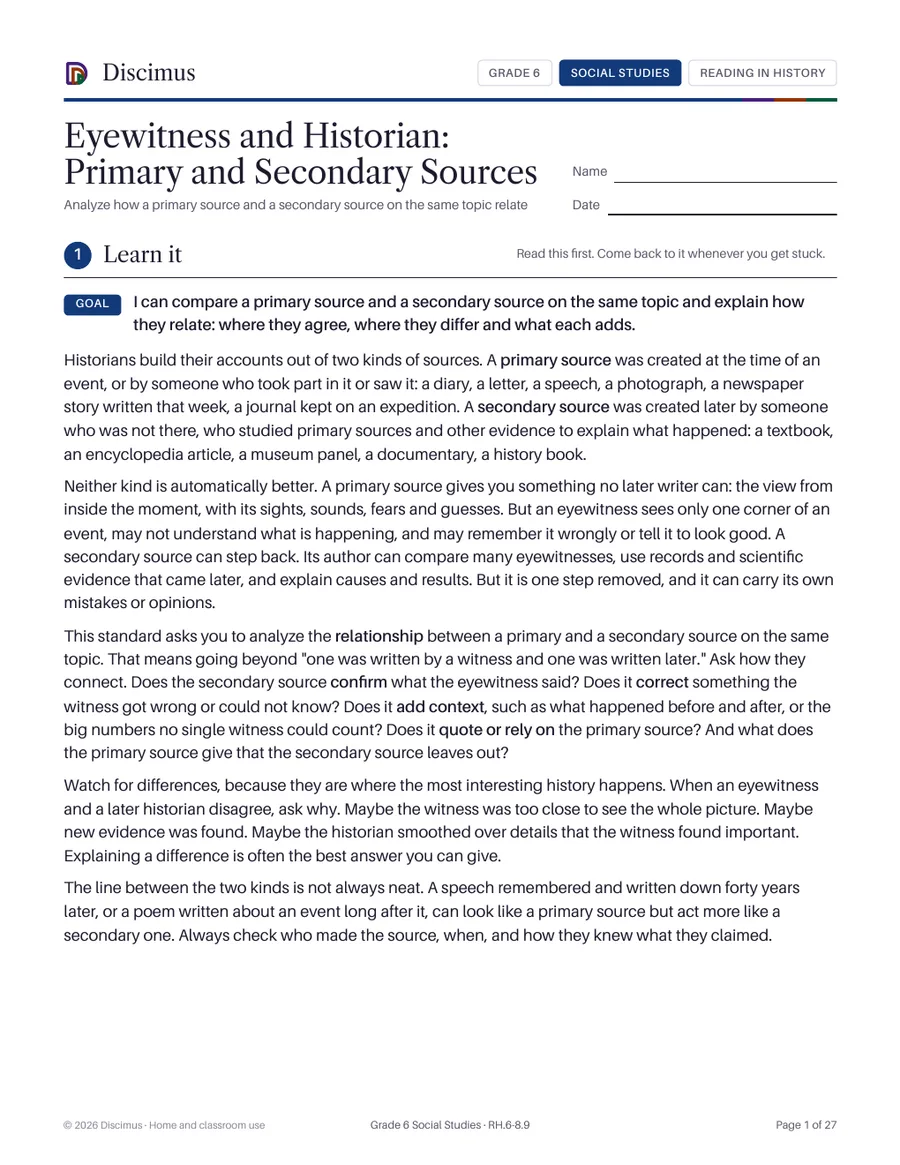
Analyze how a primary source and a secondary source on the same topic relate
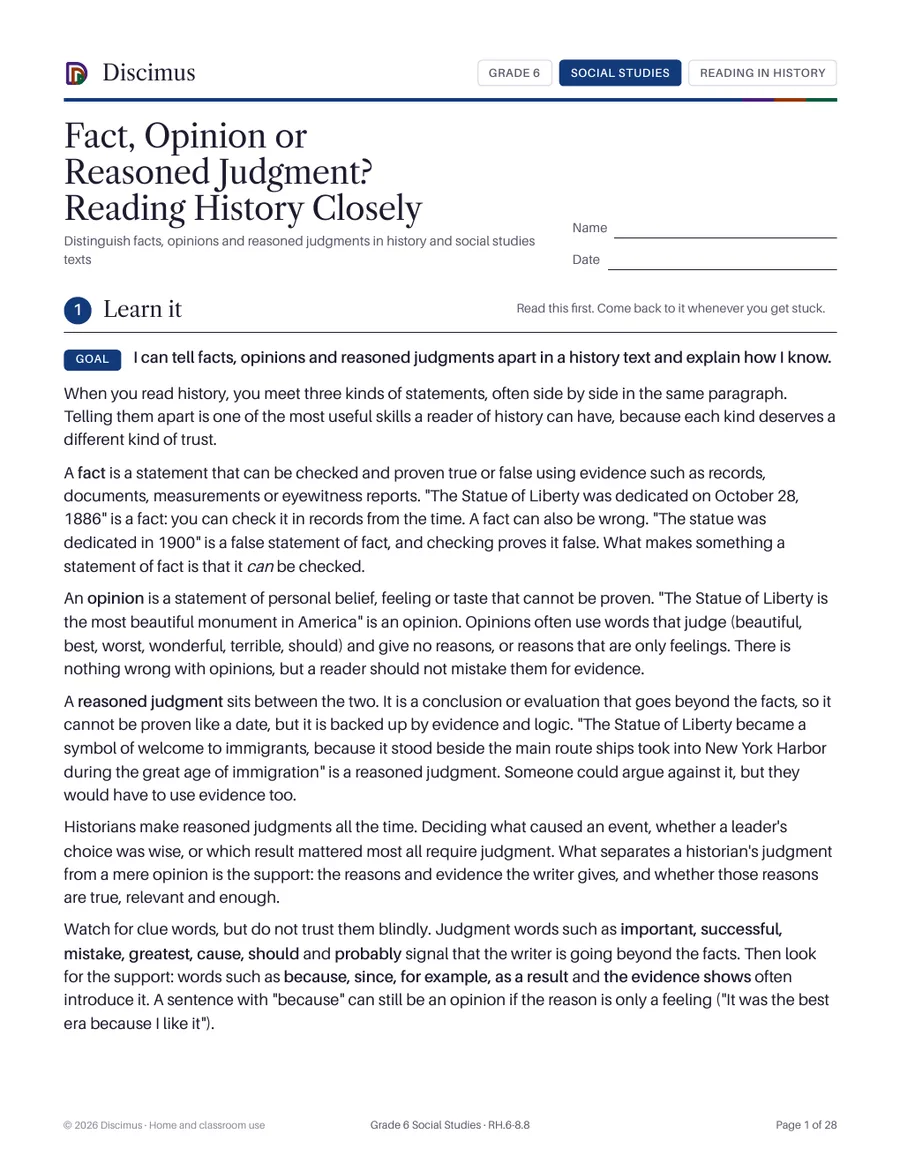
Distinguish facts, opinions and reasoned judgments in history and social studies texts
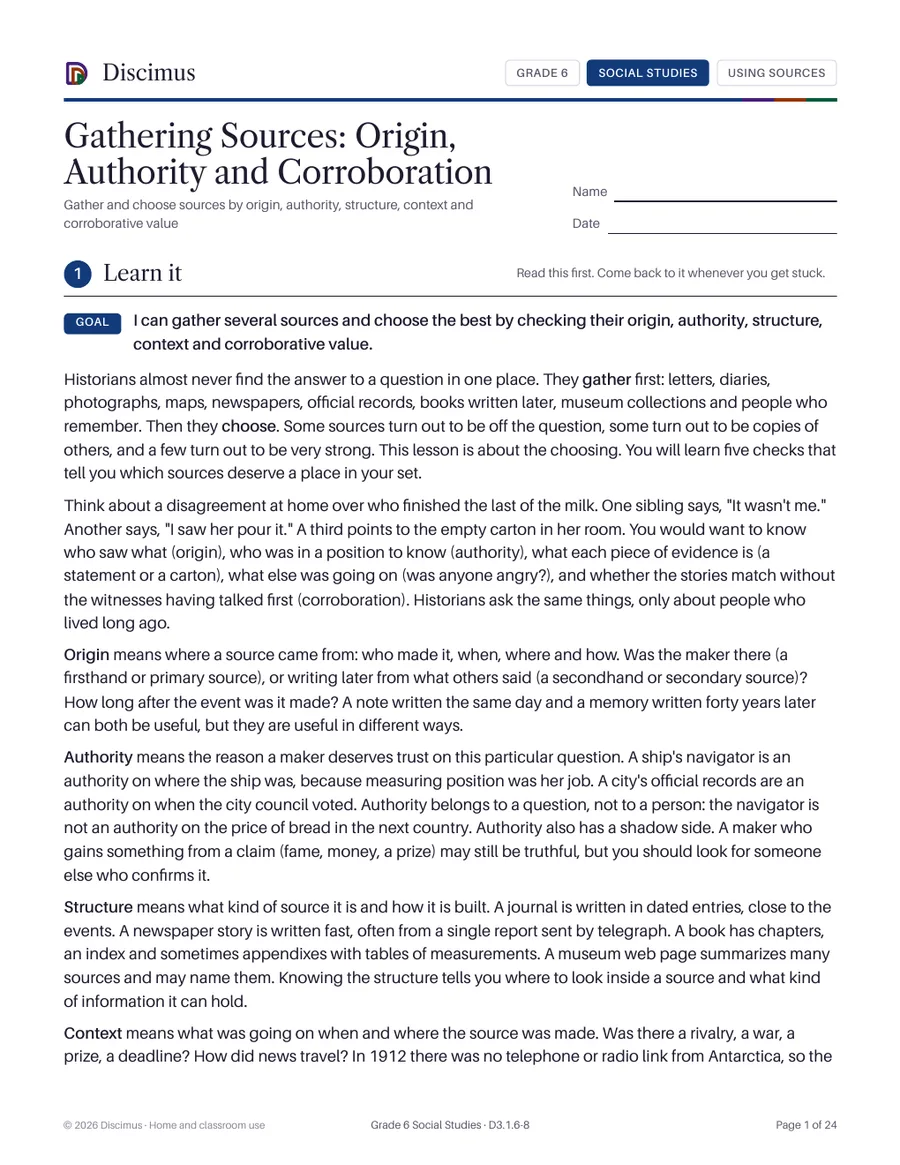
Gather and choose sources by origin, authority, structure, context and corroborative value
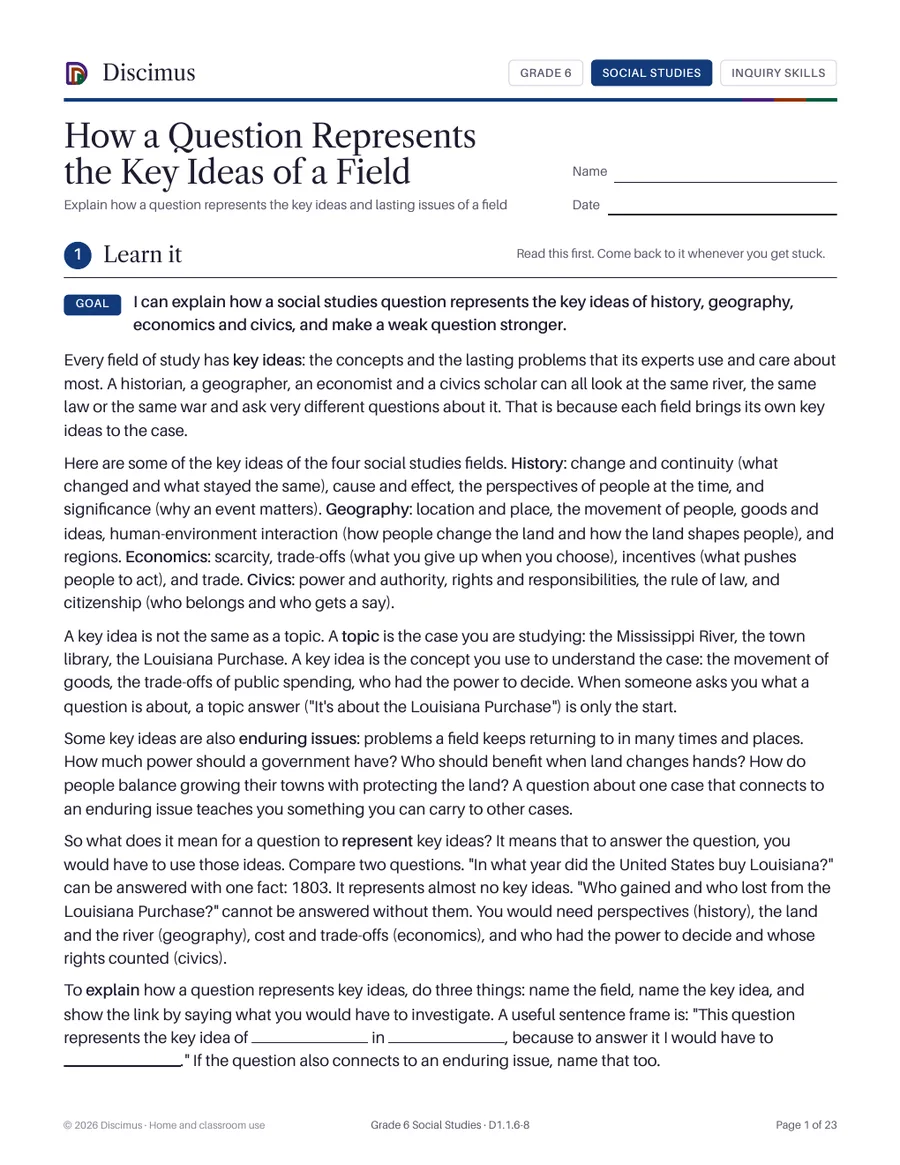
Explain how a question represents the key ideas and lasting issues of a field
Explain how culture and economic choices change environments and lives near and far
Describe how a history text presents information: sequence, comparison, cause and effect
Judge a source's credibility for a question by its relevance and its intended use
Explain how physical and human characteristics of places connect to identity and culture
Build thematic maps from data and explain patterns of cultural and environmental features
Use paper and electronic maps and graphs to show and analyze spatial patterns
Explain several causes and effects of the rise of the first cities in Mesopotamia
Explain how changes in where people live change the way land is used in particular places
Apply democratic procedures such as motions, votes, consensus and ranked choice to decide
Analyze a problem at local, regional and global levels over time using four lenses
Explain how compelling and supporting questions shape and strengthen each other
Use maps, satellite images and photos to explain environmental change and place links
Read and understand grade 6 to 8 history and social studies texts independently
Integrate information from cartoons, diagrams, graphs and tables with a history text
Cite specific text evidence to support analysis of primary and secondary history sources
Explain how transport and communication technology change links and the spread of ideas
Identify loaded language and included or omitted facts that reveal a history author's view
Analyze how human-environment relationships extend or shrink settlement and movement
Identify the key steps, actors and conditions in a text's description of a civics process
Analyze how cultural and environmental characteristics vary among world regions
Adapt an argument or explanation for a real audience and venue outside the classroom
Evaluate how human-caused environmental change shapes conflict and cooperation
Find the central idea of a history source and write an accurate, objective summary
Explain points of agreement among experts about the ideas in a compelling question
Explain points of agreement among experts about the ideas in a supporting question
Explain how the environment of places shapes production and patterns of world trade
Assess individual and group capacity to act using levers, strategies and outcomes
Determine the meaning of history and civics words and phrases as they are used in a text
Tell decision procedures apart by the civic purpose each is designed to serve
Explain the roles of buyers and sellers in product, labor and financial markets
Distinguish the powers and duties of citizens, parties, interest groups and the media
Apply civic virtues and democratic principles to real school and community situations
Describe how corporations, nonprofits and labor unions each act in a market economy
Assess actual and proposed rules and laws as ways to solve public problems
Analyze principles in the founding documents and explain how they shape U.S. society
Describe how competition helps determine prices and wages in a market economy
Explain and calculate how a change in interest rates changes borrowing and investing
Explain how money makes exchange easier by reducing transaction costs
Analyze how innovation and entrepreneurship drive change in a market economy
Explain how interests, perspectives, civic virtues and principles shape public issues
Use employment, inflation, GDP and income data to judge how well an economy is doing
Explain why standards of living rise when productivity improves
Analyze a policy's purpose, implementation, and intended and unintended consequences
Describe how political, civil and economic organizations shape people's lives
Explain the powers and limits of branches, officials and agencies, in the U.S. and abroad
Explain how economic decisions affect individuals, businesses and society
Explain the roles citizens play, from voter and juror to protester and office-holder
Explain how external costs and benefits cause markets to produce too much or too little
Predict how shifts in supply or demand change price and quantity in four kinds of markets
Compare the deliberative processes different groups use to discuss and decide
Examine the origins, purposes and impact of the Bill of Rights, laws and treaties
Compare historical and modern ways people change society and promote the common good
Explain barriers to trade and how they change trade among nations
Explain the origins, functions and structure of U.S., state and other governments
Explain how inflation, deflation and unemployment affect different groups of people
Evaluate solutions to an economic issue by their costs and benefits for different groups
Weigh the benefits and costs of a trade policy for individuals, businesses and society
Classify a series of historical events as change, continuity or both, with evidence
Compare the central arguments of secondary history works in several media
Analyze how an event connects to broader developments in its historical context
Detect limitations in the historical record using evidence from different kinds of sources
Explain how and why people's perspectives changed over time, using evidence
Judge how relevant and useful a source is by its maker, date, place, audience and purpose
Organize relevant evidence into a clear, logical argument about the past
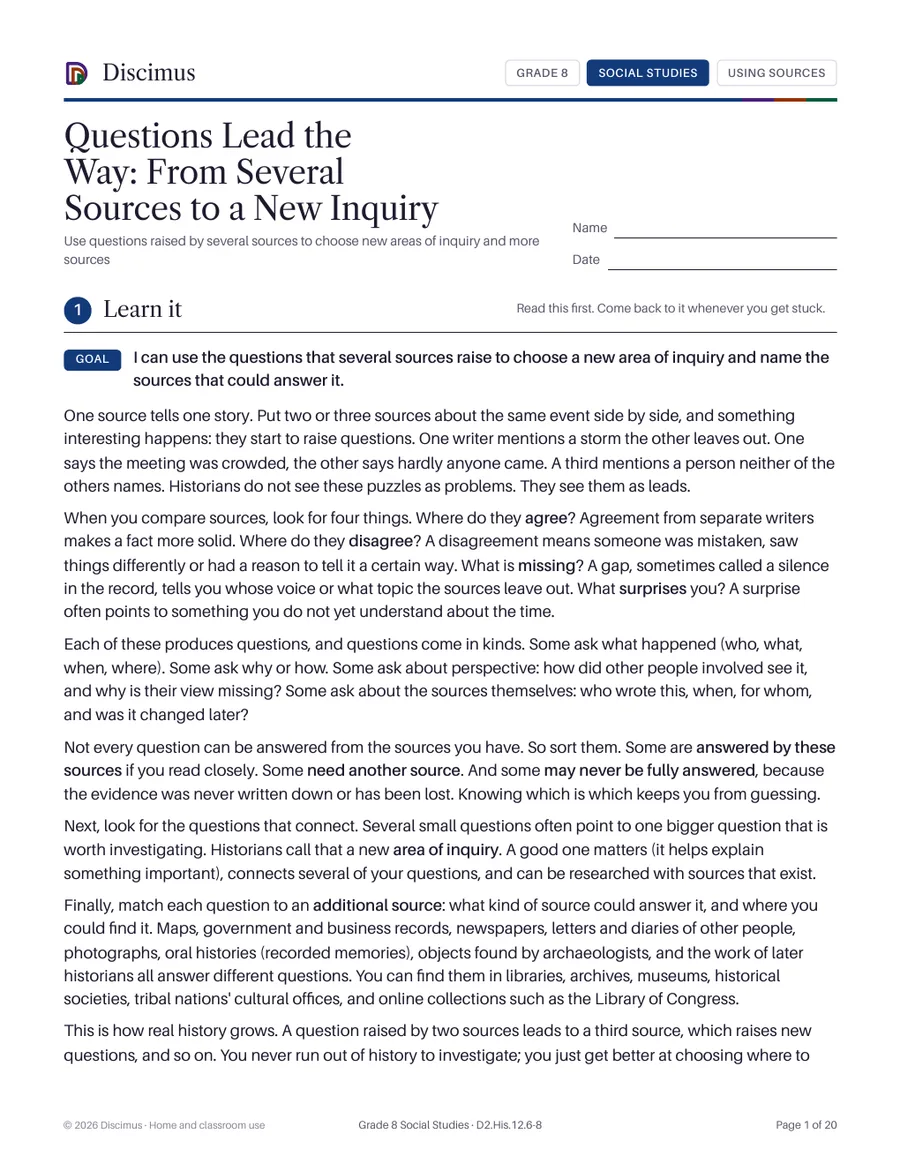
Use questions raised by several sources to choose new areas of inquiry and more sources
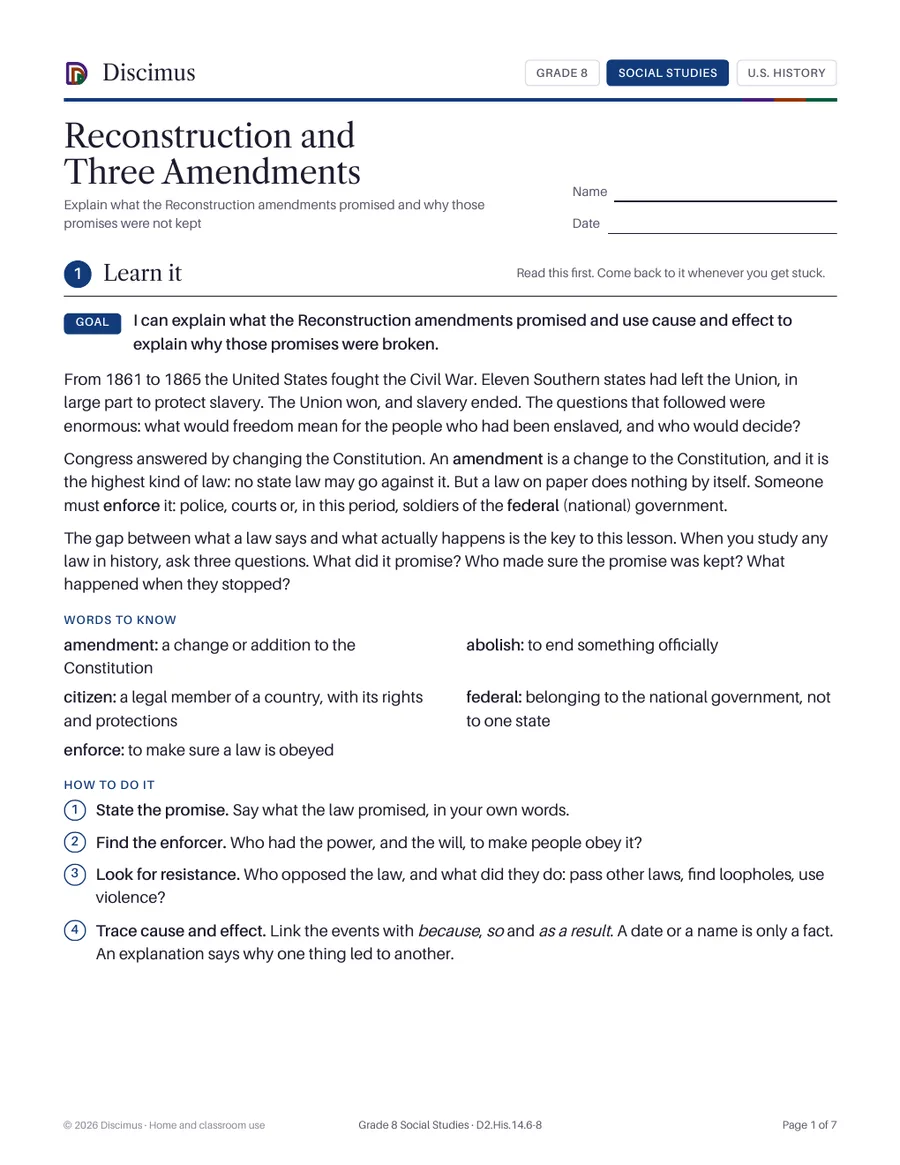
Explain what the Reconstruction amendments promised and why those promises were not kept
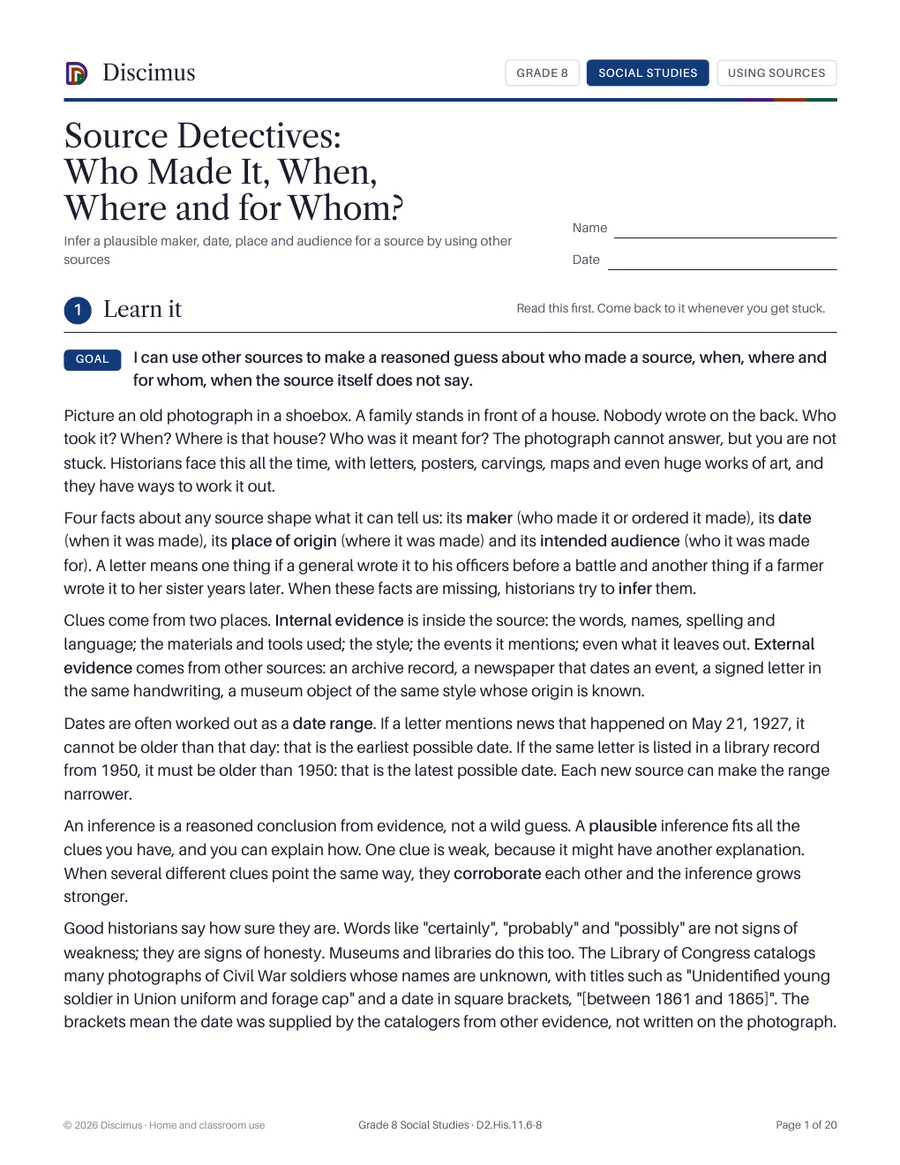
Infer a plausible maker, date, place and audience for a source by using other sources
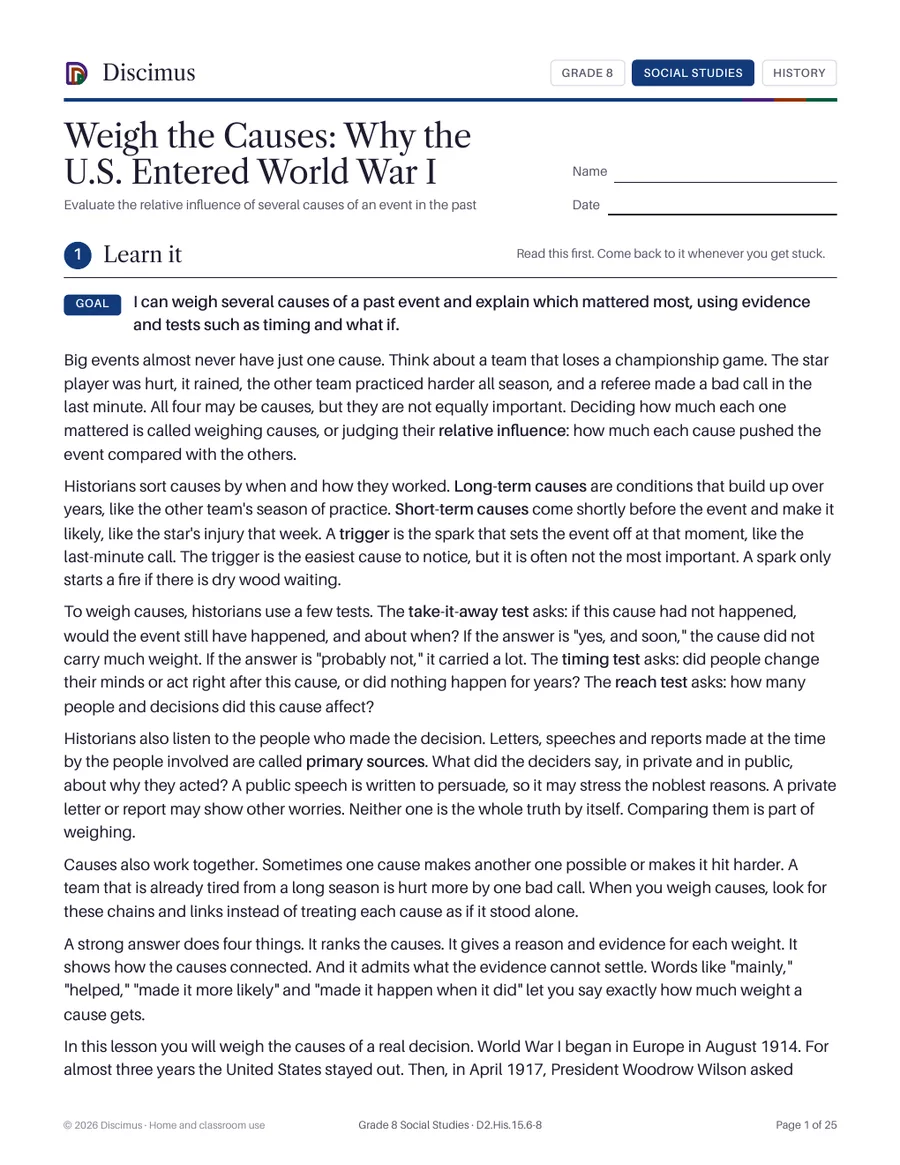
Evaluate the relative influence of several causes of an event in the past
Classify the kinds of historical sources used in a secondary interpretation
Analyze the factors that shaped people's perspectives in different historical eras
Analyze how creators' perspectives shaped the information in the sources they made
Use questions about people and groups to explain why they are historically significant
Evaluate how natural and human-made catastrophes affect trade, politics and migration
Evaluate how environmental and cultural change in a place reshapes trade and land use
Choose and apply deliberative and democratic procedures to make and act on group decisions
Evaluate how political and economic decisions changed a place's culture and environment
Explain where experts agree and disagree about a concept behind a supporting question
Explain where experts agree and disagree about a concept behind a compelling question
Explain how rivers and river valley societies have shaped each other, then and now
Gather sources from many views and select them by origin, authority and corroboration
Judge a source's credibility by examining how experts have valued it and why
Explain how supporting questions build an inquiry and how sources raise new questions
Use inconsistencies across several sources to revise or strengthen a historical claim
Evaluate how economic activity and policy shape urban, suburban and rural patterns
Use maps, images and data to explain how location shapes a place's politics and economy
Use several lenses to analyze a problem's causes and compare it across places and times
Build thematic maps from real data and use map layers to explain spatial patterns
Assess options for individual and collective action with causal reasoning and reflection
Analyze how events and the spread of ideas shaped migration, and how migration spread them
Adapt an argument for different audiences and venues in print, oral and digital forms
Use geographic data to compare how a spatial pattern changes from global to local scales
Choose sources for an inquiry by weighing their points of view, availability and uses
Explain how a question reflects an enduring issue in a social studies field
Refine claims and counterclaims for precision and significance, and weigh both
Evaluate how human settlement activities changed the environment and culture of a region
Evaluate how globalization and scarce resources lead to conflict and cooperation
Critique the credibility of claims and evidence in an argument
Build an argument with a precise claim, several sources, counterclaims and evidence limits
Evaluate how long-term climate variability shapes migration, settlement and land use
Critique an explanation's reasoning, sequence of events and supporting details
Build explanations with sound reasoning, correct order, pertinent data and stated limits
Critique whether the sources behind a historical interpretation can support its claims
Analyze what changed and what stayed the same across a historical era
Analyze how historical contexts shaped people's perspectives and still shape them today
Explain how the perspectives of people in their present shape interpretations of the past
Tell long-term causes from triggering events to argue why the 1857 rebellion happened
Analyze a series of historical events and decide whether earlier events caused later ones
Find the central idea of a history source and summarize how its events or ideas develop
Cite specific evidence from primary and secondary sources, weighing their date and origin
Analyze how a history text's structure emphasizes key points and builds an explanation
Work out what political, social and economic words mean as used in history texts
Use questions to assess how the significance of people's actions changes with context
Critique the central argument of a history book, film, painting or poem for accuracy
Compare and contrast how several primary and secondary sources treat the same topic
Judge a source's usefulness for an inquiry by maker, date, place, audience and purpose
Integrate charts, tables and data with a history text to test and explain its claims
Detect limits in different kinds of historical evidence and in differing interpretations
Read and understand complex grades 9-10 history texts independently and proficiently
Compare authors' points of view on one topic and the details each includes and emphasizes
Analyze how a secondary interpretation selects, reads and goes beyond its primary sources
Analyze how multiple causes combined to start World War I and trace its complex effects
Use questions raised by several sources to pursue an inquiry and find additional sources
Analyze how the sources that survive limit our interpretations of people's perspectives
Assess how well the reasoning and evidence in a history text support the author's claims
Analyze the interacting factors that shaped people's perspectives in a past era
Integrate several primary sources and interpretations into one reasoned argument
Analyze how the perspectives of those writing history shaped the histories they produced
Describe intended and unintended consequences of government policies to improve markets
Evaluate which monetary and fiscal policies fit different economic conditions
Analyze how comparative advantage shapes what nations produce and trade, and who gains
Explain how globalization affects growth, jobs, rights, environment and income in nations
Evaluate how much competition exists among sellers and among buyers in a specific market
Analyze how a policy's incentives change choices and spread costs and benefits to groups
Explain how technology, capital goods and human capital raise growth and living standards
Use marginal benefit and marginal cost to build an argument for or against a solution
Describe how clear property rights and the rule of law make a market economy work
Use leading, coincident and lagging indicators to judge the economy's present and future
Describe the consequences of competition in specific markets
Use current data to explain how spending, production and money affect the economy
Analyze multiple causes and effects of a historical migration using text and data
Evaluate how unique circumstances and broader contexts shaped the New Deal
Use benefits and costs to evaluate how well a government policy improves market outcomes
Generate explanations for a government role in markets where inefficiencies exist
Apply civic virtues and democratic principles when working and disagreeing with others
Choose and use a deliberative process that fits the setting, the stakes and the people
Evaluate how effectively citizens and institutions addressed social and political problems
Find the central ideas of a history source and summarize how its key details relate
Evaluate opposing views on one issue by judging each side's claims, reasoning and evidence
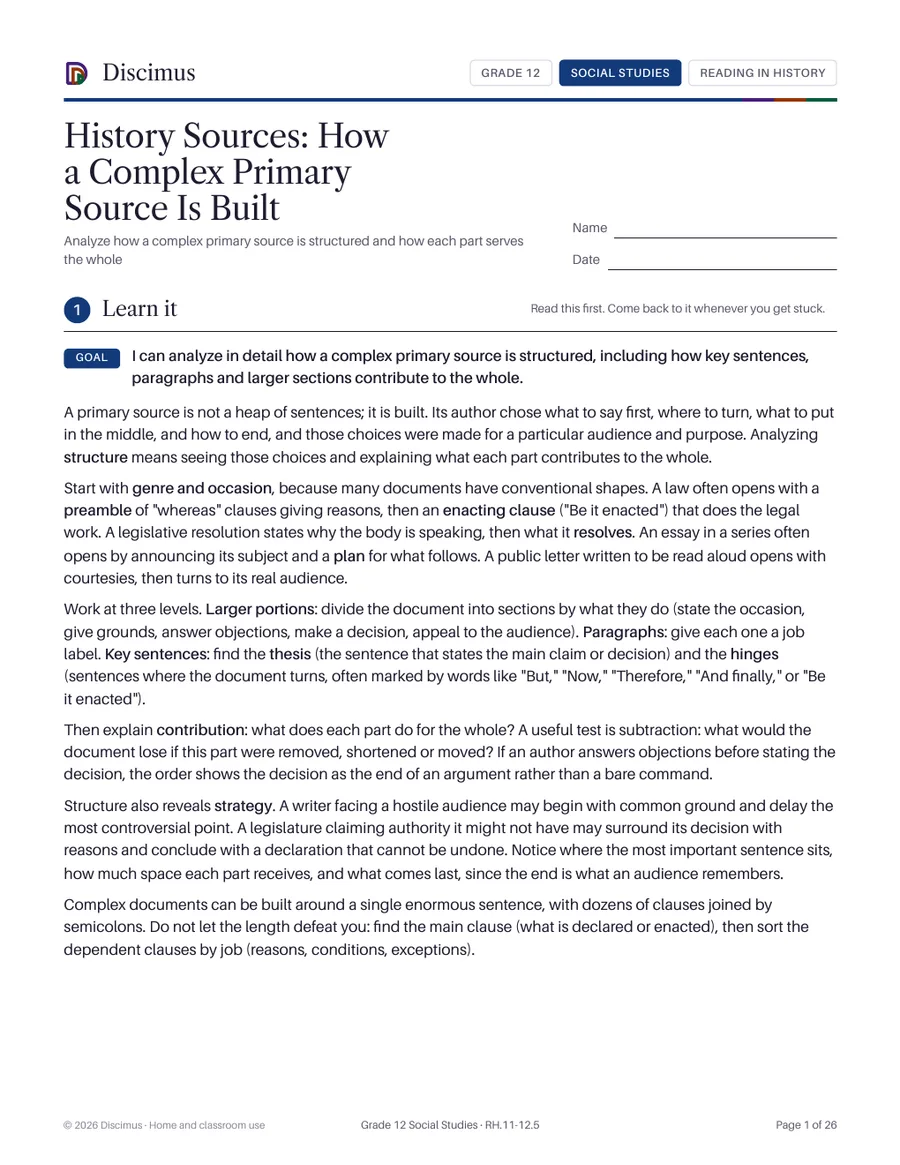
Analyze how a complex primary source is structured and how each part serves the whole
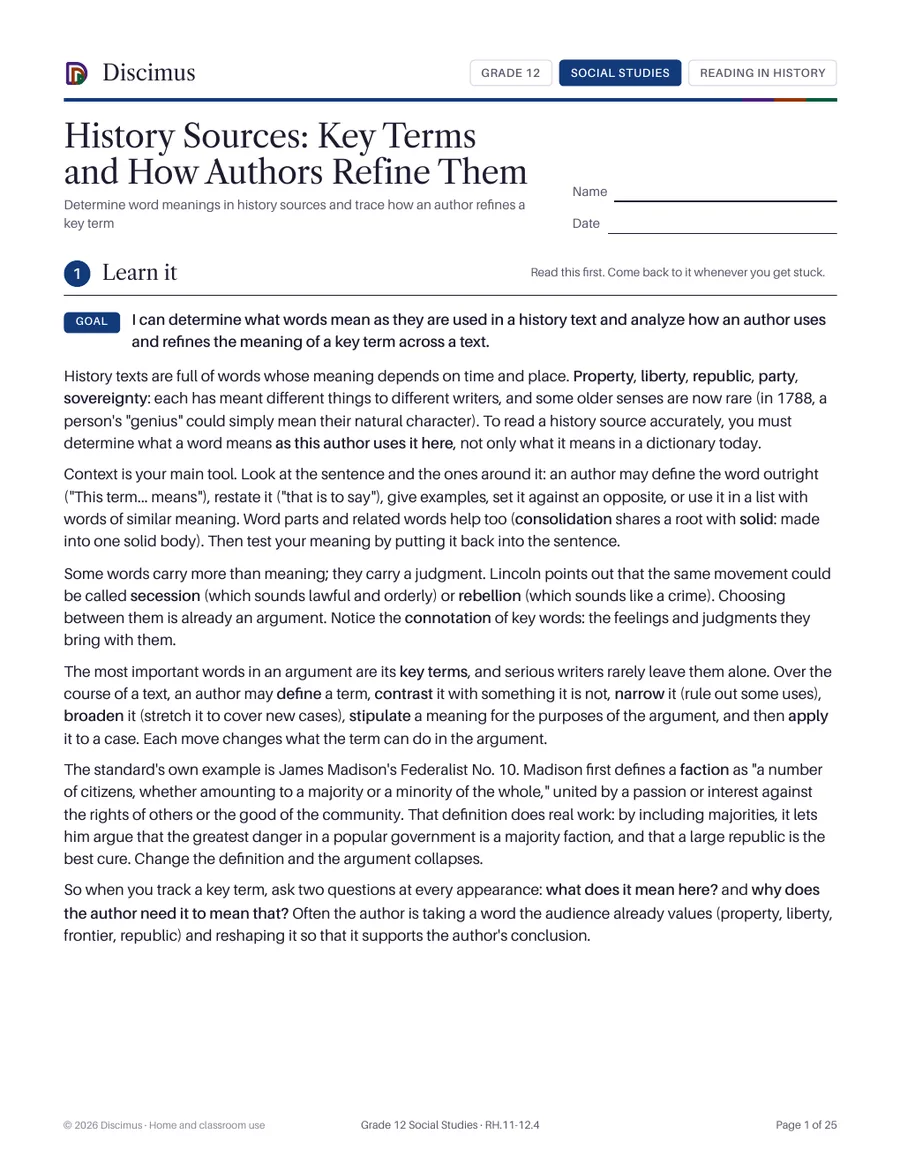
Determine word meanings in history sources and trace how an author refines a key term
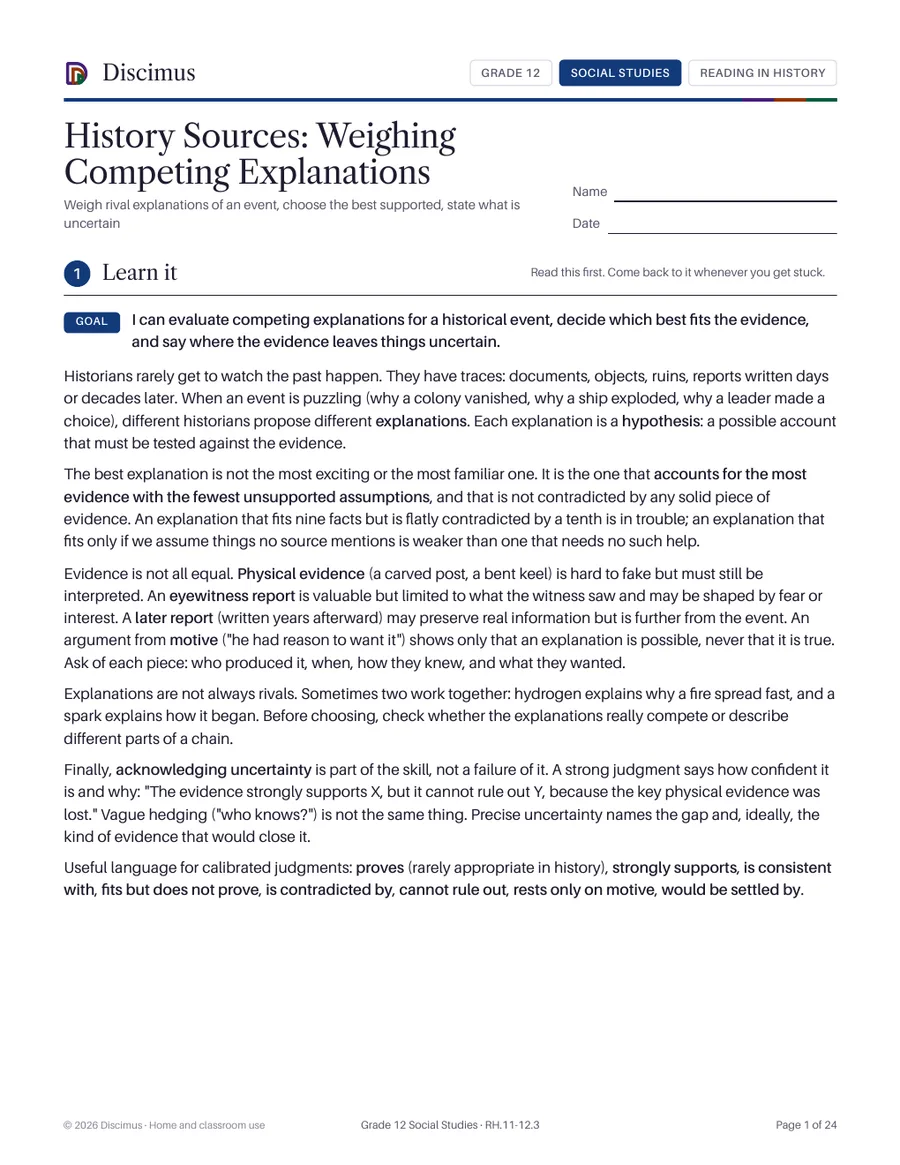
Weigh rival explanations of an event, choose the best supported, state what is uncertain
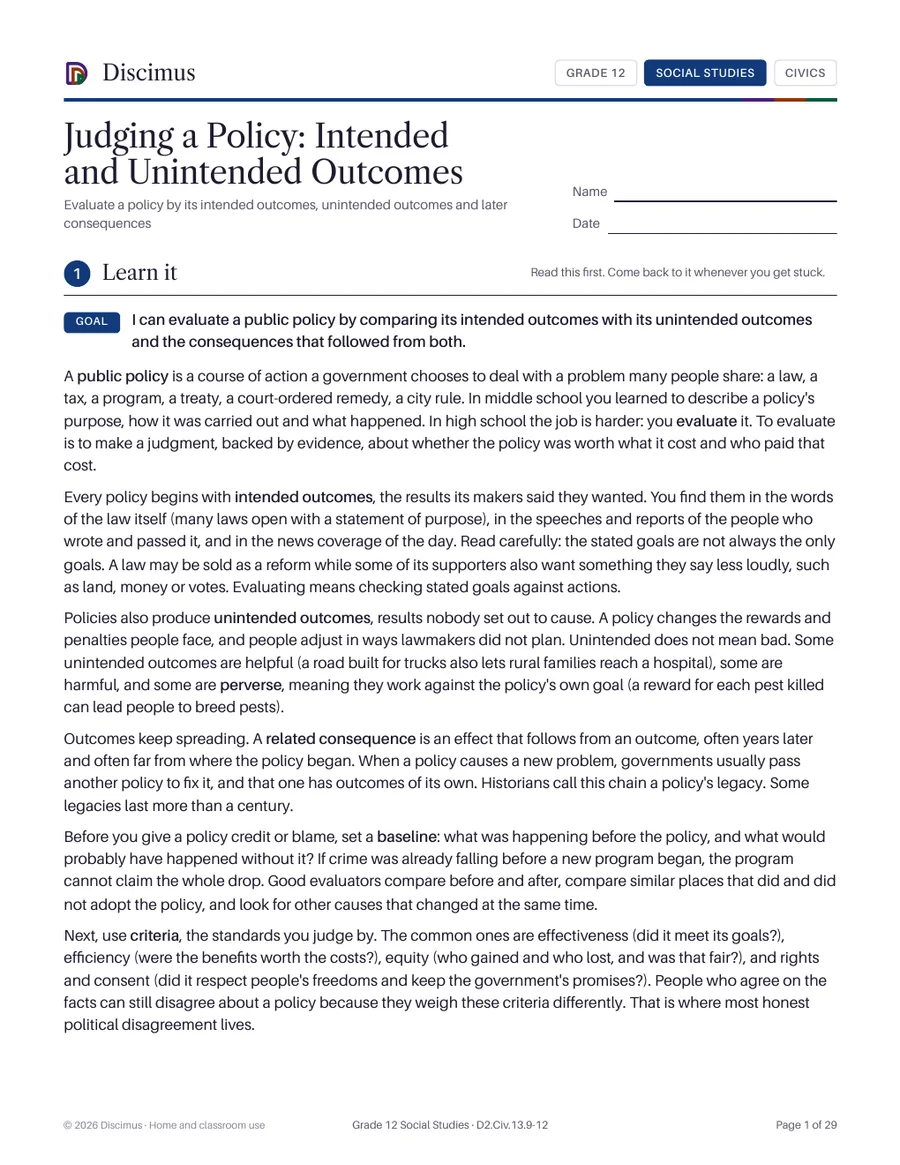
Evaluate a policy by its intended outcomes, unintended outcomes and later consequences
Analyze how constitutions, laws and treaties keep national and international order
Integrate and evaluate texts, tables, charts and maps to answer a historical question
Integrate primary and secondary sources into one account of an event, noting discrepancies
Explain how constitutional powers and limits have changed over time and remain contested
Read and understand complex history and social science texts independently
Analyze past, present and emerging means of changing society and protecting rights
Explain how price incentives decide what a market produces and who gets it
Evaluate systems from different times and places that build civic virtue and democracy
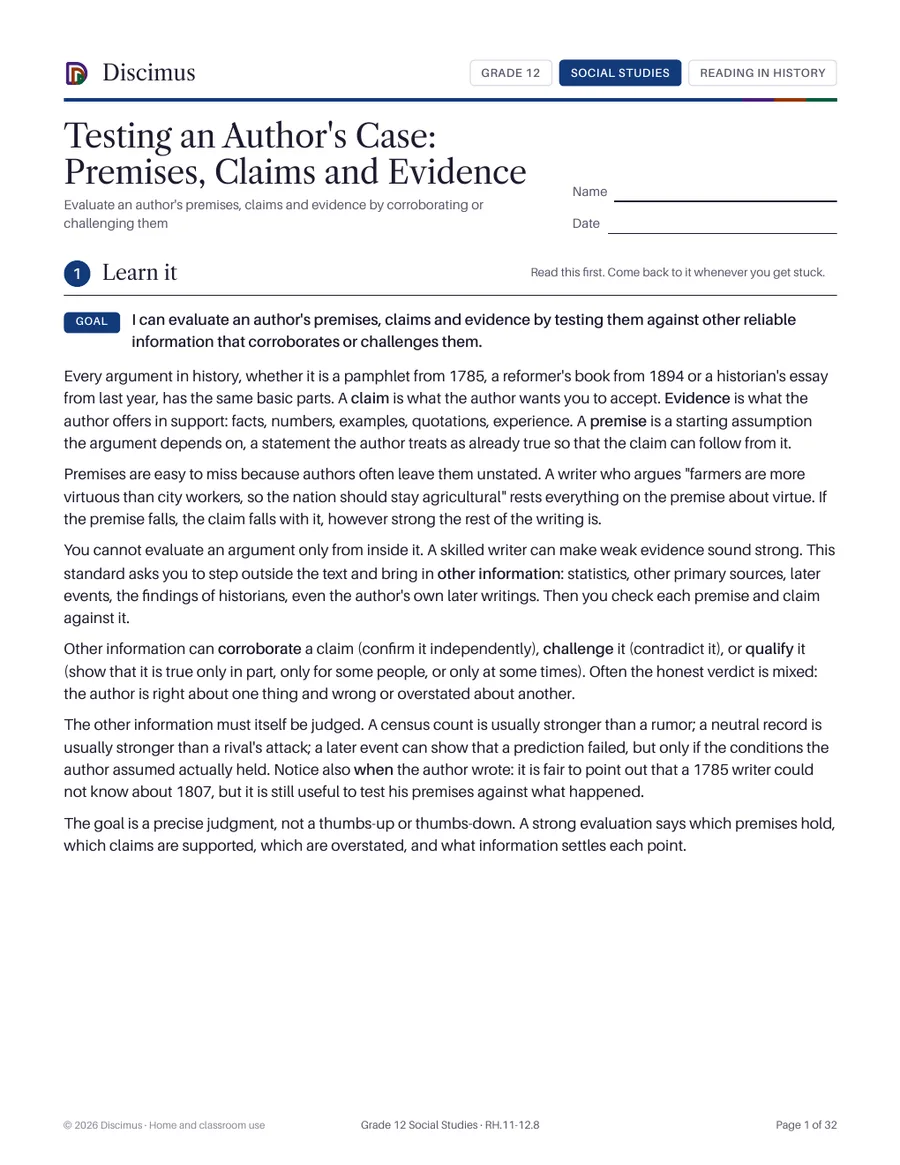
Evaluate an author's premises, claims and evidence by corroborating or challenging them
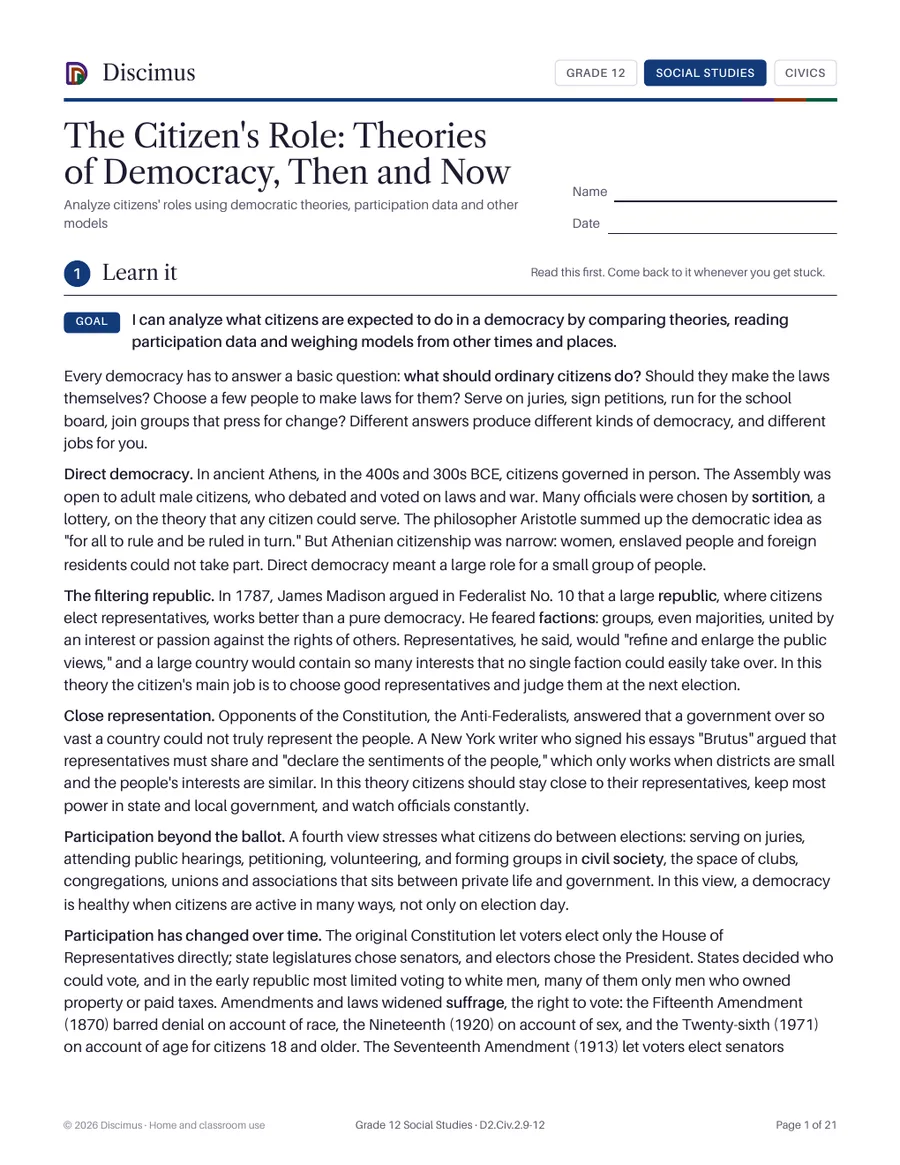
Analyze citizens' roles using democratic theories, participation data and other models
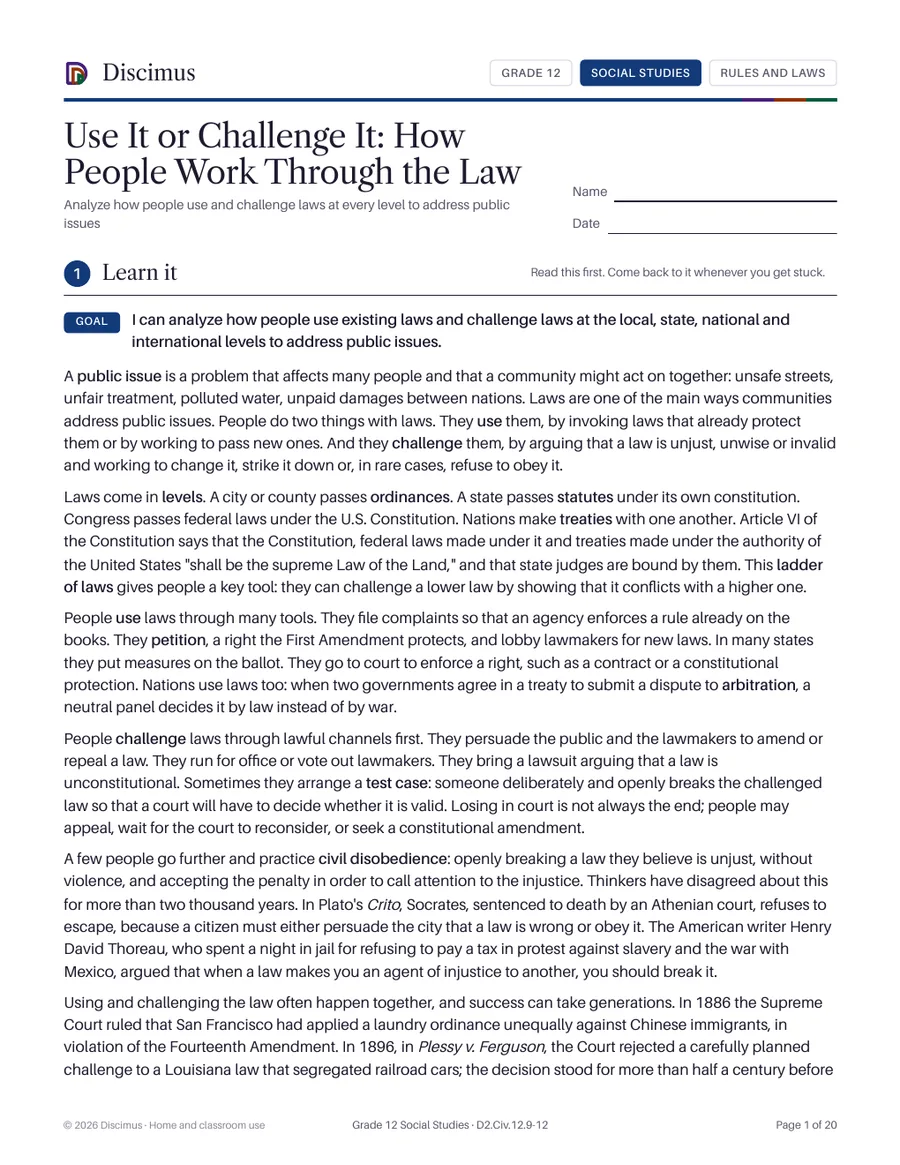
Analyze how people use and challenge laws at every level to address public issues
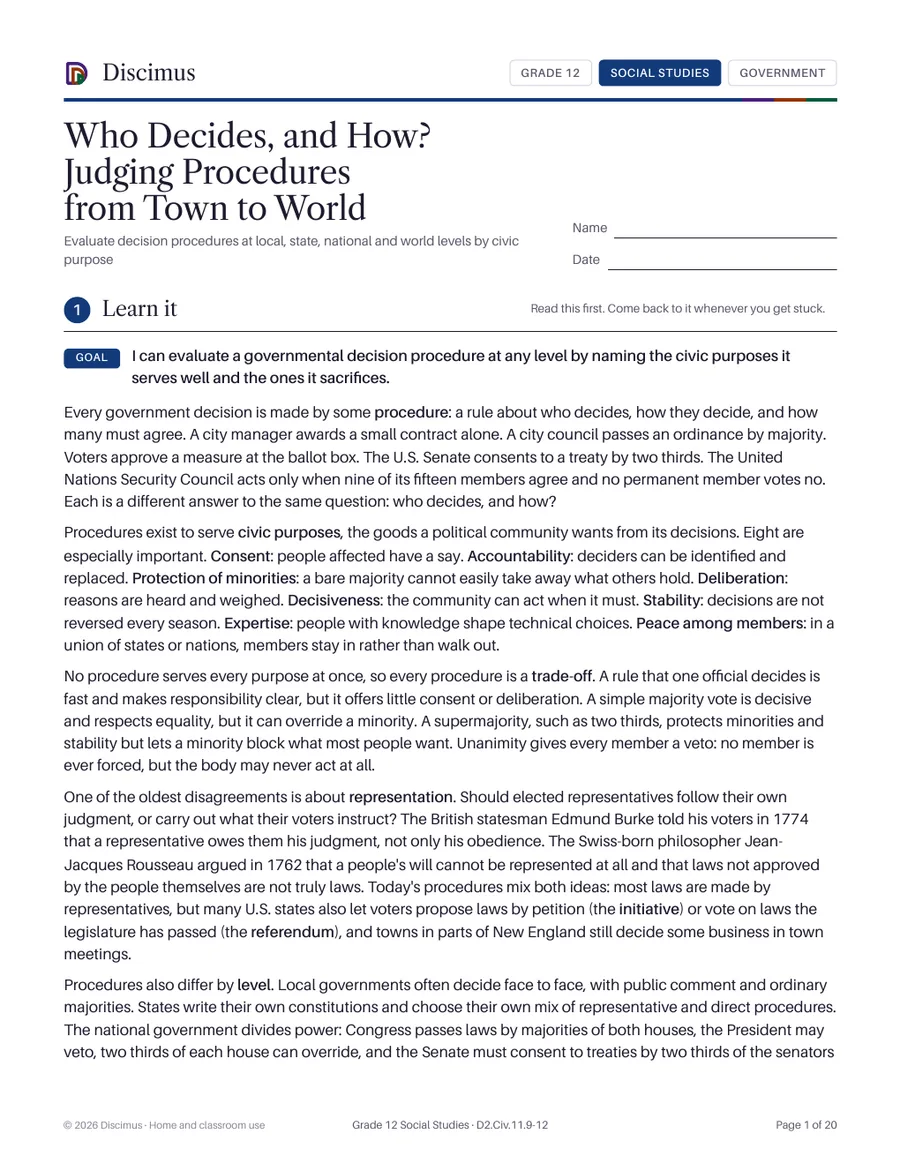
Evaluate decision procedures at local, state, national and world levels by civic purpose
Distinguish the powers of local, state, tribal, national and international institutions
Critique relationships among governments, civil society and markets using clear criteria
Analyze how personal interests and perspectives shape the way people apply rights