Conditional Probability and Independence in Everyday Life
Recognize and explain conditional probability and independence in everyday situations
9 worksheets match.
Recognize and explain conditional probability and independence in everyday situations
Find conditional probabilities and interpret independence as P(A given B) = P(A)
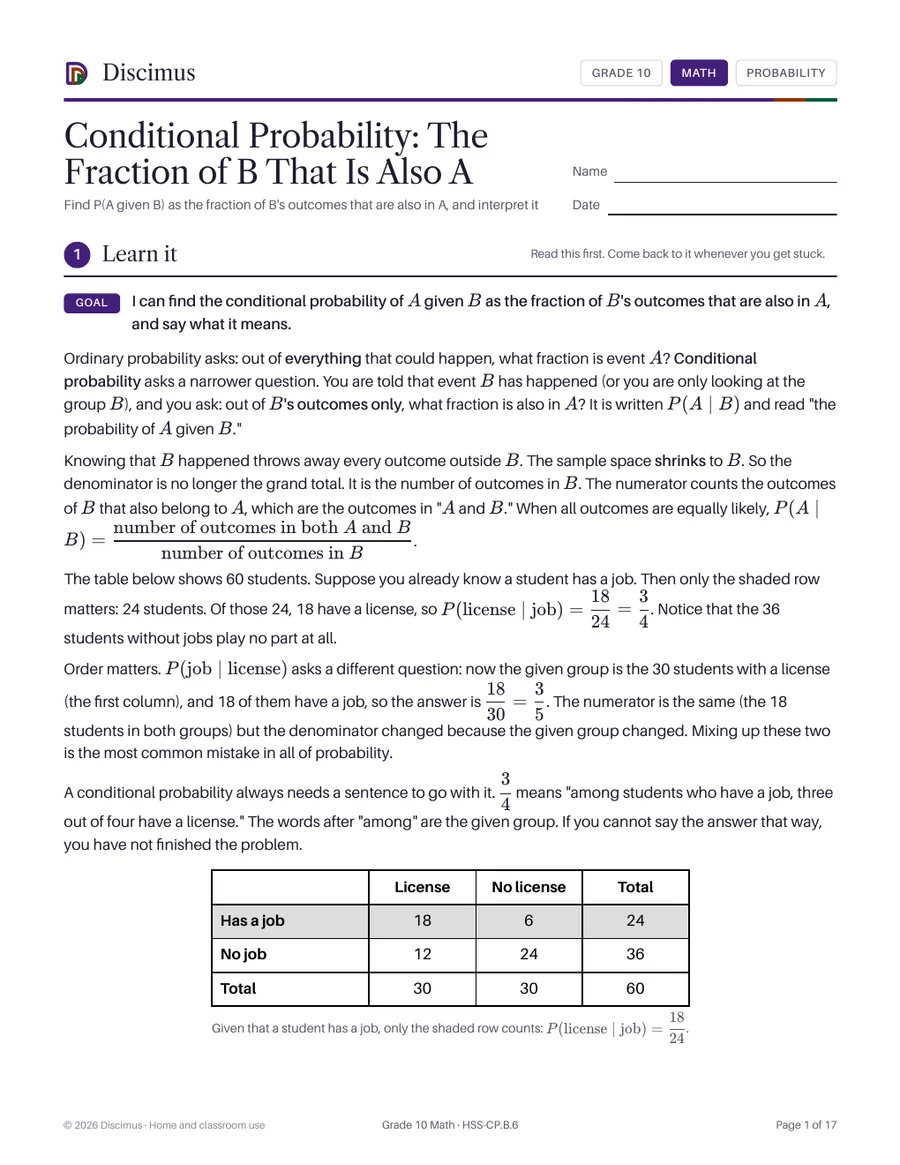
Find P(A given B) as the fraction of B's outcomes that are also in A, and interpret it
Describe events as subsets of a sample space using unions, intersections and complements
Decide whether two events are independent by comparing P(A and B) with P(A) times P(B)
Use permutations and combinations to find probabilities of compound events
Apply the Addition Rule P(A or B) = P(A) + P(B) - P(A and B) and interpret the answer
Apply the general Multiplication Rule P(A and B) = P(A)P(B|A) and interpret the answer
Use two-way frequency tables to estimate conditional probabilities and decide independence